
The internet holds over 1.34 billion websites in 2026, but fewer than 200 million are active.
Digital use grows, and so does the push for online presence plus engagement, where website traffic plays a crucial part.
With this data-backed article, we will take you through website traffic statistics, from global internet usage patterns to top-performing websites, device preferences, and much more.
Website Traffic Statistics: Key Takeaways
- Google.com gets the highest traffic on the internet with 105 billion average monthly visits.
- Approximately 5.65 billion individuals worldwide utilize the internet.
- Mobile devices drive 63.05% of all web traffic.
- China & India together contribute 1,968,583,000 internet users.
- Facebook provides 71.58% of social referral traffic.
- Organic search generated 53% of total website traffic.
Which Website Has The Highest Web Traffic?
- Google.com draws the highest website traffic with 105 billion average monthly visits and 5.87 billion average unique visitors.
- Standing second is Google’s subsidiary, YouTube.com, with 47 billion average monthly visits.

Here are the top 10 websites with their average monthly traffic in 2025.
| Rank | Website | Total Visits (Monthly Ave.) |
|---|---|---|
| 1 | google.com | 105 billion |
| 2 | youtube.com | 47.0 billion |
| 3 | facebook.com | 10.5 billion |
| 4 | instagram.com | 5.93 billion |
| 5 | chatgpt.com | 5.24 billion |
| 6 | wikipedia.org | 5.07 billion |
| 7 | reddit.com | 4.51 billion |
| 8 | pornhub.com | 4.46 billion |
| 9 | x.com | 3.88 billion |
| 10 | whatsapp.com | 3.02 billion |
Source: Datareportal
Website Traffic Demographics
- Currently, 5.65 billion people, from a total of 8.23 billion across the globe, connect to the internet. This represents 68.7% of the global population.
- The number of internet users increased by 1.8% in 2025, from 5.45 billion in 2024.
Source: Datareportal, Datareportal 2
Website Traffic By Gender
The exact number of men and women who visit the website is challenging to research. However, we can look at the general trend of internet use to get an idea.
- Among the global female population, 66.5% use the internet. For men, the figure stands at 70.8%.
- Annual growth is stronger among women (3.7% vs. 2.7%), which is gradually closing the gap.
- There is only a 4.3 percentage point difference between female and male internet users, indicating that internet access is becoming increasingly universal with each passing day.
The way people use the internet changes dramatically with age and gender.
- Young females in the age group of 16–24 spend the most time online, around 43 hours per week, and often use the following:
| 16–24 Aged Females Internet Usage Activities | Time Spent In % |
|---|---|
| Social media platforms | 60.8% |
| Video streaming sites | 58.5% |
| Music apps | 54.4% |
| e-learning platforms | N/A |
| Lifestyle or fashion websites | N/A |
- Young males aged 16 to 24 average 40 hours weekly, with gaming taking a 41% share of their online time, followed by video streaming, social media, e-learning sites, and sports or entertainment platforms.
Here is the breakdown of the top reasons, males & females from different age groups use the internet for:
| Group | Avg. Hours Online (Weekly) | Top Activities | Other Niche Activities |
|---|---|---|---|
| Males 16–24 | 40 hrs | Gaming (41.0%) | Video streaming, Social media, E-learning, Sports/Entertainment |
| Adults 25–34 | 36–38 hrs | Informational content (58.0%), News (49.5%) | Career/Professional platforms, Streaming, E-commerce |
| Adults 35–54 | 30–32 hrs | News & Finance (56.8%), Tutorials (50.8%) | Travel booking/reviews, E-commerce, Health/Wellness |
| Adults 55–64 | 26 hrs | News (59.6%) | Family social platforms, Travel/Retirement planning, E-commerce, Health |
| Seniors 65+ | 18 hrs | News (66.3%) | Health portals, Finance, Learning resources, Travel/Lifestyle |
*These figures may overlap as individuals may engage in multiple activities simultaneously.
Source: Datareportal
Website Traffic By Age
- Finding information is the top universal driver, peaking at 78.9% in the 65+ group, clearly highlighting the informational websites drawing significant traffic.
- More than 57% people across all age groups contact friends and family often. This explains the high use of social media and messaging sites, such as Instagram & Facebook.
- Watching videos decreases from 58.5% for young people to 36.5% for older people. This shows less interest in video streaming services such as YouTube, Netflix, and Prime Video among older users.
- Learning how to do things is steady across ages, slightly higher among older users (57.5% for 65+).
- Finding new ideas is common across younger and middle-aged groups, but drops below 41% in the 55+.

| Sr. No. | Reason | 16-24 | 25-34 | 35-44 | 45-54 | 55-64 | 65+ |
|---|---|---|---|---|---|---|---|
| 1 | Find information | 59.1% | 58.0% | 59.5% | 63.1% | 65.9% | 78.9% |
| 2 | Contact friends & family | 60.8% | 57.3% | 57.1% | 58.2% | 60.5% | 62.9% |
| 3 | Watch videos & shows | 58.5% | 56.5% | 54.8% | 54.5% | 53.8% | 36.5% |
| 4 | Learn how to do things | 50.0% | 48.2% | 49.3% | 50.8% | 51.5% | 57.5% |
| 5 | Find new ideas | 49.7% | 47.7% | 47.2% | 45.4% | 40.8% | – |
Source: Datareportal
While the data on traffic by age isn’t directly available, the above internet usage reasons reveal which types of sites attract different age groups.
Website Traffic By Country
Country data about internet use shows how many people connect and how their numbers change across the globe.
This offers insight into the size and development of a nation’s online audience, which then suggests how much website traffic it could draw.
- China and India have 1,968,583,000 internet users, which makes up nearly two billion users. Because of this, they are the most important markets for website traffic.
- The United States leads in internet use, as 93.1% of its people go online. This country has fewer total users than Asian markets.
- Indonesia grows fastest, with a yearly increase of 9.9%, which shows quick digital adoption.
- Pakistan, besides Nigeria, has the lowest rates of internet use, about 45% to 46%, which means considerable room for growth.
- Japan and Russia report drops in internet use, down 0.5% and 0.6% respectively. This points to market saturation or a change in how they count users.

| Rank | Country | Users Connected Via Internet | % of Population | YoY Change |
|---|---|---|---|---|
| 1 | China | 1,113,052,000 | 78.6% | 0.012 |
| 2 | India | 855,531,000 | 58.4% | 0.066 |
| 3 | United States | 323,468,000 | 93.1% | 0.005 |
| 4 | Indonesia | 223,691,000 | 78.3% | 0.099 |
| 5 | Brazil | 184,508,000 | 86.7% | 0.005 |
| 6 | Russian Federation | 132,830,000 | 92.2% | -0.6% |
| 7 | Pakistan | 116,278,000 | 45.6% | 0.01 |
| 8 | Mexico | 110,123,000 | 83.5% | 0.019 |
| 9 | Nigeria | 108,526,000 | 45.7% | 0.024 |
| 10 | Japan | 107,077,000 | 87.0% | -0.5% |
Source: Datareportal
Web Traffic Analysis By Industry
- According to the latest available data, the apparel and footwear industry gained 30.49k new users in 2023, which was also the highest new user gain among several other sectors.
This lead highlights the audience’s interest and gives an overview of shopping websites that receive the most traffic.
- The food industry gained the second most new users (11.2k), which was 2.7 times less than the apparel and footwear industry.
This growth likely came from increased traffic to food delivery platforms, online grocery stores, and recipe or meal-kit websites.
- The Health & Wellness sector gained 1.43k new users, which was the lowest among other sectors.

| Sr. No. | Industry | New Users |
|---|---|---|
| 1 | Apparel & Footwear | 30.49k |
| 2 | Automotive | 4.15k |
| 3 | Construction | 1.7k |
| 4 | Consulting & Professional Services | 2.11k |
| 5 | eCommerce & Marketplaces | 6.56k |
| 6 | Education | 10.95k |
| 7 | Food | 11.2k |
| 8 | Health Care | 2.85k |
| 9 | Health & Wellness | 1.43k |
| 10 | Information Technology & Services | 3.53k |
| 11 | Industrials & Manufacturing | 2.89k |
| 12 | Real Estate | 2.62k |
| 13 | SaaS | 3.52k |
| 14 | Technology | 5.31k |
- Talking of page views, just like new users, the apparel and footwear sector was way ahead of all other sectors with 192.86k views.
- The education sector, which had 35.88k views, was 5.7 times less than apparel and footwear.
- Travel & Leisure (26.8k) and automotive (25.79k) also show strong traffic benchmarks, together accounting for nearly one-fourth of the total new users across all industries.
- On the lower end, industries such as construction (4.44k), consulting & professional services (4.24k), and SaaS (7.14k) attract significantly fewer new users.

| Sr. No. | Industry | New Users |
|---|---|---|
| 1 | Apparel & Footwear | 192.86k |
| 2 | Automotive | 25.79k |
| 3 | Construction | 4.44k |
| 4 | Consulting & Professional Services | 4.24k |
| 5 | eCommerce & Marketplaces | 33.39k |
| 6 | Education | 35.88k |
| 7 | Food | 21.03k |
| 8 | Health Care | 9.95k |
| 9 | Health & Wellness | 6.9k |
| 10 | Information Technology & Services | 8.68k |
| 11 | Industrials & Manufacturing | 8.01k |
| 12 | Real Estate | 9.03k |
| 13 | SaaS | 7.14k |
| 14 | Technology | 11.27k |
| 15 | Travel & Leisure | 26.8k |
Source: Databox
Website Traffic By Device
- Mobile devices dominate the web traffic with a 63.05% share, which is almost two-thirds of the total traffic.
- Desktop, which was once the only device for using the internet, now shares 35.27% of the total web traffic.
- Other devices like smart TVs, gaming consoles, etc, contribute to just 0.03% of the total web traffic.

| Sr. No. | Device | Traffic Share |
|---|---|---|
| 1 | Mobile | 63.05% |
| 2 | Desktop | 35.27% |
| 3 | Tablet | 1.65% |
| 4 | Other Devices | 0.03% |
- Since 2015, mobile’s share in the global web traffic has grown by 92.28%.
- The CAGR over the 10 years is around 6.55%, showing steady annual growth.

| Sr. No. | Year | Mobile Web Traffic Share |
|---|---|---|
| 1 | 2025 | 63.05% |
| 2 | 2024 | 60.06% |
| 3 | 2023 | 50.43% |
| 4 | 2022 | 59.00% |
| 5 | 2021 | 55.25% |
| 6 | 2020 | 50.44% |
| 7 | 2019 | 47.85% |
| 8 | 2018 | 51.95% |
| 9 | 2017 | 51.64% |
| 10 | 2016 | 43.45% |
| 11 | 2015 | 32.79% |
Source: Datareportal
- These numbers make it clear that a mobile-first approach to website design is essential, especially since mobile users are 5X more likely to abandon a task on a non-optimized site.
Source: Toptal
Top Website Statistics
- With 105 billion monthly visits, Google remains far ahead in the global web traffic race, reaffirming itself as the first preference of almost everyone when it comes to information seeking.
- As the second most visited site, YouTube continues to lead in video content with 47 billion visits, though it lags significantly behind Google in overall visits.
- WhatsApp.com shows high user engagement, with a typical session lasting 38 minutes and 56 seconds. This is almost three times longer than YouTube’s 23 minutes and 51 seconds.
- ChatGPT.com quickly rose into the top five globally with 5.24 billion monthly visits – it passed Wikipedia, with 5.07 billion trips, and Reddit, with 4.51 billion – this shows a notable move toward interaction guided by AI.
The numbers suggest a trend – users do not just consume content; they increasingly use sites that offer practical help, communication, and immediate support.
| Rank | Website | Unique Visitors (Monthly Ave.) | Average Time/Visit | Average Pages/Visit |
|---|---|---|---|---|
| 1 | google.com | 5.87 billion | 13m 04s | 5.29 |
| 2 | youtube.com | 3.06 billion | 23m 51s | 8.51 |
| 3 | facebook.com | 1.67 billion | 16m 49s | 7.52 |
| 4 | instagram.com | 1.30 billion | 13m 34s | 9.24 |
| 5 | chatgpt.com | 597 million | 15m 25s | 4.45 |
| 6 | wikipedia.org | 1.21 billion | 9m 19s | 2.93 |
| 7 | reddit.com | 962 million | 13m 26s | 3.5 |
| 8 | pornhub.com | 886 million | 10m 21s | 7.8 |
| 9 | x.com | 820 million | 17m 04s | 8.67 |
| 10 | whatsapp.com | 480 million | 38m 56s | 6.06 |
| 11 | bing.com | 504 million | 11m 22s | 4.12 |
| 12 | xvideos.com | 586 million | 12m 33s | 9.11 |
| 13 | amazon.com | 603 million | 11m 42s | 6.67 |
| 14 | yahoo.com | 397 million | 12m 37s | 4.17 |
| 15 | temu.com | 507 million | 9m 10s | 2.69 |
| 16 | duckduckgo.com | 166 million | 14m 42s | 2.66 |
| 17 | yahoo.co.jp | 158 million | 12m 13s | 5.5 |
| 18 | tiktok.com | 787 million | 10m 45s | 7.2 |
| 19 | yandex.ru | 230 million | 11m 48s | 4.74 |
| 20 | weather.com | 507 million | 3m 14s | 1.61 |
Source: Datareportal
Website Traffic Trends Statistics
- 44% of the internet population aged 16 and above has visited at least one brand website in the past month.
A brand’s social media page receives 24 percentage points fewer visits than its website. This shows that people visit websites more often than social media pages.

This makes website traffic a crucial medium to get attention online.
| Rank | Interaction Type | Percentage (%) |
|---|---|---|
| 1 | Visited the brand’s website | 44.10% |
| 2 | Watched brand video | 25.60% |
| 3 | Followed brand (social) | 22.90% |
| 4 | Visited brand page (social) | 20.10% |
| 5 | Read brand email/newsletter | 19.50% |
| 6 | Used the share button | 16.70% |
| 7 | Used the brand app | 16.50% |
| 8 | Scanned the brand QR code | 16.20% |
| 9 | Clicked promoted post | 15.10% |
| 10 | Left review/feedback | 14.80% |
| 11 | Clicked online ad | 14.70% |
| 12 | Asked the brand a question | 13.00% |
| 13 | Played brand game | 12.40% |
| 14 | Unfollowed brand | 12.40% |
| 15 | Read the brand blog | 12.10% |
Source: Datareportal
Organic vs Referral vs Paid Traffic
Siege Media recently analyzed 352 million sessions from its past clientele to check ChatGPT’s referral traffic to websites from May to July 2025.
- In May 2025, organic search generated 107.7 million sessions.
- In June 2025, organic search traffic increased to 113.1 million sessions.
- In July 2025, organic search sessions jumped further to 131 million, representing a 15.9% increase compared to June.
- In May 2025, ChatGPT referrals accounted for 265,947 sessions.
- In June 2025, ChatGPT referral traffic grew by 10.7% reaching 294,497 sessions.
- In July 2025, ChatGPT referral traffic declined by 3.8%, dropping to 283,169 sessions.
- By July 2025, organic search traffic was over 460 times larger than GPT referral traffic.
Source: Siegemedia
- Organic search comprises 53% of all websites in 2025.
Source: Seoinc
- This is a very evident fact as search engines drive a lot of traffic, and are used by 80.6% of internet users as a gateway to other sites.
Source: Datareportal
- Direct traffic accounts for 25% of website visits in the standard traffic distribution.
- Referral traffic represents 13% of the overall website traffic.
Source: Seoinc
Search Engine Traffic Trends
- The smaller share of referral traffic can be observed in Google’s search engine traffic pattern, which has surprisingly reduced by 3.64 percentage points from 2023 to 2025.
- The possible reasons being discussed for this decline are the increasing AI-overviews and zero-click search offerings by the platform.
Source: wearesocial
- Social media drives 4% of the website traffic despite chat and messaging apps/websites being used by 93% of the internet users.
Source: Datareportal
- Paid search accounts for 5% of total traffic, which suggests the audience’s preference for organic results over sponsored results.

| Sr. No | Traffic Type | Traffic Share % |
|---|---|---|
| 1 | Organic Search | 53% |
| 2 | Direct Traffic | 25% |
| 3 | Referral Traffic | 13% |
| 4 | Paid Search | 5% |
| 5 | Social Media | 4% |
Source: Seoinc
Website Traffic by Category
- Email and shopping sites are also popular, with over 70% of users visiting, while business and gaming sites see less traffic, under 35%.
- Leisure categories like Shopping attract 74.3% of traffic. Business or work, a professional activity, attracts 29.5%.
- The 44.8-point difference shows that users prefer to use services for personal reasons over work.
| Sr. No. | Type of Website/App | Percentage of Internet Users (%) |
|---|---|---|
| 1 | Chat and Messaging | 93.6% |
| 2 | Social Networks | 93.4% |
| 3 | Search Engines or Web Portals | 80.6% |
| 4 | 75.8% | |
| 5 | Shopping, Auctions, or Classifieds | 74.3% |
| 6 | Maps, Parking, or Location-Based Services | 53.8% |
| 7 | Music | 47.5% |
| 8 | Entertainment | 44.9% |
| 9 | Weather | 42.8% |
| 10 | News | 41.5% |
| 11 | Banking, Investing, or Insurance | 38.6% |
| 12 | Travel | 37.8% |
| 13 | Food Takeaway & Delivery | 37.4% |
| 14 | Games | 32.3% |
| 15 | Business, Work, and Collaborative Working | 29.5% |
Source: Datareportal
- Bing showed consistent gains over the period, growing from 2.77% in 2023 to 3.98% in 2025. This shows a 43.7% relative growth in referral traffic share.
- Yandex saw the most significant growth, increasing from 1.17% in 2023 to 2.51% in 2025. Its share is more than double, showing its growing reach in the search market.
| Sr. No. | Search Engine | 2023 | 2024 | 2025 |
|---|---|---|---|---|
| 1 | 92.64% | 91.06% | 89.57% | |
| 2 | Bing | 2.77% | 3.72% | 3.98% |
| 3 | Yandex | 1.17% | 1.45% | 2.51% |
| 4 | Yahoo | 1.09% | 1.26% | 1.33% |
| 5 | Baidu | 0.84% | 0.87% | 0.82% |
| 6 | Duckduckgo | 0.51% | 0.6% | 0.69% |
| 7 | Naver | 0.21% | 0.39% | 0.31% |
| 8 | Others | 0.77% | 0.65% | 0.79% |
Source: Datareportal, Datareportal 2, Datareportal 3
Social Media Referral Traffic
- Facebook accounts for 71.58% of social media referral traffic, making it the dominant platform, driving more than almost 8 times the traffic of Instagram, which is the second largest platform at 8.88%.
- The combined share of Instagram, X, and Pinterest totals 22.74%. This is less than one-third of Facebook’s (23.86%).
- LinkedIn and Reddit together send only 1.59% of traffic; they direct a few users to other sites compared to mainstream platforms.
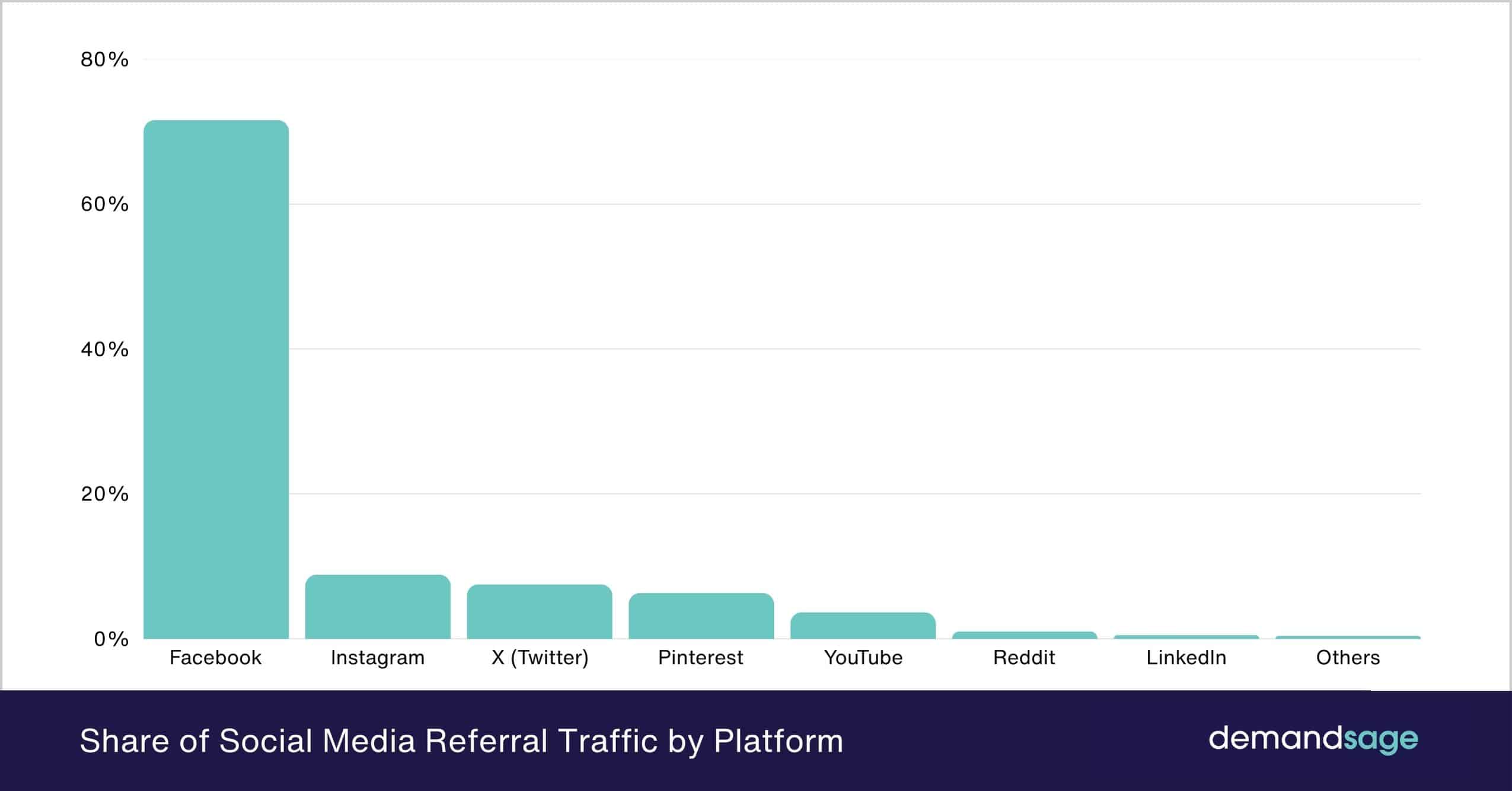
| Sr. No. | Social Media Platform | Share of Referral Traffic (%) |
|---|---|---|
| 1 | 71.58% | |
| 2 | 8.88% | |
| 3 | X (Twitter) | 7.52% |
| 4 | 6.34% | |
| 5 | YouTube | 3.67% |
| 6 | 1.04% | |
| 7 | 0.55% | |
| 8 | Others | 0.42% |
Source: Datareportal
Website Traffic Benchmarks
- According to HubSpot, an average website gets 375,773 visits per month, but the top websites with very high traffic easily change this average.
- A median website draws 20,000 unique visitors each month.
- 46% of the websites get 1,001 to 15,000 total monthly visitors.
- Only 0.5% of the websites get over 10 million visitors every month.
| Sr. No. | Monthly Unique Visitors | % of Websites |
|---|---|---|
| 1 | 1,001-15,000 | 46% |
| 2 | 15,001-50,000 | 19.3% |
| 3 | 50,001-250,000 | 23.2% |
| 4 | 250,001-10 million | 11% |
| 5 | Over 10 million | 0.5% |
Source: Hubspot
Conclusion: Google is the top-visited website with 100+ Billion Monthly Active Visits!
Over 63% of all visits to websites in 2026 now come from smartphones, showing the small screen dominates browsing behavior. Additionally, Google still commands the lion’s share with 105 billion visits monthly, setting the pace for discovery.
Organic search is another important driver that drives 53% of site visits, far outpacing social media, where Facebook alone contributes a staggering 71.58% of referrals.
