
As per the latest data recorded, approximately 54% of students use AI on a daily or weekly basis. Overall, 86% of students use multiple AI tools worldwide.
Around 53% of male students are more likely to be active users of AI tools than females, accounting for 51% of all active users of AI tools. Additionally, it is expected that the market for students using AI will grow to $112.3 billion by 2034.
In this AI in Education Statistics report, we present all the key facts about AI in education and the job market to help you understand the changes and what to expect down the line.
“AI has the potential to support a single teacher who is trying to generate 35 unique conversations with each student.” – Bryan Brown, Professor of Education, Stanford University.
AI In Education Statistics 2026 (Top Picks)
- On average, 86% of students in schools and higher education utilize AI.
- Nearly half (50%) of students have used AI writing tools at least once in school.
- After using Microsoft 365 Copilot Chat, there was a 265% boost in self-learning.
- Approximately 66% of students use ChatGPT for educational purposes.
- Over 30% women are more overwhelmed by using AI than 21% men.
- More than two-thirds (68%) of urban teachers have not received any kind of AI training.
How Many Students Use AI?
- Currently, 86% of students use AI globally for studies.
- In the USA, 51% of students use generative AI, with 14 to 22-year-olds being the most frequent users.
- ChatGPT and Grammarly are the most used AI tools by students, with 66% and 25% usage data, respectively.
- According to the UNESCO survey report, which covered more than 450 schools and universities, only 10% have established guidelines for using AI.
Source: Digital Education Council, Harvard Edu, Campus Technology, UNESCO
AI Education Market Growth: Year By Year
- By the end of 2025, the market value of AI education will increase to $7.57 billion compared to last year’s $5.47 billion. This shows the compound annual growth rate of 38.4%.
- The artificial intelligence education market is expected to reach $112.3 billion by 2034.
- China leads in AI education, with 80% of excited students, compared to 35% in the US and 38% in the UK.
- From 2025 to 2029, the market is expected to increase by 41.4% as institutions now include various AI technologies for students in education.

The table below highlights the current and projected statistics about AI education growth in the market.
| Year | Market Value | Growth Rate (CAGR) |
|---|---|---|
| 2025 | $7.57 billion | 38.4% |
| 2024 | $5.47 billion | 48.6% |
Forecasted Value:
| Year | Market Value | Growth Rate (CAGR) |
|---|---|---|
| 2029 | $30.28 billion | 41.4% |
| 2034 | $112.3 billion | 29.9% |
Source: World Economic Forum 2025, The Business Research Company, MIT Technology Review
How Many Students Use AI In Schools?
- As per the Hepi survey 2025, 94% of students use AI in school in some form, up from 66% in 2024. 94% report that AI-generated content gives a good grade in their subjects.
- AI usage has increased from the school to the university level, with 92% of students now using AI tools. The 2024 to 2025 period saw the most significant growth, with AI usage among university students rising from 66% in 2024 to 92% in 2025.
- 88% of students now use generative AI specifically for assessments in 2025, up from 53% in 2024, indicating rapid adoption after the school year.
- Approximately 65% of students agree that AI tools are essential for success.
- A study found that 51% of students have used AI for schoolwork for brainstorming, and 53% use AI to get information.
- Additionally, 28% LGBTQ+ teens are likely to use generative AI more, which has negatively impacted their lives more than 17% of cisgender or straight young people.
- Moreover, should AI be used in schools is a common concern of parents and teachers. Still, around 27% of students use generative AI tools regularly.
- According to estimates, around half of students have tried AI writing tools at least once in school.
Source: Hepi AI Survey 2026, WE Forum, GSE Harvard, University of Illinois
How Students Use Artificial Intelligence In Education?
- In the school, AI is most commonly used between the ages of 14 and 22. Approximately 51% of young people use generative AI.
- Among teens, 31% make images, 16% use artificial intelligence tools for creating sound, and 15% use the AI tools to write code.

| Use Case | Percentage of Students |
|---|---|
| Getting information | 53% |
| Brainstorming | 51% |
| Make pictures or images | 31% |
| Create sound or music | 16% |
| Create code | 15% |
- 86% of students say they use AI in their studies.
- As of now, 78% of businesses (organisations) use the different Gen AI skills.
- Approximately 93% of students are familiar with AI tools at least once or twice for school purposes. But around 99% of education leaders use AI more than students do.
(Source: AI In Education Microsoft Study, Harvard GSE, Digital Education Council, Stanford HAI 2025
Most Popular AI Tools Among Students
- Students use an average of 2.1 AI tools for their courses.
- According to the Digital Education Council’s Global AI Student Survey, 3,839 students from 16 countries, studying for bachelor’s, master’s, and doctoral degrees in various fields, hold diverse views on AI in education.
- The data below comprises results from two sources, where, on average, students’ usage rate for AI writing assistance tools is included.
| AI Tool | Usage Rate | Primary Function |
|---|---|---|
| ChatGPT | 66% | Most common overall tool |
| Grammarly | 25% | Grammar and writing assistance |
| Microsoft Copilot | 25% | General assistance and productivity |
- Students are more engaged and confident when using Microsoft 365 Copilot Chat, with a 15% increase in passing rates.
- Brisbane Catholic Education incorporated Microsoft 365 Copilot for 12,500 of its educators and support staff.
- Also, BCE allowed 13 older students to use Microsoft 365 Copilot Chat for brainstorming and confidence-building, which ultimately resulted in a 265% boost in their ability to direct their learning.
Beyond AI writing assistants, students and professionals are also exploring AI-powered app builders to create websites, automate workflows, and develop projects without extensive coding knowledge. If you’re planning to try one, check out our Base44 coupon code to save 20% on your subscription.
(Source: AI In Education Microsoft Study, Digital Education Council, Campus Technology, Microsoft Copilot
How Many Teachers Use AI In Education?
- Nearly half of school administrators use the technology daily. 50% of teachers and 52% principals say digital learning tools are helpful to track student progress.
- Moreover, 71% of teachers say AI tools are essential for student success in college and work.
- About 60% of teachers integrate AI into their teaching.
- Teacher usage of generative AI tools increased by 32% between the 2022-2023 and 2023-2024 school years.
- 83% of K-12 teachers use generative AI tools for either personal purposes or school-related activities as of the 2023-2024 academic year.
The following table gives a detailed breakdown of the teachers using AI in education.
| Teacher Group | Current Usage |
|---|---|
| K-12 teachers using generative AI | 83% |
| Higher education faculty using AI regularly | 22% |
| Education leaders using AI daily | 47% |
Source: NEA 2025, Microsoft1, Microsoft 2, News Schools, WeForum, World Economic Forum
AI Impact On Student Performance And Learning
- On average, 16% of students are mostly positive about using AI. However, young people between the ages of 14 and 22, in the next 10 years, AI will have both positive and negative impacts.
- Among 51% of young people, only 4% are daily users.
- However, around 2.4% of students think that AI is not beneficial for their education.
- In March 2025, Macquarie University students using AI have improved by up to 10% in examination results. The new AI-powered Chatbot helped students a lot.
- Over 30% of students can become overly dependent on AI tools. (Source: AI In Education Microsoft Study)
- On average, 33% of students face accusations related to excessive use of AI and plagiarism, which raises concerns about academic honesty and cheating.
- More than 25% teachers feel AI affects education negatively more than positively. Only 6% of K-12 teachers believe AI tools do more good than harm in education.
- However, 32% of those who use AI in K-12 education have mixed feelings about the benefits and drawbacks of using artificial intelligence tools.
- Approximately 35% are not sure about the advantages and disadvantages of AI.
The table below provides the data on AI’s impact in K-12 education, showing teacher perceptions and student usage patterns across different grade levels and academic tasks.
| Category | Data |
|---|---|
| Teachers saying AI does more harm than good | 32% |
| Teachers saying AI does more good than harm | 6% |
| Teachers unsure about AI impact | 35% |
| High school teachers with negative views | 35% |
| Elementary teachers with negative views | 19% |
| Teens using ChatGPT for schoolwork | 26% |
| 11th-12th graders using ChatGPT | 24% |
| 7th-8th graders using ChatGPT | 12% |
| Teens accepting ChatGPT for research | 54% |
| Teens accepting ChatGPT for essays | 18% |
| Teens accepting ChatGPT for math problems | 29% |
Source: Harvard GSE PDF, MDPI, Microsoft, Pew Research
AI Training And Professional Development In Education
- Approximately 26% of districts planned to offer AI training during the 2024–2025 school year.
- Around 74% of districts will train teachers by Fall 2025.
- 59% of teachers (educators) expect to have basic AI skills from Grade 6 by university.
- 60% Tennessee educators mention that AI skills can benefit students, and 69% feel that these skills will help students get high-paying jobs in the future. (Source: Amazon Assets Report)
The table below highlights the training status of educators using AI in education.
| Training Status | Rate/Percentage |
|---|---|
| UK students who’ve received AI support from an institution | 36% |
| K-12 teachers with NO AI training (US) | 71% |
| UK staff well-equipped to help with AI | 42% |
| Educators globally who received NO training | 45% |
Source: HEPI 2025, NEA, Microsoft 2025, RAND, Amazon Assets Report)
AI Skills Demand In The Job Market
- The most common skills students added on LinkedIn were ChatGPT (60%) and prompt engineering (38%).
- As of now, 26% are more likely to learn AI skills compared to the others.
- Additionally, recruiters, marketers, salespeople, healthcare workers, and other professionals typically add new AI skills to job platforms at a rate of 40% on average.
This growth report highlights the demand for AI skills in the job marketplace last year.
| Job Market Metric | Growth Rate/Percentage |
|---|---|
| LinkedIn jobs listing AI literacy skills | 6x increase |
| LinkedIn members adding AI literacy skills | 177% increase |
| AI technical talent hiring growth | 52% |
| Leaders who wouldn’t hire without AI literacy | 66% |
Source: Economic Graph
Benefits Of AI In Education By Countries
- Private AI investment in the U.S. reached $109.1 billion, which is almost 12 times more than China’s $9.3 billion and 24 times higher than the U.K.’s $4.5 billion.
- Therefore, it is expected that AI usage in the United States will increase in the future years.
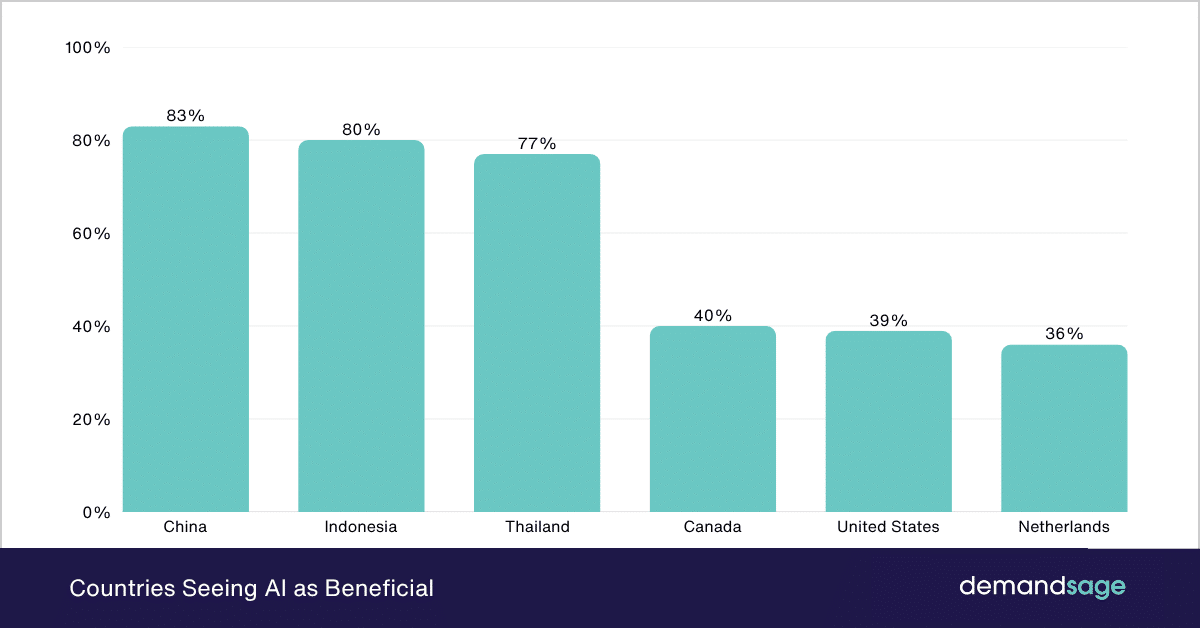
The details below showcase the pros of using AI by countries.
| Country | Percentage Seeing AI as Beneficial |
|---|---|
| China | 83% |
| Indonesia | 80% |
| Thailand | 77% |
| Canada | 40% |
| United States | 39% |
| Netherlands | 36% |
Source: Stanford HAI 2025
How Does AI Affect Education Negatively?
- Although there is high usage of AI, some teachers and students claim it affects education negatively in the academic sector.
“Some uses of generative AI can undermine their learning, particularly when the tools are used to do the cognitive work of thinking for students rather than to support their learning.” – Professor Martin West from Harvard University.
(Source: Harvard Edu)
The reasons are explained in the following table, which includes the percentage of students reporting concerns in each category.
| Student Concern | Global Rate | Region Based |
|---|---|---|
| Lacks sufficient AI knowledge | 58% | Global students |
| Unprepared for an AI-enabled workforce | 48% | Global students |
| Institutional support for AI skill development | 36% | UK students |
| Students who want involvement in AI integration decision-making | 71% | Global students |
| Feel institutions actively seek their feedback on AI | 34% | Global students |
| Mixed reactions to AI-assessed exams | 34% would increase effort, 29% would decrease effort, 27% no change | UK students |
Source: Digital Education Council, HEPI 2025
- Also, Professor Christopher Piech, an Assistant Professor of Computer Science and, by courtesy, at Stanford University, told a story of a student who was concerned about the rapid progress of ChatGPT and how this would deter future job prospects after many years of learning how to code. (Source: Stanford)
“‘Technology creates a shock. This shock is sometimes of a magnitude that we cannot even understand it, in the same way that we still haven’t absorbed the sharp shock of the mobile phone.” – Houman Harouni, the professor at Harvard University
AI Usage In Education: Gender & Attitude Differences
- Around 44% of children actively engage in generative AI. More than 54% of students use AI for schoolwork or homework.
- Overall, male students use AI more frequently than female students for learning and research. As per ResearchGate, the mean AI use of men is 3.14, higher than that of females, 2.73.
| Metric | Male Students | Female Students |
|---|---|---|
| Overwhelm | 21% feel overwhelmed | 30% feel overwhelmed |
| Use for Social Learning | 63% better informed about friends | 70% better informed about friends |
| Family Connection Usage | 56% better informed about family | 65% better informed about family |
- During the HEPI survey of 1041 full-time undergraduate students, it was seen that women were more concerned about academic misconduct and false results than men.
- Through the survey, men were excited about the AI. The wealthier students and those in STEM courses also show great enthusiasm for AI.
- Currently, the overall AI usage increased from 66% in 2024 to 92% in 2025 across all student demographics. GenAI usage for assessments rose from 53% in 2024 to 88% in 2025.
- The ratio of women to men who are more overwhelmed by AI is 30:20. Additionally, it is more overwhelming for people over 50 (approximately 30%) than for those who fall in the 18 to 49 age range (estimated percentage of AI overwhelm is 22%).
Source: Stanford, Pew Research, HEPI, AIPRM, Research Gate
AI In Education: Government Policies and Institutional Strategies
- Right now, all 50 states, along with Washington, D.C., and U.S. territories, have considered some form of AI-related legislation.
- Tennessee makes its own policies for school AI education.
- New York has banned the use of facial recognition technology in schools across the state.
- As per the U.S. Department of Education, over 25 countries are working together on AI rules, showing a global effort to make similar policies.
- AI policies in schools must follow three main US laws. These are FERPA, which protects student records; CIPA, which keeps kids safe online; and IDEA, which supports students with disabilities.
AI Cost And Efficiency Improvements
- The global investment in generative AI is expected to reach around $200 billion by 2028.
The table below highlights how efficiency trends are breaking the barriers to make a path for advanced artificial intelligence.
| Efficiency | Improvement Rate |
|---|---|
| Inference cost reduction (GPT-3.5 level) | 280-fold decrease |
| Hardware costs decline | 30% annually |
| Energy efficiency improvement | 40% annually |
| Performance gap (open vs closed models) | From 8% to 1.7% |
Source: Stanford HAI, WE forum
AI In Education – Future Outlook (2026)
- The AI education market is expected to reach $112.3 billion by 2034.
- By 2030, approximately 70 percent of job skills are expected to change, primarily due to the impact of AI.
- Regarding the workforce, more than 47% of leaders will consider upskilling employees in AI. Approximately 78% are currently hiring for AI roles to build a foundation for the future in AI.
- AI usage has become effectively ubiquitous, with 95% of students and faculty using AI on campus daily; however, only 25% of educators worldwide feel they have been sufficiently trained to use the technology effectively in their curriculum.
- 85% of teachers and 86% of students reported using AI tools during the 2024–25 school year, per CDT’s “Hand in Hand” report.
- AI cheating is now normalized among teens. About 59% of teens think cheating with AI has become a regular feature of student life.
- Khan Academy’s Khanmigo AI tutor grew from roughly 68,000 users in 2023-24 to over 1.4 million by mid-2025.
- Just 18% of teachers report receiving any formal guidance from administrators on AI use, while 34% receive none at all
Source: World Economic Forum 2025, Microsoft 2025, Coursera, HumanizeAI, PEW Research, TutorBase, Gallup.
Should AI Be Used In Schools?
- As per the Walton Family Foundation survey, approximately 71% of teachers and 65% of students agree that AI should be used in schools and also in the workplace.
- Over 80% of teachers and K-12 students found AI tools helpful in teaching and learning, respectively.
- More than 43% of parents said that AI might be beneficial for their children in the future.
- More than 68% of urban teachers haven’t been given any kind of AI training since joining.
- Teachers who use AI tools at least weekly save an average of 5.9 hours per week, which adds up to roughly 6 extra weeks of reclaimed time across a standard school year.
- A 2025 Harvard University physics study found that students using AI tutors learned more than twice as much in less time compared to those in traditional active-learning classrooms.
- Global student AI usage jumped from 66% in 2024 to 92% in 2025. By the start of 2026, it is estimated that 86% of all students in higher education utilize AI as their primary research and brainstorming partner.
- Human tutors can interpret student emotional states with 92% accuracy, while even the most advanced AI tutoring systems currently manage only 68% accuracy.
- While 80% of high school educators report that their students are receiving formal AI literacy lessons, only 8% of students in grades Pre-K through 3rd are receiving the same training, creating a significant developmental gap in early childhood education.
“The trick about AI is that to get it, we need to change what we’re educating people for, because if you educate people for what AI does well, you’re just preparing them to lose to AI. But if you educate them for what AI can’t do, then you’ve got IA (Intelligence Augmentation).”
-Chris Dede, Associate Director of Research for the National AI Institute for Adult Learning and Online Education, Harvard Graduate School of Education
Source: Edweek, WE Forum, AIPRM, Gallup, ICT Works, Codegnan, Dialzara
