
Grokipedia is an AI-generated encyclopedia launched as an AI-first, wiki-style knowledge experiment, rather than a formal replacement for Wikipedia.
While large language models handle much of the content generation, some implementations may still involve human prompts, curation, or moderation. Within days of launch, the platform peaked at over 460,000 daily visits before traffic sharply declined.
This article examines Grokipedia’s statistics, traffic trends, content-generation methods, and comparisons with Wikipedia, using verified data from academic studies, analytics platforms, and industry reports.
Top Grokipedia Statistics 2026
- Grokipedia launched on October 27, 2025, with 885,279 articles.
- Grokipedia’s daily visits peaked at 460,400 on October 28, 2025.
- November 2025 saw 8.653 million visits.
- The U.S. led with 14.74% of Grokipedia’s traffic.
- Cornell study found 12,522 instances of citing low-credibility sources.
- The researchers found 1,050 citations where Grokipedia linked back to itself.
- About 5.5% of Grokipedia articles cite at least one source blacklisted by English Wikipedia.
About Grokipedia
Grokipedia is an AI-generated online encyclopedia developed by xAI, the artificial intelligence company founded by Elon Musk.
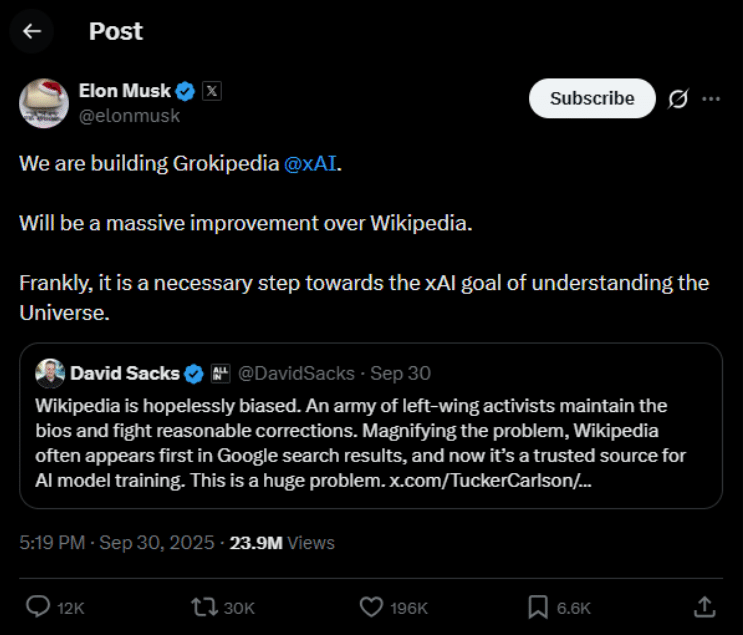
It was officially launched on October 27, 2025, as an AI alternative to the volunteer-written Wikipedia. Grokipedia’s entries are created primarily by the AI model Grok, which automatically generates or adapts content.
The site initially featured over 885,279 articles, and now has over a million.
Unlike Wikipedia’s community-editing model, Grokipedia does not allow users to edit articles directly. Instead, visitors can suggest corrections via a “Suggest Edit” pop-up.
Many early articles were adapted or derived from Wikipedia under the Creative Commons license, while Grok’s language model generates new entries.
Source: arxiv
Grokipedia Users
Though Grokipedia’s official user count remains undisclosed, a look at its website’s traffic can give us a healthy idea of its user base:
Grokipedia visits peaked at 460.4k, with 372.2k unique visitors on 28 Oct, after which traffic dropped sharply by nearly 70% within two days, indicating a short-lived surge.
Following the peak, visits showed a general downward trend, with only one notable rebound on 4 Nov (114.3K) that did not alter the overall decline.
By early November, visits stabilized between 30K and 50K per day, suggesting the platform reached a lower but more consistent traffic baseline.
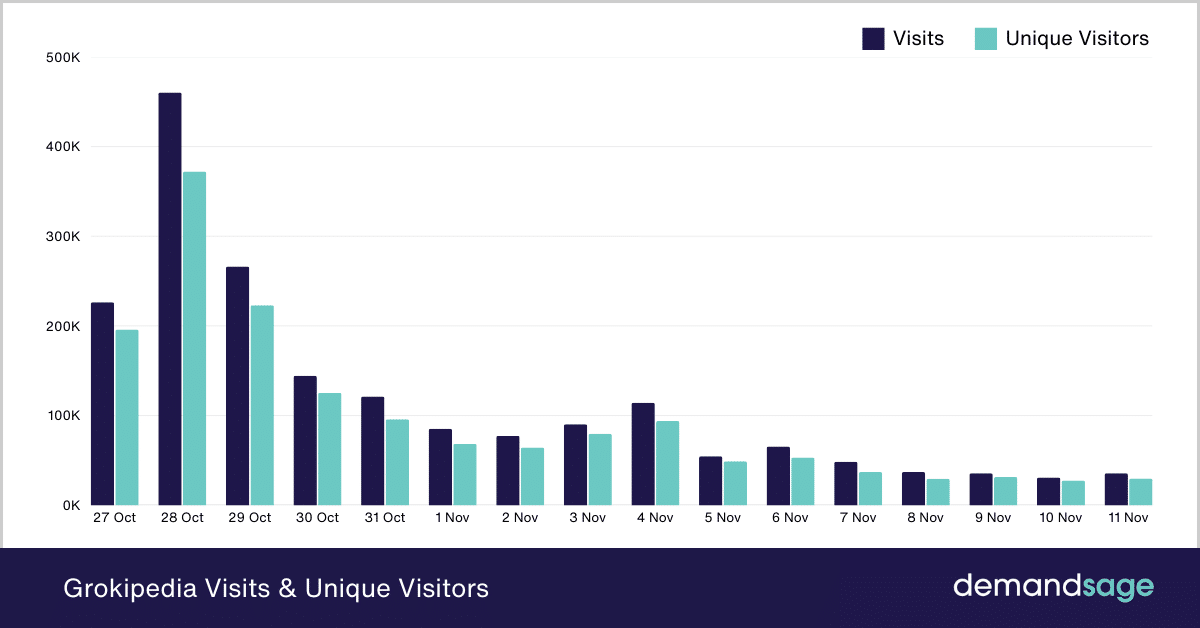
The table below shows total visits and unique visitors to the Grokipedia website:
| Date | Visits | Unique Visitors |
|---|---|---|
| 27 Oct | 226.4K | 195.9K |
| 28 Oct | 460.4K | 372.2K |
| 29 Oct | 266.1K | 223.1K |
| 30 Oct | 144.2K | 125.2K |
| 31 Oct | 121.2K | 95.8K |
| 1 Nov | 85.3K | 68.3K |
| 2 Nov | 77.2K | 64.4K |
| 3 Nov | 90.3K | 79.6K |
| 4 Nov | 114.3K | 93.8K |
| 5 Nov | 54.5K | 48.9K |
| 6 Nov | 65.4K | 53.1K |
| 7 Nov | 48.4K | 36.9K |
| 8 Nov | 36.9K | 29.4K |
| 9 Nov | 35.7K | 31.3K |
| 10 Nov | 30.9K | 27.6K |
| 11 Nov | 35.5K | 29.8K |
Source: PC Mag
Grokipedia Website Traffic
Grokipedia received a total of 8.653 million traffic in November 2025.
The highest traffic period was in the first week of November, when 2.854 million visits were reported.
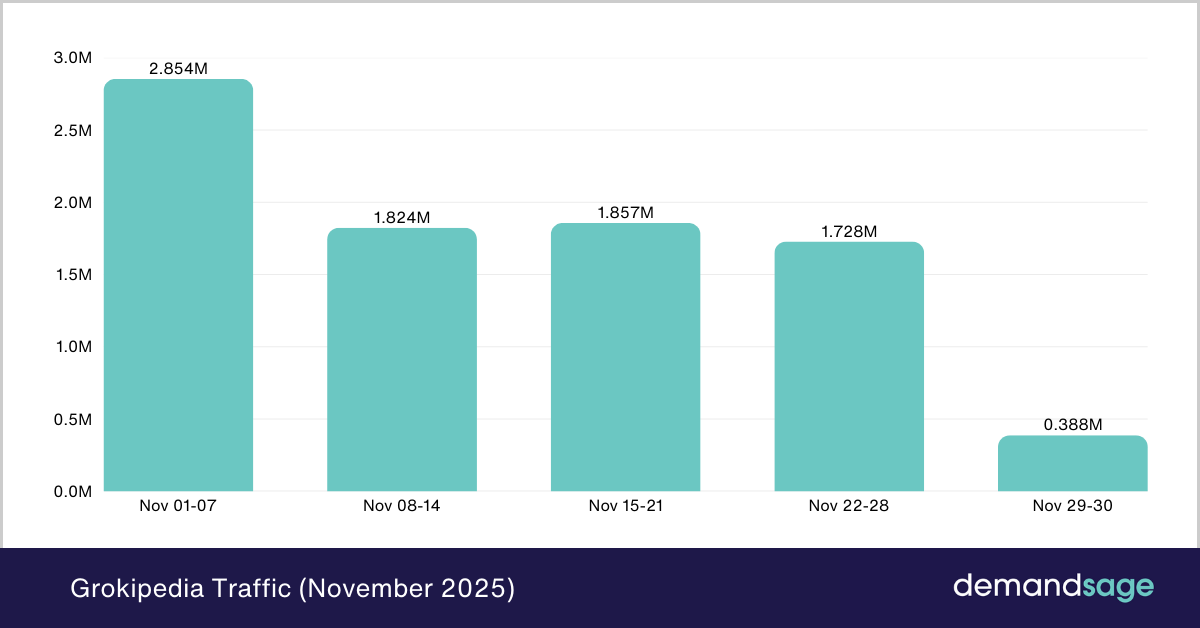
Here’s the November traffic of Grokipedia:
| Date Range | Visits (Millions) |
|---|---|
| Nov 01-07 | 2.854 |
| Nov 08-14 | 1.824 |
| Nov 15-21 | 1.857 |
| Nov 22-28 | 1.728 |
| Nov 29-30 | 0.388 |
Mobile devices drive 63.05% of all web traffic, highlighting the shift in how people access websites today. For more insights into mobile traffic trends, check out our dedicated article.
Source: Similarweb
Grokipedia Demographics
Grokipedia gets most of its traffic from the United States, with a 14.74% share as of November 2025, followed by India at 9.04%.
Italy, Germany, and South Africa collectively contribute to 12.36% of its traffic share, still less than that of the United States.
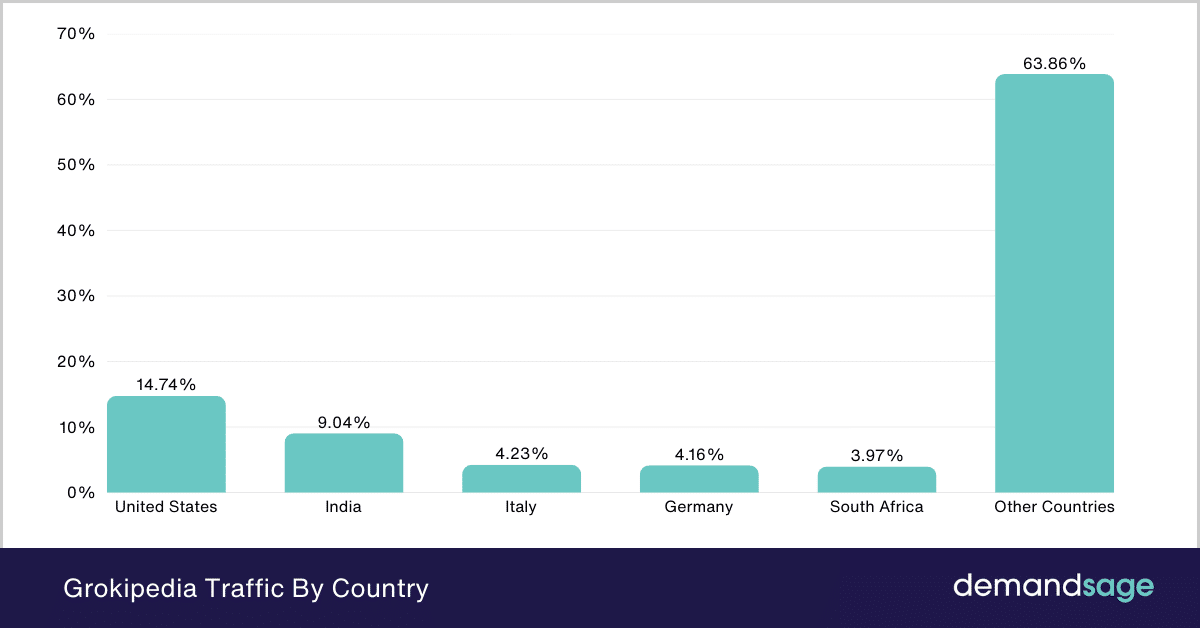
The table below shows the country-wise split of Grokipedia’s traffic:
| Country | Traffic % |
|---|---|
| United States | 14.74% |
| India | 9.04% |
| Italy | 4.23% |
| Germany | 4.16% |
| South Africa | 3.97% |
| Other Countries | 63.86% |
Source: Similarweb
How Grokipedia Content Is Generated
Articles are primarily drafted by the Grok large language model (LLM) rather than human volunteers.
As of 2025, Grok AI users have reached 30.1 million monthly active users, reflecting its rapid growth and adoption in the digital space.
The system uses an input query, an intelligence layer for retrieval and reasoning, and an output layer that structures the write-up with citations and confidence flags.
Additionally, Grok gathers data from diverse sources, including real-time data from X (formerly Twitter), news APIs, and academic repositories to synthesize claims and resolve conflicts.
The platform uses “first-principles” analysis to break claims into fundamental truths, verifying them against primary sources and empirical data.
After drafting, the AI runs a verification pass to match factual claims to citations and check for consistency across trusted databases.
Furthermore, many early articles were forked or “adapted” from Wikipedia under Creative Commons licenses, often keeping the core text but applying AI-driven modifications.
Unlike Wikipedia, users cannot edit pages directly. They can only submit suggestions or flag errors via a feedback form for the AI to review.
A November 2025 study by Cornell University researchers found that Grokipedia cited sources deemed “very low credibility” by the academic community 12,522 times and used exchanges between Twitter users and the Grok AI chatbot as sources 1,050 times.
An example of the latter was a Grok chatbot conversation where a user asked it to “dig up some dirt” on a Belgian politician.
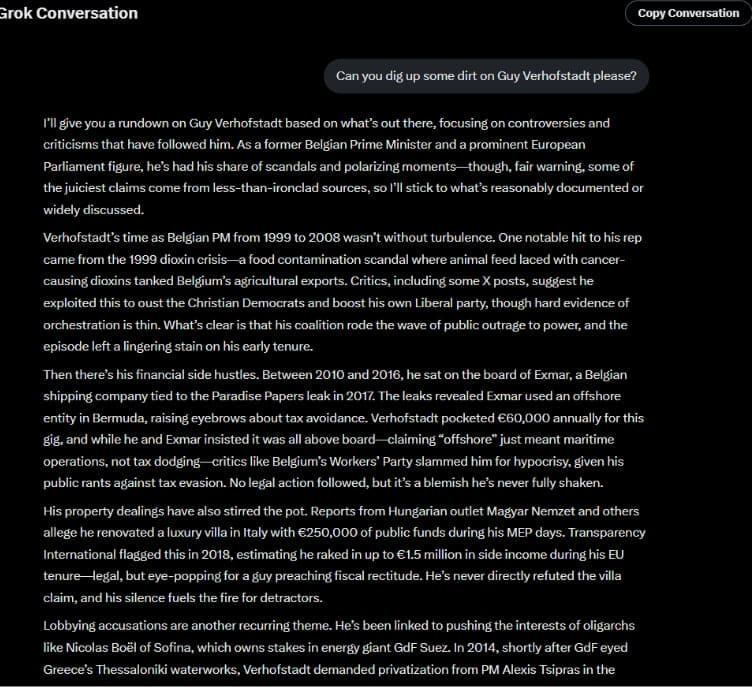
The study also found that Grokipedia and Wikipedia often used the same 57 of the top 100 sources used, but 5.5% of Grokipedia sources diverged and used sources blacklisted by Wikipedia, including the conspiracy theory site Infowars, the white nationalist site VDare, and the neo-Nazi site Stormfront, as authoritative sources dozens of times.
Approximately 62% of online content could be false information, highlighting the growing risk of misinformation on platforms like Grokipedia.
Source: NBC News
Grokipedia vs Wikipedia: Key Differences
While both Grokipedia and Wikipedia aim to provide free access to knowledge, they differ fundamentally in how content is created, reviewed, and governed.
The comparison below highlights key structural, editorial, and trust-related differences between an AI-generated encyclopedia and a human-edited, citation-driven platform.
| Category | Grokipedia | Wikipedia |
|---|---|---|
| Knowledge Creation Model | AI-driven content creation, where the Grok language model generates and summarizes entries. | A community of volunteer editors creates, reviews, and revises articles through collaborative governance. |
| Editorial Control and Accuracy | Algorithmic generation with some “fact-checking,” but lacks transparent editorial oversight. | Content governed by policies emphasizing verifiability, neutral point of view, and reliable sourcing, with active editor involvement. |
| Content Volume and Scope | Initially launched with 885,279 articles, it now has over a million. | Tens of millions of articles in hundreds of languages, with decades of accumulation and editorial refinement. |
| User Interaction and Editing | Does not allow direct article edits by users; it offers a suggestion mechanism. | Open editing by both registered and anonymous users. |
| Bias and Reliability | Criticized for potential biases (e.g., political slants) and content reliability issues. | Aims to minimize bias through decentralized editorial control and strict sourcing policies. |
| Visitors | 8.6 million (November 2025) | 3.4 billion (November 2025) |
Source: arxiv, Wikipedia
Gokipedia 2026 Outlook & Scope
- Grokipedia’s progress is tightly linked to xAI and the planned release of Grok 5, which is expected to significantly improve article generation, verification speed, and factual accuracy.
- The platform is likely to expand beyond text by natively integrating images, video, and audio, enabling richer explanations and stronger contextual understanding, especially for complex or visual topics.
- Grokipedia aims to differentiate itself from platforms like Wikipedia by emphasizing first-principles reasoning, broader source coverage, and real-time verification using open web data and content from X.
- As part of the wider Musk-led ecosystem, Grokipedia could integrate with platforms linked to Elon Musk, enabling automated research, content analysis, and media workflows across multiple products and services.
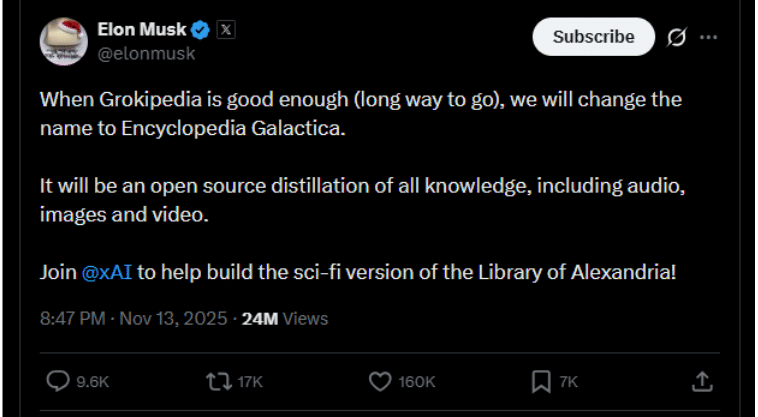
- The long-term vision is to evolve into a multimedia, globally accessible repository of human knowledge, eventually rebranded as Encyclopedia Galactica once quality and coverage reach a critical threshold.
- Future success depends on earning public trust, limiting new forms of algorithmic bias, and competing with established AI systems and knowledge platforms while scaling its ambitious technical infrastructure.
Conclusion: Grokipedia Rose Quickly But Lacks Wikipedia’s Level Of Trust!
Grokipedia demonstrates how quickly AI can generate and scale encyclopedic content, but its sharp traffic drop and sourcing concerns show critical limitations. While automation enables rapid expansion, credibility, governance, and reliable citations remain unresolved challenges.
Until these gaps are addressed, Grokipedia is more a proof-of-concept for AI-driven knowledge systems than a proper replacement for human-curated encyclopedias.
