
The Health Insurance market worldwide is projected to reach $1.17 trillion. Around 92% of people had health insurance coverage for some part or for the full year in the United States.
The United States’ health insurance market is forecast to reach $318.41 billion. Only 8% of people in the U.S. were without any health insurance policy.
After COVID-19, more than half of the world’s population, around 4.5 billion people, had no proper access to basic healthcare. Further in this article, we will go through the health insurance trends, understand the health benefits data, and learn all about the past and current statistics.
Top Health Insurance Statistics & Trends Of 2026
- Around 92.0% of the United States population has health insurance coverage.
- Nearly 8.0% are still uninsured, which means they have not enrolled in any health insurance plan.
- Over 24.3 million enrolled in ACA Marketplace plans.
- By 2025, the health insurance market is projected to reach $1.17 trillion.
- United States health insurance market is expected to be $318.41 billion by the end of 2025.
- Approximately 52% of women have exchange-based coverage, compared with 48% of men.
Health Insurance Market Size Worldwide
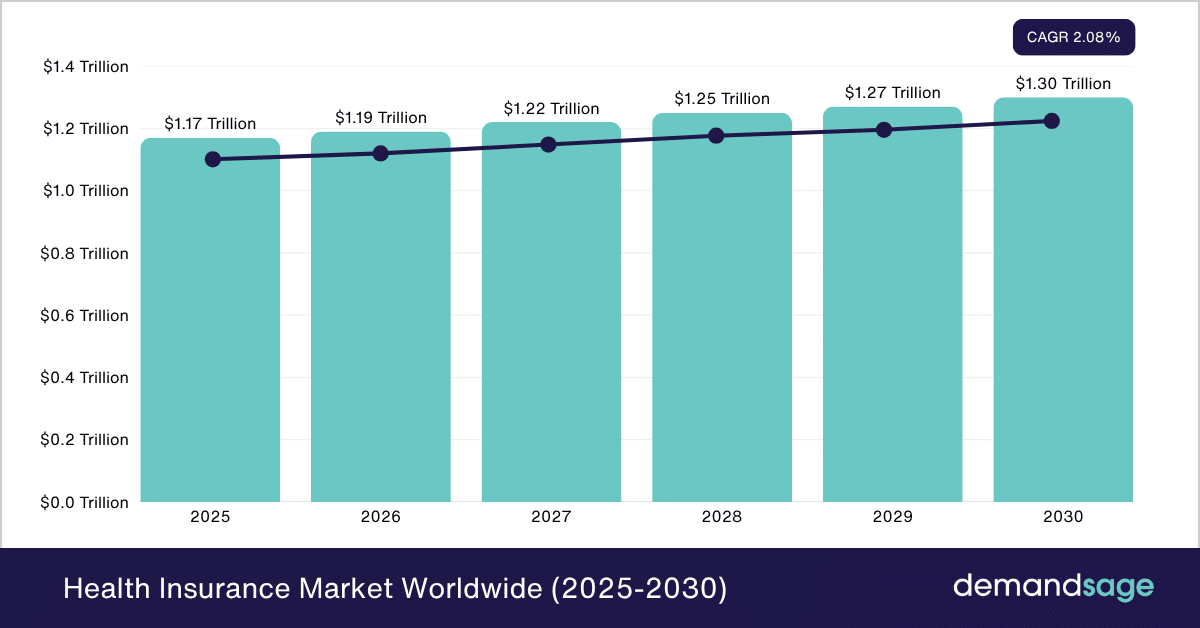
The global health insurance market worldwide is projected to reach $1.17 trillion by 2025.
This is the Gross Written Premium, which means an insurance company collects the amount in exchange for insurance policies during a year.
| Metric | Value |
|---|---|
| Gross Written Premium (2025) | $1.17 trillion |
| Growth Rate (2025) | 12.26% |
| Average Per Capita Spending | $149.58 |
| Projected CAGR (2025-2030) | 2.08% |
| Projected Market Volume (2030) | $1.30 trillion |
Source: Statista
The global health insurance market grew by 12.26% in 2025. But the CAGR till 2030 is estimated to increase by 2.08%.
By 2030, this market volume is expected to reach $1.30 trillion.
Health Insurance Market In The United States
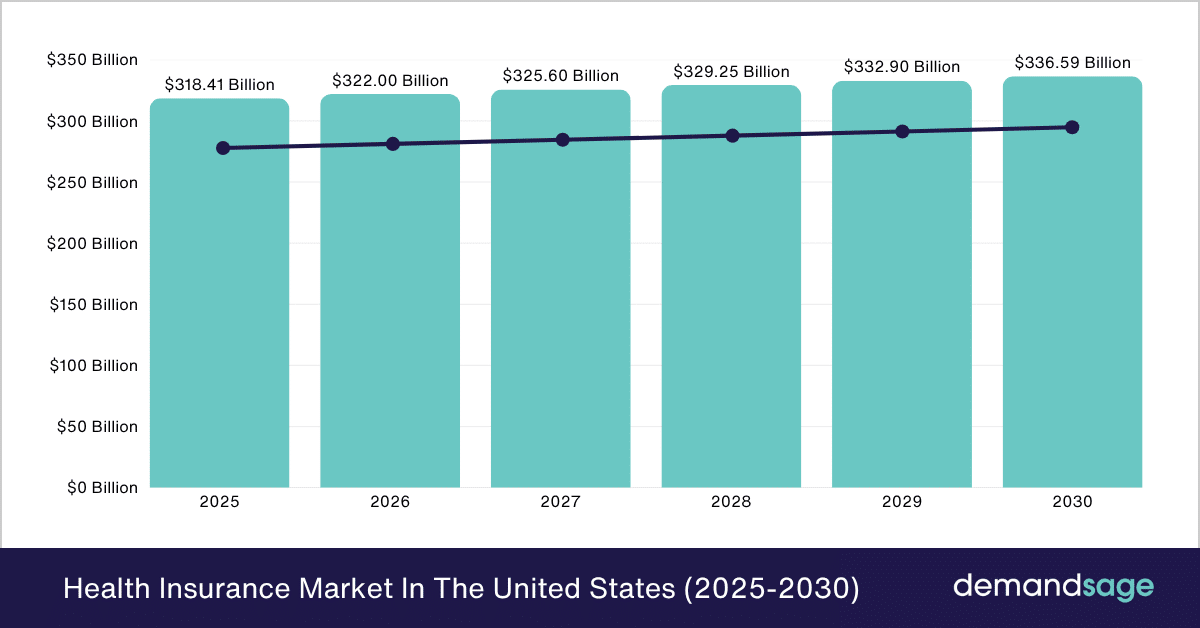
Particularly in the United States, there is quite a lot of awareness of the health benefits, which leads to the health insurance market size of nearly $318.41 billion by the end of 2025.
The gross written premium change in 2025 is 8.96%. However, there might be a steady annual growth rate (CAGR) of 1.12% till 2030.
| Metric | Value |
|---|---|
| Gross Written Premium (2025) | $318.41 billion |
| Growth Rate (2025) | 8.96% |
| Average Per Capita Spending | $926.67 |
| Projected CAGR (2025-2030) | 1.12% |
| Projected Market Volume (2030) | $336.59 billion |
Source: Statista1
The average per capita expenditure is predicted to reach $926.67 in 2025. In addition to this data, the health insurance market volume might grow to $336.59 billion by 2030.
This shows that, as people’s health awareness grows, the United States is dominant in the health insurance market compared to other countries.
The North American health insurance market, including the USA, is projected to reach $360.10 billion by the end of this year.
The North American health insurance market is highly competitive, with multiple insurance options available. Given this ongoing growth, the market volume could reach $382.09 billion by 2030.
(Source: Statista2)
Health Insurance Coverage By Type
In the last year, approximately 310 million people have taken the health insurance in the United States.
This accounts for around 92.0%, whether for a short period or for a full year. Private health insurance was more popular than public coverage, at 66.1% and 35.5%, respectively, in the U.S.
The private health insurance population in the U.S. can be around 223 million. The health insurance also has a subcategory, which includes employment-based, direct purchase, Medicare, etc.
| Coverage Type | Percentage | Population (millions) |
|---|---|---|
| Any Insurance | 92.0% | 310 |
| Private Insurance | 66.1% | ~223 |
| Employment-based | 53.8% | ~181.4 |
| Direct-purchase | 10.7% | ~36.1 |
| Public Insurance | 35.5% | ~119.7 |
| Medicare | 19.1% | ~64.4 |
| Medicaid | 17.6% | ~59.3 |
| TRICARE | 2.8% | ~9.4 |
| VA & CHAMPVA | 1.2% | ~4.0 |
| Uninsured | 8.0% | ~27.1 |
(‘~’ indicates the approximate count)
Source: Census
Employer benefits employees through employment-based health insurance, which remains the most common, covering 53.8% of the U.S. population.
Direct purchase health insurance is coverage purchased by an employee from the company. This count accounts for around 10.7% of the U.S. population.
The percentage of public insurance purchased is comparatively less than that of private insurance, whose coverage is only 33.5%.
Besides employer health insurance, known as employer-sponsored or group health insurance, employees also consider purchasing plans with Medicare, Medicaid, TRICARE, and VA & CHAMPVA for family protection.
However, there are only 8% of people in the United States who have not purchased any of the health insurance plans, either private or public.
Health Insurance Coverage By Demographic
Taking health insurance for self and family members has become a priority, and people of all age groups have almost understood it.
92.0% of the U.S. population, with all ages combined, had health insurance coverage in 2024.
Among this, only 8% of the people in the United States (including all ages) were uninsured.
1. Coverage By Age Group
The children in the 19 and under age group and the adults 65 and older have purchased more insurance policies.
Approximately 93.9% of families have taken out some form of health insurance for their children under 19 years old. This means around 76,970 children had health insurance last year in the U.S.
In comparison to them, 99% of individuals aged 65 and older are taking advantage of health insurance, either private or public.

| Age Group | Any Insurance | Private | Public | Uninsured |
|---|---|---|---|---|
| Total (All Ages) | 92.0% | 66.1% | 35.5% | 8.0% |
| Under 19 years | 93.9% | 63.0% | 34.2% | 6.1% |
| 19 to 64 years | 89.0% | 74.0% | 17.9% | 11.0% |
| 65 years and older | 99.0% | 44.3% | 94.1% | 1.0% |
Source: Census1
Among people aged 19 to 64, nearly 198,600 have purchased health insurance, accounting for 89.0% of the U.S. population.
To clarify, here is the breakdown of the percentage of adults with any type of health insurance plan, regardless of whether it is short-term or long-term.
- 85.7% of adults in the 19 to 25 age group have purchased private or public health insurance.
- Nearly 87.1% of those with insurance plans fall within the age group of 26 to 34.
- 89.2% comes in the range of 35 and 44 years.
- And around 91.2% of people getting health insurance plans are in the 45 to 64 age group.
In addition to this data, AI in healthcare is taking place worldwide prominently for patient care, hospital operations, and clinical facilities. The market for AI in healthcare could exceed $110 billion by 2030.
2. Exchange-Based Coverage By Gender Distribution
EBC or Exchange-based coverage (on-exchange coverage) is any plan you purchase through the official government-run or state-run health insurance marketplace.
Exchange-based coverage is a way of obtaining health insurance.
| Gender | 2023 | 2024 | 2025 |
|---|---|---|---|
| Female | 53% | 52% | 52% |
| Male | 47% | 48% | 48% |
Source: CMS
Female exchange-based coverage is 52%, which is steady from last year. On the other hand, approximately 47% of males go through this coverage plan.
Males show a lower exchange-based health insurance coverage purchase rate than females.
However, looking at the enrollment rate for men in 2020, which was 45%, marketplace insurance has recently been attracting more men, increasing to 48% in 2025.
In contrast, there was around 55% of women enrollment in health and other associated plans through exchange-based coverage in 2020, but the percentage has declined to 52% in 2025.
This shows that men are catching up to women in enrollment or buying marketplace health insurance in 2025.
3. Health Insurance Coverage By Race and Ethnicity
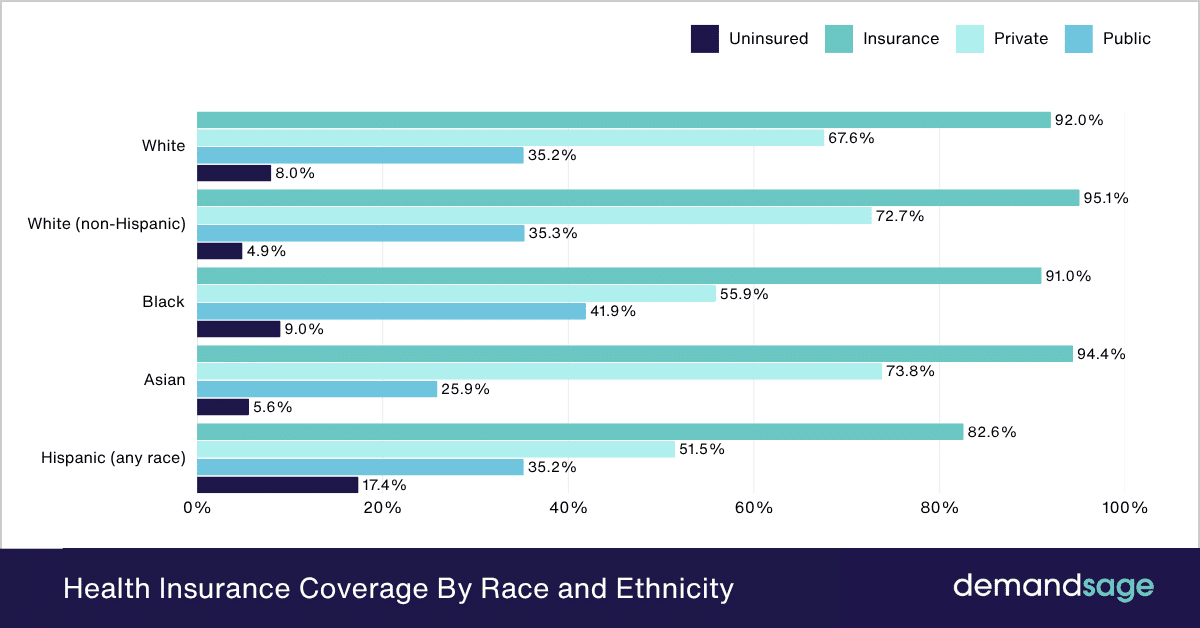
As per the recent data, around 92.0% of white people are insured, of whom 67.6% have purchased private health insurance and 35.2% have purchased public health insurance.
95.1% of non-Hispanic white people have purchased insurance, meaning nearly 192,700 people enrolled in health insurance policies in the United States.
| Race/Ethnicity | Insured | Uninsured | Private | Public |
|---|---|---|---|---|
| White | 92.0% | 8.0% | 67.6% | 35.2% |
| White (non-Hispanic) | 95.1% | 4.9% | 72.7% | 35.3% |
| Black | 91.0% | 9.0% | 55.9% | 41.9% |
| Asian | 94.4% | 5.6% | 73.8% | 25.9% |
| Hispanic (any race) | 82.6% | 17.4% | 51.5% | 35.2% |
Source: Census1
Black and Asian people have 91.0% and 94.4% of health Insurance coverage, respectively.
Hispanic (any race) shows a slightly lower number, with approximately 82.6% of people having health Insurance coverage.
4. Health Insurance Coverage By Citizenship And Nativity
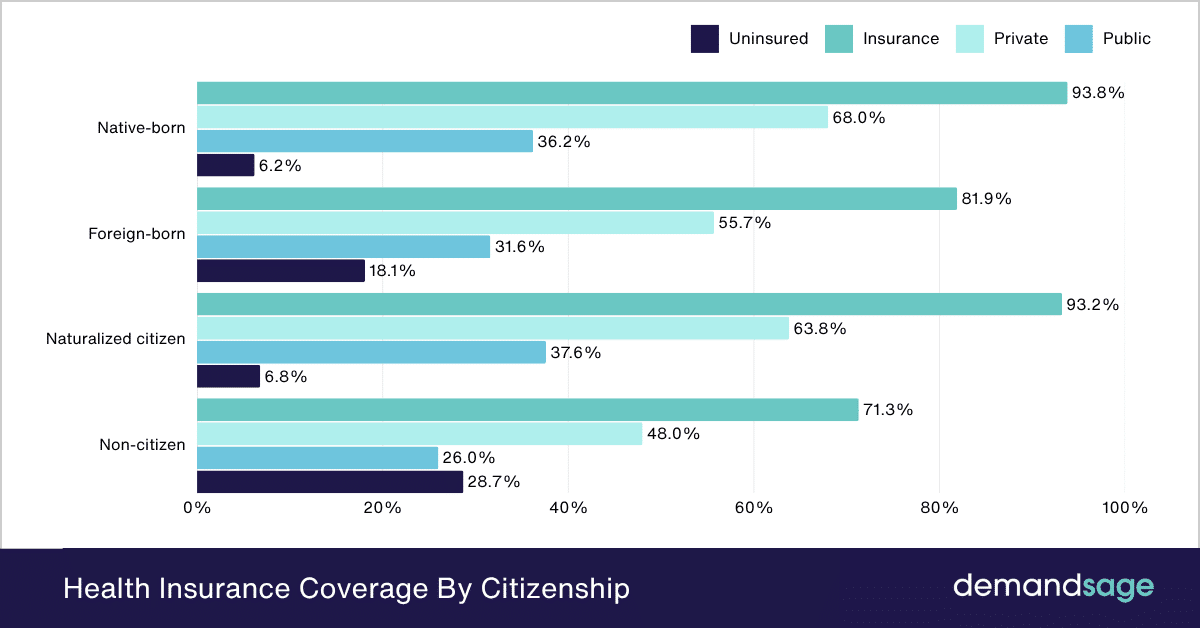
Around 284,000 individuals are already under the health insurance plans from the origin country. This means 93.8% of the native-born people have health insurance coverage, and only 6.2% are uninsured.
81.9% of foreign-born people (outside the USA) residing in that country have health insurance coverage plans for themselves and family members.
| Status | Insured | Uninsured | Private | Public |
|---|---|---|---|---|
| Native-born | 93.8% | 6.2% | 68.0% | 36.2% |
| Foreign-born | 81.9% | 18.1% | 55.7% | 31.6% |
| Naturalized citizen | 93.2% | 6.8% | 63.8% | 37.6% |
| Non-citizen | 71.3% | 28.7% | 48.0% | 26.0% |
Source: Census1
The foreign-born also has subtypes, naturalized citizens and non-citizens.
- 93.2% naturalized citizens who are foreign-born but have citizenship of the residing country are protected with health insurance policies.
- 71.3% of non-citizens also have backup for their families under the health policies. However, around 28.7% did not have any health coverage plans.
5. Health Insurance Coverage By Region
Nearly 56,970 individuals of all ages in the northeast of the USA have any form of private or public health insurance. This accounts for 94.9% insurance purchased, with a 5.1% uninsured rate.
Approximately 93.5% of the Midwest is insured, where 68.6% is with private health insurance policies and 35.8% are with public insurance policies.
| Region | Insured | Uninsured | Private | Public |
|---|---|---|---|---|
| Northeast | 94.9% | 5.1% | 68.0% | 37.3% |
| Midwest | 93.5% | 6.5% | 68.6% | 35.8% |
| South | 89.3% | 10.7% | 64.7% | 33.7% |
| West | 92.8% | 7.2% | 64.7% | 36.9% |
Source: Census1
More than 131,400 come from the South USA with health insurance coverage status. Although more than 1 lakh people have these health policies, there are still 10.7% of the total population in that region who have no insurance policies.
92.8% are insured in the western part of the USA, and 7.2% are uninsured. Among all this, the Northeast is the leading region, accounting for 94.9% of health insurance types.
6. Health Insurance Challenges By Income Level (Adults 18-64)
Income level affects access to employer health benefits, with adults more likely to receive coverage through their workplace.
Low-income adults below 100% or 200% FPL have the highest uninsured rate, ranging from 21.2% to 22.4%.
Adults with incomes between 200% and 400% FPL have an uninsured rate of about 13.1%. The lowest uninsured rate is among working adults with incomes above 400% FPL.
They have the highest private coverage rate, 90.9% primarily through employer health benefits.

| Income Level | Uninsured | Public Coverage | Private Coverage |
|---|---|---|---|
| <100% FPL | 21.2% | 54.9% | 25.6% |
| 100% to <200% FPL | 22.4% | 40.4% | 39.5% |
| 200%-400% FPL | 13.1% | 18.3% | 70.7% |
| >400% FPL | 3.9% | 6.6% | 90.9% |
Source: CDC
Data show that part-time workers are not included in employer-sponsored health coverage. Only 27% of larger firms and 18% of small firms offer health benefits to part-time employees.
34% of small employers who do not offer any health benefits to their employees state that Medicaid is “very important” coverage for their employees.
Additionally, nearly 22% of employers mention that Medicaid is “somewhat important” for small workers.
This shocking part is that only 43% of workers receive employer health benefits at companies with many low-wage workers, compared to 64% at companies with few low-wage workers.
The 21% point gap shows that low-income workers are less likely to get insurance through their jobs, even when they work full-time.
Interesting Read: If you want to build your own Fintech startup, understand that there are more than 30,000 Fintech startups worldwide. Additionally, around 48% of global customers use insurance Fintech services.
Basic Health Programs & Essential Plan Enrollment
The basic health program (BHP) and other essential programs enrollment have been implemented in states such as Minnesota, New York, and Oregon.
The total BHP and Essential Plan (EP) Expansion enrollment rate of people in these states is 1,792,695, which means 1.8 million.
Minnesota and Oregon states in the U.S. offer health coverage to people earning between 133% and 200% of the Federal Poverty Level (FPL).
| State | 2023 | 2024 | 2025 |
|---|---|---|---|
| Minnesota | 94,811 | 103,638 | 97,078 |
| New York | 1,123,110 | 1,198,396 | 1,663,673 |
| Oregon | – | – | 31,944 |
| Total | 1,217,921 | 1,302,034 | 1,792,695 |
Source: CMS
New York expanded its health insurance program in 2025 to cover people earning up to 250% of the poverty level.
38% of the BHP and other plans’ total enrollment rose from 1.3 million people in 2024 to 1.8 million people in 2025.
Overall, New York saw the biggest increase with 39% more people enrolling after the EP Expansion.
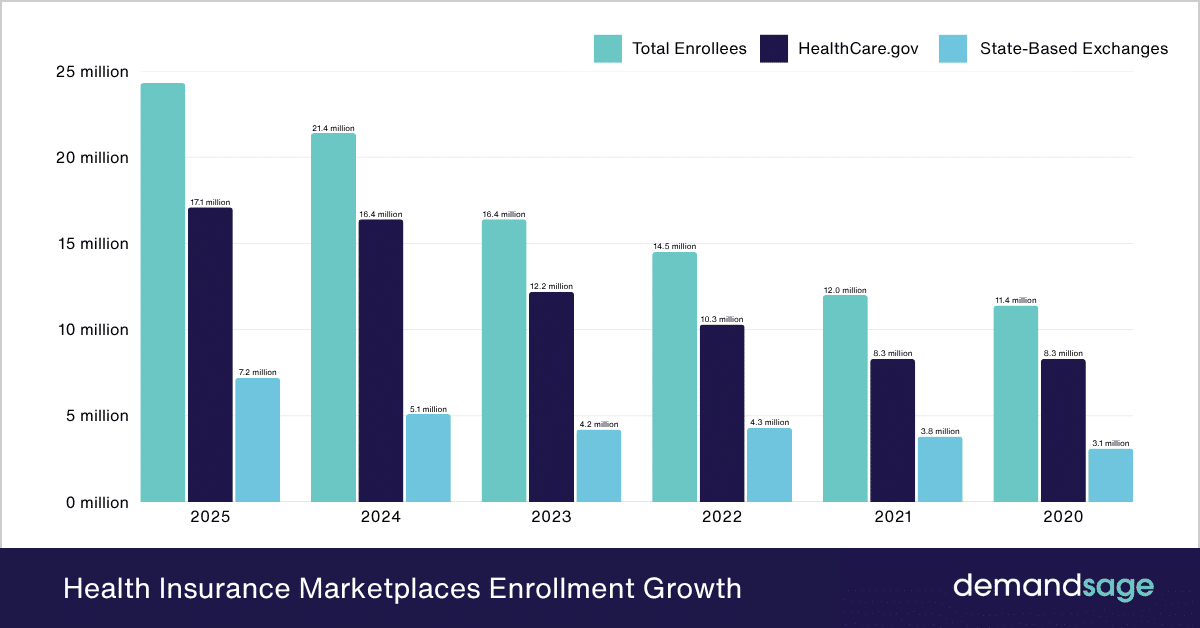
Health Insurance Marketplaces Enrollment Growth
24.3 million people were re-enrolled in an exchange plan during the open enrollment period (OEP).
17.1 million consumers enrolled through the Healthcare official website, and 7.2 million enrolled through state-based exchanges (SBE).
| Year | Total Enrollees | HealthCare.gov | State-Based Exchanges | YoY Change |
|---|---|---|---|---|
| 2025 | 24.3 million | 17.1 million | 7.2 million | +13% |
| 2024 | 21.4 million | 16.4 million | 5.1 million | +30% |
| 2023 | 16.4 million | 12.2 million | 4.2 million | +13% |
| 2022 | 14.5 million | 10.3 million | 4.3 million | +21% |
| 2021 | 12.0 million | 8.3 million | 3.8 million | +5% |
| 2020 | 11.4 million | 8.3 million | 3.1 million | – |
Source: CMS
This shows an approximate 13% year-over-year increase in total enrollees across the Healthcare.gov and State-based exchanges.
In 2025, 40 out of 51 state exchange marketplaces grew by at least 10%. States such as Louisiana, West Virginia, Kentucky, and others also saw an increase in health insurance, BHP (Basic Health Program), and other plan selections to protect family members.
Current Challenges In Health Insurance
Health insurance does not apply to all individuals. The criteria for private and public companies differ.
- Small-firm workers face average deductibles of $2,631, compared with $1,670 at large firms.
- 53% of small-firm workers face deductibles of at least $2,000, and 36% face deductibles of at least $3,000.
- In 2025, nearly three-quarters (72%) of employees have reached the out-of-pocket maximum for single health insurance coverage, including 21% who have exceeded $6,000.
- 59% of the largest employers with 5000+ workers report that GLP-1 costs have exceeded expectations.
- An estimated 27.1 million people, or 8.0% of the population, did not have health insurance.
- Around 10 states, including Alabama, Florida, Georgia, Kansas, Mississippi, South Carolina, Tennessee, Texas, Wisconsin, and Wyoming, did not choose to implement the ACA Medicaid expansion.
Future Outlook Of Health Insurance
- The health insurance market volume is projected to reach $1.30 trillion by 2030.
- Those who have purchased the insurance expect a double-digit increase in small-group and individual markets.
- Scaling up primary health care could save 60 million lives by 2030.
- The younger generation below 19 and between 25 in the future will be more aware of taking health insurance for themselves and the family’s safety.
Sources: Census, KFF, WHO
Conclusion: By the end of 2025, the Health Insurance market worldwide is projected to reach $1.17 trillion.
The health insurance market worldwide is projected to reach $1.17 trillion by the end of 2025. Regarding the current dominant country, around 92.0% (~310 million) of people in the United States already have health insurance.
Also, 93.9% people in the 19 and below age group show an increasing purchase of health insurance than other age groups. However, 99.0% of people who are above 65 are already covered with this insurance.
But as the awareness regarding health is widespread, teens and adults are more active in taking out health insurance for their families.
With all this data, it is estimated that the health insurance market will be $1.30 trillion by 2030.
FAQs
Approximately 92.0% of the U.S. population had health insurance coverage. Coverage includes employer-sponsored, Medicare, Medicaid, and marketplace plans.
Currently, New England has the lowest health insurance coverage rate. In the United States, the Northeast region has the lowest uninsured rate at 5.1%.
Employment-based insurance covers 53.8%, Medicare covers 19.1%, Medicaid covers 17.6%, and marketplace plans cover 5.7%. Direct-purchase, TRICARE, and VA programs cover additional populations with some overlap.
The health insurance market might reach $318.41 billion by the end of 2025 and is forecasted to grow to $336.59 billion by 2030. Enrollment in the health insurance market doubled, from 11.4 million to 24.3 million.
As of now, the biggest health insurance coverage gaps in America are Medicaid coverage, which comes under the Affordable Care Act (ACA). Additionally, part-time workers rarely receive employer-sponsored benefits.
In 2025, the average family premium reached $26,993 annually. The cost can vary from $456 per month for an individual to $111 per month for an employer-sponsored plan. Understand that health insurance costs depend on the type, plan, region, and specific plan coverage.
