
Christmas spending for 2025-26 is anticipated to increase significantly, and shoppers are projected to spend an average of $1,595 on gifts, travel, and entertainment, representing a 10% fall from 2024.
Notably, 26% of consumers plan to increase their holiday budgets, with some expecting to spend up to $3,076, while Gen Z plans to cut short their budgets by 23%.
Approximately 35% of shoppers intend to spend over $500, with 80% focusing on gifts and food. The total U.S. Christmas spending was forecasted to reflect a substantial investment, with over 60% of budgets allocated to gifts.
Let’s get into the details of how much and by whom this Christmas money is being spent in 2025.
Christmas Spending Stats 2025-2026: Top picks
- 80% of shoppers were planning to spend over $100 on Christmas in 2025.
- U.S. holiday retail sales surpassed $1 trillion in 2025.
- Online holiday spending reached a record $257.8 billion.
- Cyber Monday generated $14.25 billion in online sales.
- Holiday retail sales increased 4.1% year over year.
- Mobile devices accounted for 56.4% of online purchases.
- Americans expected to spend $1,007 on holiday gifts.
Christmas Spending
About 80% of consumers were planning to spend over $100 on Christmas in 2025.
Meanwhile, 10% indicated they’ll keep their holiday spending between $50 and $100. Also, the remaining 10% reported plans to spend less than $50, showing that most shoppers are budgeting a significant amount for the holiday season.

Here is a table displaying the estimated spending of the holiday shoppers on Christmas:
| Christmas Spending Intentions | Percentage Of Holiday Shoppers |
|---|---|
| Less than $50 | 4% |
| $50-$99 | 6% |
| $100-$199 | 11% |
| $200-$299 | 16% |
| $300-$399 | 14% |
| $400-$499 | 13% |
| Greater than $500 | 35% |
Source: Numerator.
8 in 10 people are looking forward to purchasing gifts for Christmas.
Meanwhile, 79% are looking forward to spending on food, and 36% are likely to spend on alcoholic beverages.
Here is a table displaying the percentage of consumers who will spend on different categories on Christmas:
| Category | Share Of Consumers |
|---|---|
| Gifts | 80% |
| Food | 79% |
| Decorations | 43% |
| Candy | 42% |
| Alcoholic beverages | 36% |
| Non-alcoholic beverages | 28% |
| Games or activities | 20% |
| Apparel or costumes | 19% |
| Party supplies | 17% |
| Nothing | 2% |
Source: Numerator
According to the NRF, consumers planned to allocate $627.93 toward gifts for family and friends. The remaining $262.56 was earmarked for seasonal items like food, candy, decorations, and greeting cards.
Nearly all U.S. adults (91%) planned to celebrate winter holidays such as Christmas, Hanukkah, or Kwanzaa in 2025, consistent with recent years. That broad participation helped sustain strong retail performance even as individual budgets tightened.
Source: NRF
Americans expected to spend $1,007 on holiday gifts, roughly in line with the $1,014 they predicted at the same point in 2024. However, by November, that figure dropped sharply to $778, a $229 decline that marked the largest October-to-November drop Gallup has ever recorded, exceeding even the 2008 recession.
| Year | October spending estimate | November spending estimate |
|---|---|---|
| 2006 | $907 | $826 |
| 2007 | $909 | $866 |
| 2008 | $801 | $616 |
| 2009 | $740 | $638 |
| 2010 | $715 | $714 |
| 2011 | $712 | $764 |
| 2012 | – | $770 |
| 2013 | $786 | $704 |
| 2014 | $781 | $720 |
| 2015 | $812 | $830 |
| 2016 | $785 | $752 |
| 2017 | $906 | $862 |
| 2018 | $885 | $794 |
| 2019 | $942 | $846 |
| 2020 | $805 | $852 |
| 2021 | $837 | $886 |
| 2022 | $932 | $867 |
| 2023 | $923 | $975 |
| 2024 | $1,014 | $1,012 |
| 2025 | $1,007 | $778 |
Source: Gallup
Here is a table showing how different surveys estimated 2025 holiday spending:
| Source | Average Planned Spend (2025) | Change from 2024 |
|---|---|---|
| NRF (per person, gifts + seasonal items) | $890.49 | -1.3% |
| Deloitte (per household, total holiday) | $1,595 | -10% |
| PwC (per person, gifts, travel, entertainment) | $1,552 | -5% |
| Gallup (per person, gifts only, October) | $1,007 | -0.7% |
| Gallup (per person, gifts only, November) | $778 | -23.1% |
| American Research Group (gifts only) | $764 | -6.8% |
Sources: NRF, Deloitte, PwC, Gallup, American Research Group
How Much Do People Spend On Christmas?
Total U.S. holiday retail sales grew 4.1% year over year during November and December 2025. That placed spending at just over $1 trillion.
Source: NRF
This growth rate marked a slight moderation from 2024’s 4.3% gain but remained above the pre-pandemic average of 3.6% annual growth between 2010 and 2019. Holiday spending now accounts for roughly 19% of annual retail sales, underscoring the season’s outsized importance to the economy.
Source: Finance Yahoo
U.S. retail sales (excluding automotive) rose 3.9% year over year from November 1 through December 21. E-commerce sales surged 7.4%, while in-store sales grew a more modest 2.9%, highlighting the ongoing shift toward digital channels.
Source: Mastercard
Deloitte’s broader holiday retail forecast projected total sales between $1.61 trillion and $1.62 trillion during the November-to-January period, a 2.9% to 3.4% increase. E-commerce within that window was expected to reach $305 billion to $310.7 billion, growing between 7% and 9%.
Source: Deloitte
Here is how U.S. holiday retail sales have grown over recent years:
| Year | Holiday Sales |
|---|---|
| 2005 | $484.0 billion |
| 2006 | $500.6 billion |
| 2007 | $513.8 billion |
| 2008 | $490.8 billion |
| 2009 | $491.9 billion |
| 2010 | $517.5 billion |
| 2011 | $541.3 billion |
| 2012 | $554.9 billion |
| 2013 | $569.1 billion |
| 2014 | $595.5 billion |
| 2015 | $610.9 billion |
| 2016 | $629.4 billion |
| 2017 | $660.3 billion |
| 2018 | $676.5 billion |
| 2019 | $701.7 billion |
| 2020 | $764.5 billion |
| 2021 | $860.3 billion |
| 2022 | $900.6 billion |
| 2023 | $936.0 billion |
| 2024 | $976.1 billion |
| 2025 | $1,012.2 billion |
Source: NRF
When calculating the expenses, we can conclude that Americans spend around a week’s salary on Christmas shopping.
The Average Amount Of Money Spent On Christmas
Out of the $890.49 average total, about two-thirds went to gifts, with spending on gifts for family increasing at the fastest annual rate among all gift categories.
| Type of Purchase | Percent Spending | Average $ Among Spenders | Percent of Total |
|---|---|---|---|
| Gifts for Family | 94.70% | 496.7 | 55.90% |
| Gifts for Friends | 68.30% | 121.5 | 13.60% |
| Gifts for Co-Workers | 33.60% | 102.27 | 11.50% |
| Gifts Other | 43.30% | 92.39 | 4.20% |
| Decorations | 71.10% | 100.53 | 13.30% |
| Greeting Cards and Postage | 64.10% | 51.9 | 5.80% |
| Candy and Food | 91.40% | 138.08 | 15.50% |
| Flowers/Plants | 47.10% | 67.27 | 7.80% |
| Weighted Total | – | 890.49 | 100% |
A PwC survey found that the average projected gift spend rose to $770, up from $721 in the firm’s June survey. That 7% increase suggested a meaningful “say-do gap,” where consumers reported plans to hold back but ultimately spent more.
Its broader spending analysis confirmed a 3.2% year-over-year increase in Q4 spending, driven by stronger combined performance across October, November, and December. Average expected spend for the quarter rose from $7,591 to $7,834.
Source: PwC
Consumers in the United States spent an average of under six weeks shopping during the holiday season.
This was a decrease compared to previous years. In 2021, consumers spent an average of 6.4 weeks in holiday shopping.
Here are further details about the time consumers spend shopping during the holiday season.
| Year | Time Spent By Consumers In Shopping |
|---|---|
| 2024 | 5.7 weeks |
| 2023 | 5.8 weeks |
| 2022 | 5.8 weeks |
| 2021 | 6.4 weeks |
| 2020 | 5.9 weeks |
| 2019 | 7.4 weeks |
| 2018 | 7.1 weeks |
Source: Statista, ElectroIQ
Consumers planned to spend an average of $1,595 in 2025.
The 2025 Deloitte holiday survey highlights that average holiday spending is forecasted to decrease 10% year over year. In 2024, the average spending was recorded at $1,778.
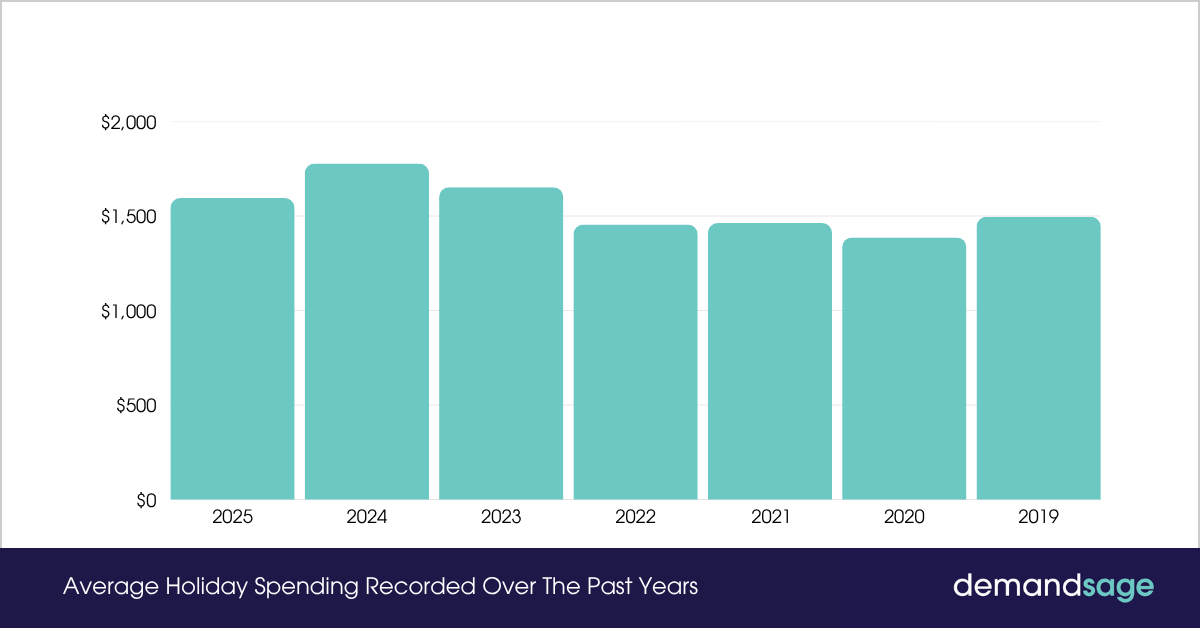
Here are further details about the average holiday spending recorded over the past years.
| Year | Average Holiday Spends | Change In Holiday Spending |
|---|---|---|
| 2025 | $1,595 | -10% YoY |
| 2024 | $1,778 | +8% YoY |
| 2023 | $1,652 | +14% YOY |
| 2022 | $1,455 | No change |
| 2021 | $1,463 | +5% YOY |
| 2020 | $1,387 | -7% YOY |
| 2019 | $1,496 | – |
Source: Deloitte.
Only 91% of consumers planned to shop during the 2025 holiday season.
Comparatively, 92% of the consumers shopped during the holiday season in 2024.
Here are further details about the percentage of consumers who are looking forward to shopping during the holiday season.
| Year | Percentage Of Consumers |
|---|---|
| 2025 | 91% |
| 2024 | 92% |
| 2023 | 95% |
| 2022 | 92% |
| 2021 | 88% |
| 2020 | 95% |
| 2019 | 97% |
Source: Deloitte
How Much Does The Average American Spend On Holiday Shopping?
The NRF’s consumer survey found average Christmas spending per person was $890.49 in 2025, down from the record $901.99 in 2024.
| Year | Expected per-person spending |
|---|---|
| 2025 | $890 |
| 2024 | $902 |
| 2023 | $875 |
| 2022 | $833 |
| 2021 | $879 |
| 2020 | $880 |
| 2019 | $886 |
| 2018 | $853 |
| 2017 | $826 |
| 2016 | $796 |
Holiday retail sales reached approximately $1.016 trillion, with NRF’s forecast of 3.7% to 4.2% growth translating to between $1.01 trillion and $1.02 trillion.
Average Christmas Spending Around The World
Many families worldwide look forward to spending 156% of their monthly income on Christmas.
According to the WorldRemit 2022 Cost of Christmas Study, households in Lebanon pay the highest amounts compared to their average monthly income(688%).
The report further states that the Dutch will be spending the least, spending just 19% of their household’s monthly income this holiday season.
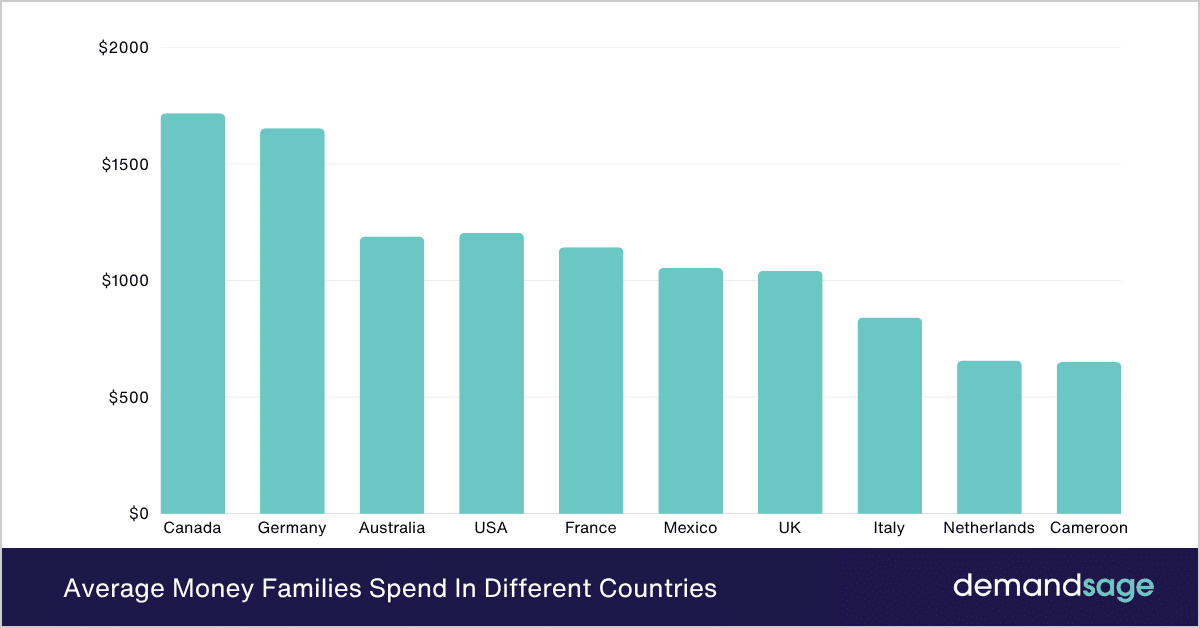
Here are further details about the average money families spend in different countries worldwide.
| Country | Christmastime Spend |
|---|---|
| Canada | $1,717 |
| Germany | $1,653 |
| Australia | $1,188 |
| USA | $1,205 |
| France | $1,142 |
| Mexico | $1,055 |
| UK | $1,042 |
| Italy | $841 |
| Netherlands | $657 |
| Cameroon | $650 |
Source: Worldremit
Overall retail spending worldwide was expected to reach $1.3 trillion during the 2023 holiday season.
This is a rise of 4.5% compared to the previous year’s holiday season.
Source: Online Dasher.
Other Findings About Christmas Spending
- Consumers in Germany spend more than 70% of their Christmas spending on gifts.
- Consumers in Spain spend most of their Christmas money on food, accounting for 73% of their spending.
- Columbia consumers will likely spend 73% of their average monthly household income during Christmas this year.
- Shoppers in Zimbabwe spend $208.70 during Christmas. This accounts for 266% of an average monthly household income.
US Christmas Gift Spending
Consumers celebrating Christmas and other winter holidays planned to spend $627.93 on gifts in 2025, down from $641 in 2024 and $620 in 2023.
In a survey conducted by Nerdwallet, it was revealed that consumers plan to spend $182 more on gifts in 2025 during the holiday season compared to the previous year.
- The total spending on Christmas gifts in the United States was estimated to be $242 billion in 2025.
To stretch budgets, 89% of consumers searched for deals, 77% traded down on brands and retailers, 73% reused or recycled items, and 49% made DIY gifts.
- In 2023, the spending on non-gift items like clothing for family, home furnishings, and decorations is forecast to jump 25% over 2022.
Source: CNN, Deloitte, Nerdwallet
Christmas Spending Demographics
Millennials planned to spend the most at $2,190, while Gen Z planned to cut budgets by 23%, which is a sharp reversal from 2024 when Gen Z spending surged 37%.
Here is how each generation’s planned holiday spending compared in the 2025 season:
| Generation | Average Planned Holiday Spending (2025) | Change vs. 2024 |
|---|---|---|
| Gen Z | $1,357 | –23% |
| Millennials | $2,190 | –1% |
| Gen X | $1,483 | +2% |
| Baby Boomers | $1,180 | +5% |
Deloitte’s data showed a similar but even steeper picture for younger shoppers. Gen Z spending was expected to decline 34% year over year, while millennial spending was projected to fall 13%. Only Gen X shoppers appeared positioned to increase their spending by roughly 3%.
Source: Deloitte
Gen Z’s approach to holiday shopping also differed qualitatively. 63% of Gen Z respondents chose resale and upcycled items, citing sustainability and health and wellness as priorities, according to PwC. Meanwhile, 82% planned to purchase less expensive alternatives, or “dupes.”
Source: PwC
Interesting Fact: 18% of Gen Alpha prefer to buy products made with sustainable materials. Moreover, their preferences for gifting are likely to be similar to or align with the preferences of Gen Z and Millennials.
- Men spend an average of 10% more than women on holiday purchases.
In general, men spend $94 more on the average holiday purchase compared to women.
Source: Zippia.
Holiday Gifts By Type
Clothing and accessories topped the list of gifts purchased during the 2025 holiday season.
The NRF’s post-Thanksgiving survey confirmed that 48% of shoppers had already bought clothing as of mid-December, followed by toys at 30% and gift cards at 27%.
| Category | Percentage |
|---|---|
| Clothing or accessories | 48% |
| Toys | 30% |
| Gift cards | 27% |
| Books and other media | 25% |
| Personal care or beauty items | 23% |
| Food/candy | 22% |
| Electronics | 21% |
| Home décor or furnishings | 20% |
| Jewelry | 16% |
| Sporting goods or leisure items | 14% |
Source: NRF
Apparel spending climbed 7.8% year over year during the holiday season, with an omnichannel approach driving the gains: online apparel sales rose 8.5% and in-store sales increased 7.0%.
Source: Mastercard
Electronics remained a strong performer. Adobe Analytics reported that the electronics category generated $59.8 billion in online sales, an 8.2% increase.
Source: Digital Commerce 360
Toys accounted for $8.8 billion online, up 7.8%. Visa’s data confirmed electronics as the hottest category, with sales rising 5.8% during the first seven weeks of the season.
Source: Visa
The preference for cash also showed a generational split. Chime’s 2025 Holiday Spending Report found that 65% of Gen Z and 61% of millennials and Gen Xers preferred cash over physical gifts, compared to 48% of baby boomers.
Source: QZ
Have you heard that almost $125 million and $103 million are lost to fraud in the payments made through credit cards and Gift cards.
Christmas Shopper’s Habits
Almost three-quarters of all holiday shoppers will consider affordability this year.
Online vs. In-Store Shopping
Online shopping continued to dominate the 2025 holiday season, though in-store shopping held its ground. A record $257.8 billion was reported in online spending from November 1 through December 31, up 6.8% year over year and setting a new record.
Source: Adobe
Mastercard SpendingPulse confirmed the gap between channels, with e-commerce sales growing 7.4% versus 2.9% for in-store. However, Black Friday still attracted 80.3 million in-store shoppers, and the Sunday after Thanksgiving drew a record 32.6 million, a 27% increase over 2024.
Source: Mastercard, NRF
The NRF found that 55% of consumers planned to make holiday purchases digitally, while 44% planned to shop at department stores. Among Super Saturday shoppers, 45% planned to use both channels, up from 44% the prior year.
Source: Alian Credit Union, NRF
Online continued to be the top holiday shopping destination, with 55% planning digital purchases. That was followed by grocery stores (46%), department stores (44%), and discount stores (42%).
Source: NRF
Mobile shopping reached a new milestone, with 56.4% of online transactions taking place on smartphones, up from 54.5% in 2024. Mobile share was highest on Christmas Day at 66.5%.
Source: Adobe
Mobile Shopping Trends
Mobile commerce reached a new milestone in 2025. The majority of online transactions (56.4%) took place on smartphones, up from 54.5% in 2024, according to Adobe. This is the first time mobile has captured more than half of seasonal online spending for a full holiday period.
Mobile shopping peaked on Christmas Day at 66.5% of online sales, followed by Thanksgiving Day at 61.6%.
Source: Adobe
Black Friday and Cyber Monday Spending
The 2025 Cyber Week delivered record-breaking results across every major shopping day.
| Shopping Day | U.S. Online Spending (2025) | Year-over-Year Growth |
|---|---|---|
| Cyber Monday | $14.25 billion | +7.1% |
| Black Friday | $11.8 billion | +9.1% |
| Weekend (Nov 29-30) | $11.8 billion | +8.7% |
| Thanksgiving Day | $6.4 billion | +5.3% |
| Cyber Week Total | $44.2 billion | +7.7% |
Source: Adobe
Cyber Monday remained the biggest online shopping day of the year. During peak hours (8 PM to 10 PM ET), consumers spent $16 million every minute.
Source: Adobe 2
Black Friday’s growth outpaced Cyber Monday for the second consecutive year, reflecting a consumer shift toward embracing early deals. On the global stage, Salesforce reported that Cyber Week generated $336.6 billion in sales worldwide, up 7% year over year.
Source: Salesforce
- 43% of the consumers in the United States of America spend on Groceries during the holiday season.
Some other top places where shoppers spend during the holiday season are clothing or accessories, local or small businesses, electronics stores, etc.
AI’s Impact on Holiday Shopping
Artificial intelligence emerged as a transformative force during the 2025 holiday season. AI influenced $262 billion in global online holiday sales, accounting for 20% of all online orders, up from 19% in 2024 and 17% in 2023.
Source: SESO
Traffic to retail sites from generative AI tools surged 693.4% year over year. While the user base remained modest in absolute terms, the growth rate signals a rapid shift in how consumers discover and evaluate products.
Source: Adobe
Visitors referred by AI search engines during the holiday season converted at a rate nine times higher than traffic from social media. Brands that deployed AI-powered shopping agents saw 59% higher sales growth (6.2%) compared to those that did not (3.9%).
Source: SESO
Roughly 42% of consumers reported using AI tools to find deals during the 2025 holiday season, according to Mastercard analysis. Among Gen Z shoppers specifically, 51% planned.
Source: Markets Financial Content
Buy Now, Pay Later
BNPL usage hit an all-time high during the 2025 holiday season, contributing $20 billion in online spend, up 9.8% year over year, according to Adobe. BNPL accounted for nearly 8% of total online sales.
Source: Adobe
Cyber Monday alone generated $1.03 billion in BNPL sales, a 4.2% increase, with 79.4% of those transactions happening on mobile devices. The surge in BNPL reflects both consumer interest in flexible payments and, for some shoppers, financial strain from persistent inflation and high credit card APRs.
Source: Fortune
35% of the consumers said that they want to stay at home and save money this Christmas.
On the other hand, 56% plan to spend the same amount or more than they usually do on gifts.
Source: Kennedy’s Confection.
Did you know? Consumers are predicted to spend $13.7 billion in 2023 during the Cyber Monday sales.
- AI technology will play a huge role in online shopping during the holiday season.
- 93% of shoppers will buy at least some gifts online this year.
41% of the shoppers look forward to purchasing most of their gifts online. At the same time, 6% of the shoppers consider buying all their gifts online.
- 81% of the in-store shoppers research the products online before purchasing them.
87% of product searches start online, and less than a quarter of shoppers visit the stores for product research.
Source: Zippia.
Conclusion: Record holiday spending exceeded $1 trillion despite economic uncertainty.
The 2025 holiday season was defined by a tension between economic anxiety and the enduring pull of holiday tradition. While total U.S. retail sales surpassed $1 trillion for the first time and online spending hit a record $257.8 billion, consumers were more budget-conscious than ever, with 89% actively hunting for deals.
The generational divide was stark, with Gen Z cutting back by up to 23–34% while Gen X and baby boomers maintained or increased their spending.
Perhaps the biggest shift was the explosion of AI-powered shopping, with a 693% increase in AI-driven retail traffic and AI influencing $262 billion in global sales.
Come back soon by the end of 2026 for more updates on the Christmas spending, as I will be updating this blog right after.
