


As per the latest data, over 56% of marketers already use generative AI in their SEO workflows, outpacing even its use in customer service and video creation.
AI SEO saw a 45% boost in organic traffic and a 38% rise in eCommerce conversions last year (2025).
Surprisingly, 83% of large organizations report measurable SEO gains from AI integration, while only 6.22% saw no improvement at all.
With the AI SEO tools market projected to soar from $1.2 billion in 2024 to $4.5 billion by 2033, the shift is accelerating. Let us find out how AI SEO is going to shape 2026!
Top AI SEO Statistics 2026: Key Data
- 56% of marketers are already using generative AI for SEO.
- 69% of SEO specialists will be impacted by generative AI, reshaping team structures and job scopes.
- The AI SEO tools market will grow from $1.2 billion in 2024 to $4.5 billion by 2033, with a CAGR of 15.2%.
- AI-driven SEO can boost organic traffic by 45% and conversion rates by 38% for e-commerce websites.
- 1 in 3 marketers use AI to generate short-form videos, showing AI’s growing role in Video SEO optimization.
- 83% of SEO professionals at companies with 200+ employees reported improved SEO performance after adopting AI.
- 86% of enterprise SEO professionals have already integrated AI into their strategy, and 82% plan to invest more in it.
Sources: Capgemini, Verified Marketer Reports, Semrush, SEO Clarity
AI SEO Adoption Statistics
- Currently, 31% of marketers use generative AI extensively for search engine optimization. At the same time, another 25% use it partially.
- This means that over 56% of organizations are actively integrating AI into their SEO workflows, surpassing even campaign creation, image/video generation, and customer service in terms of AI adoption
- 29% of organizations currently use search engine AI optimization across multiple initiatives
- 45% of these organizations plan to use generative AI extensively for search engine optimization in the next 2-3 years (up from 31% currently).
- 72% of marketing roles will be impacted by generative AI, including 69% of SEO Specialists.
- What it means for SEO numbers is that nearly 7 in 10 SEO professionals are expected to see moderate to high disruption from AI.
From content creation to keyword analysis, generative AI is automating core SEO tasks like:
- Writing blog posts, meta descriptions, and FAQs.
- Optimizing content for search intent.
- Conducting competitive SERP analysis faster than ever.
Enterprise SEO Statistics
AI tools adoption in SEO is high, is 58% in B2B and 60% in B2C.

Over half of businesses in both the B2B and B2C industries are using AI tools for the following reasons:
- Generate long-form SEO content at scale.
- Identify high-ranking keywords using AI-enhanced data.
- Personalize web content based on user behavior and search history.
- Back in 2023, 86.07% of enterprise SEO professionals had already integrated AI technologies into their SEO strategy. Here is what the rest of them said:

| Statistic | Percentage |
|---|---|
| Enterprise SEO professionals who integrated AI into strategy | 86.07% |
| Enterprise SEOs planning to invest more in AI for SEO | 82% |
| Enterprise SEOs who believe generative AI cannot enhance SEO | 4.09% |
| SEOs with no concerns about using generative AI | 2.36% |
Source: SEO Clarity, Capgemini
AI SEO Tools Market
- AI visibility tools and the AI SEO market are experiencing explosive growth, projected to skyrocket from USD 1.2 billion in 2024 to an impressive USD 4.5 billion by 2033.
- This remarkable expansion represents a Compound Annual Growth Rate (CAGR) of 15.2% from 2026, showcasing the rapid adoption of AI-powered SEO solutions.
- The AI SEO tools market is forecast to more than triple its value in less than a decade.
Source: Verified Marketer Reports
AI will continue to reshape SEO as we move forward in 2026. With traditional SEO now mixing with AI SEO (or AEO as we speak), marketers need to go beyond just the old tactics. This means businesses now need to track performance and optimize where their audience is asking questions – AI platforms.
Tools like Semrush now offer an integrated AI SEO toolkit, and users can explore its full capabilities through the Semrush ONE 14 days trial to test AI search and GEO capabilities in one plan. This hands-on experience helps businesses understand how AI-driven SEO tools improve performance and rankings.
AI Search Engine Optimization Statistics Performance
- AI-driven SEO campaigns can lead to a 45% increase in organic traffic and a 38% increase in conversion rates for e-commerce sites.
- 83% of SEOs from organizations with over 200 employees reported an improvement in their SEO performance following the integration of artificial intelligence.
- Whereas, only 6.22% of the total respondents indicated that they did not observe any enhancements resulting from the implementation of AI.
- In research, the average confidence level among participants in utilizing AI for SEO strategies and tactics stands at 7.14 out of 10.
- Additionally, 66.85 percent of SEO Leads and Managers believe that the most significant benefit of generative AI is its capacity to automate repetitive SEO tasks.
- As 47% of B2B marketers noticed increased web traffic from consumers using AI for search, here are the additional findings from this survey:

| Marketer Segment | Noticed Increased Traffic | Noticed Decreased Traffic |
|---|---|---|
| B2B Marketers | 47% | 5% |
| B2C Marketers | 45% | 3% |
This is the primary reason why 19% of marketers plan to build an SEO strategy for generative AI in search.
These numbers make one thing clear: the brands that show up in ChatGPT, Perplexity, and Google AI Overviews in 2026 aren’t the ones chasing keywords — they’re the ones publishing proprietary data, schema-marked pages, and content designed to be cited across search engines and LLMs. If you’re a B2B SaaS looking to build that moat before the category crowds, DemandSage Agency helps companies at $1M–$15M ARR win across all three surfaces — SEO, AEO, and GEO.
Source: Hubspot, SEO Clarity, Semrush
AI Impact On Search Rankings
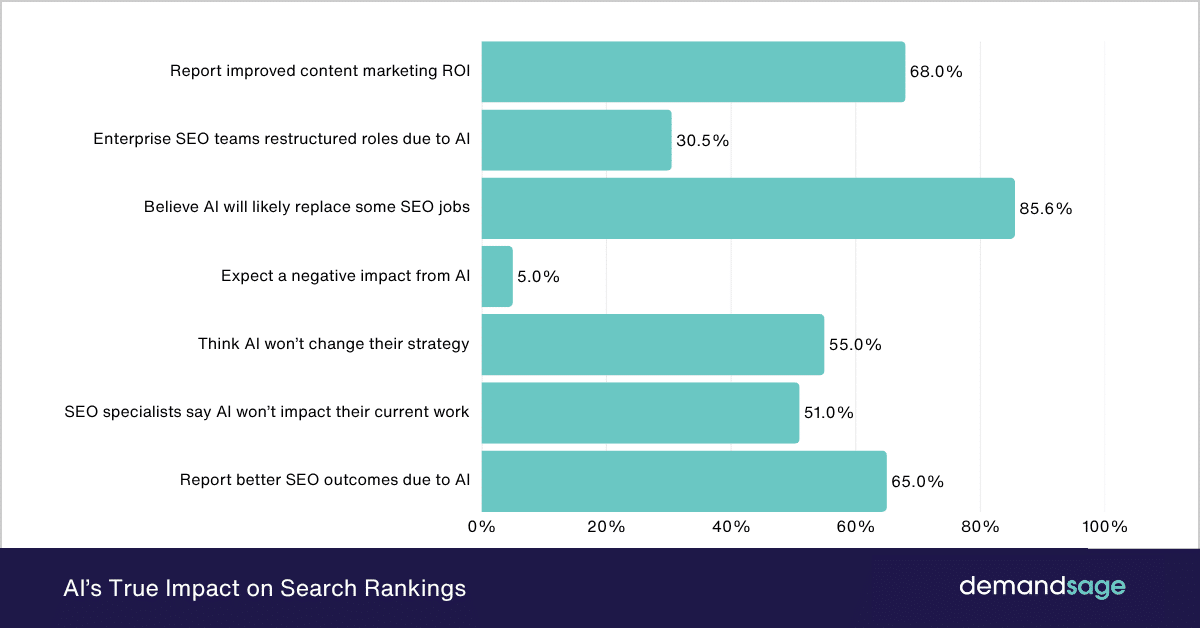
- Businesses are seeing tangible returns, and an impressive 68% report an increase in content marketing ROI directly attributable to AI.
- 30.49% of enterprise SEO teams have undergone a restructuring of roles and responsibilities as a result of AI implementation.
- Additionally, 85.56% of respondents believe it is moderately to highly likely (scores of 5 out of 10 or above) that generative AI will assume SEO jobs in the future.
- While 44% of marketers foresee a positive impact of AI on SEO, a small but notable 5% anticipate the opposite effect.
- Perhaps surprisingly, the majority of marketers, a full 55%, believe AI won’t dramatically alter their current SEO strategy.
- 51% of SEO specialists believe AI won’t impact their current strategies, suggesting many are underestimating AI’s disruptive potential.
- 65% of businesses have noticed better SEO results with AI implementation, demonstrating measurable performance improvements.
- The proof is in the results, where 65% of companies are achieving better SEO outcomes, thanks to the strategic integration of AI.
Source: Semrush, WP Beginner, SEO Profy, SEO Clarity
AI SEO Statistics In Marketing Performance
- ChatGPT was the most trusted LLM among enterprise SEOs at 49.7%
- 64.48% of SEOs prioritize accuracy and reliability of insights when choosing AI solutions.
- 65.14% cite content quality and authenticity as their biggest concern about generative AI.
- 58.64% are concerned about data security and privacy when using generative AI.
Source: SEO Clarity
AI SEO & Content Marketing Statistics
- 67% of people see improvement in content quality when using AI tools for content creation
- 84% of marketers believe AI’s most effective use case is aligning web content with Google search intent
- 58% utilize AI tools for topic research, and more than half (52%) depend on AI for rewriting
- In comparison, 50% rely on it for content writing, highlighting AI’s significant role in both ideation and execution

| Use Case | Percentage of Respondents |
|---|---|
| Researching content and topic ideas | 58% |
| Rewriting and paraphrasing text | 52% |
| Writing content from scratch | 50% |
| Creating a content marketing strategy | 47% |
| Expanding text with more ideas | 40% |
| Creating content outlines | 39% |
| Optimizing copy for target keywords | 33% |
| Audience research | 30% |
| Improving readability | 29% |
| Creating content briefs | 27% |
| Improving tone of voice | 26% |
| Writing meta tags | 23% |
| Optimizing for a specific audience | 23% |
| Creating visual content (images, video) | 23% |
| Avoiding plagiarism | 20% |
| Grouping and clustering keywords | 16% |
| Content localization and translation | 9% |
- 67% portion of small businesses are already leveraging AI for their content and SEO strategies.
- 40% of respondents spend less than 5 hours per week on content production when utilizing AI.

Let us check the time spent on content production using AI tools (per week):
| Weekly Time Spent (hrs) | Percentage of Respondents |
|---|---|
| Less than 5 hours | 40% |
| 5–10 hours | 36% |
| 11–20 hours | 16% |
| 21–40 hours | 6% |
| More than 40 hours | 2% |
- 71% of respondents create AI-generated content in under 3 hours per week, reflecting rapid turnaround times enabled by AI tools.

Here is a breakdown of the weekly active content creation hours using AI:
| Active Content Creation Time | Percentage of Respondents |
|---|---|
| Less than 1 hour | 36% |
| 2–3 hours | 35% |
| 4–5 hours | 14% |
| 6–8 hours | 8% |
| More than 8 hours | 4% |
| At least a few days | 2% |
| Over a week | 1% |
- 51% of users create long-form content using AI at zero cost, while 26% spend between $100 to $300, showcasing significant budget variability.

Let’s look at the monthly content production budget with AI:
| Cost per Long-form Content Piece | % of Respondents |
|---|---|
| $0 – No additional cost | 51% |
| $100–$300 | 26% |
| $300–$500 | 9% |
| $500–$700 | 5% |
| $700–$1,200 | 4% |
| $1,200–$1,500 | 2% |
| $1,500–$2,000 | 1% |
| Over $2,000 | 1% |
Source: Semrush
Video SEO & AI-Driven Engagement
- Nearly 1 in 3 marketers rely on AI to generate short-form videos.
- 31% of marketers use AI tools to create short videos, and 18% for long videos, making video one of the top 10 formats produced using AI, positioning it as a key area for Video SEO efforts.
- Nearly 1 in 4 marketers use AI tools for video generation and optimization, boosting discoverability via captions, keywords, and schema markup in Video SEO.
| Sr. No. | Content Type | Percentage of Respondents |
|---|---|---|
| 1 | Blog posts | 58% |
| 2 | Social media posts | 55% |
| 3 | Short articles | 49% |
| 4 | Short videos | 31% |
| 5 | Emails/Newsletters | 29% |
| 6 | Images | 28% |
| 7 | Product descriptions | 25% |
| 8 | Landing pages | 20% |
| 9 | Ads | 18% |
| 10 | Long videos | 18% |
| 11 | Creative writing (stories) | 16% |
| 12 | Ebooks | 14% |
| 13 | Case studies | 9% |
| 14 | White papers | 7% |
| 15 | Audio | 7% |
| 16 | Quizzes | 7% |
| 17 | Other | 1% |
Source: Semrush
SEO AI & Keyword Optimization Statistics
- 21% of organizations plan to implement voice search optimization in Q2 of 2025.
- 40% of organizations frequently use voice search optimization platforms. (Amazon’s Alexa, Google Assistant, Apple’s Siri)
- 45% of organizations will use voice search optimization frequently in the next 2-3 years.
- A staggering 99% of users still employ other tools for content and SEO in addition to AI.
Source: Semrush, Capgemini
AI SEO Tools Market Trends
- 86% of marketers believe AI-generated influencers will likely replace traditional influencers.
- A surprising 35% of businesses are unaware that AI can be utilized for content and SEO, revealing a significant knowledge gap.
- Among those aware but not adopting AI, 37% hold back due to a lack of proper training or a lack of understanding.
Source: Semrush, Hubspot
AI SEO Trends & Search Shifts in 2026
- By the end of 2026, traditional search engine volume is projected to drop by 25% as users shift toward AI chatbots and virtual assistants (like ChatGPT, Claude, and Gemini) for direct answers.
- Only 17% of the sources cited in Google’s AI Overviews (AIO) actually rank in the top 10 organic results for the same query. This means traditional SEO “Page 1” status no longer guarantees visibility in AI-generated answers; AI prioritizes semantic depth over traditional backlink authority.
- When a brand is cited within an AI Overview, it receives a 35% higher organic click-through rate (CTR) compared to instances where an AI Overview is present but the brand is not mentioned.
- As of early 2026, approximately 60% of all searches now end without a single click to a third-party website (Zero-Click). This is driven by AI Overviews providing the full answer directly on the search results page, forcing marketers to optimize for On-SERP brand awareness rather than just site traffic.
Source: Gartner, BrightEdge, Seer Interactive, Digital Loft
