
The rise of artificial intelligence is changing the way people work. According to a Goldman Sachs report, 300 million jobs will be affected by 2030.
At the same time, WEF predicts that AI will create 170 million job opportunities by 2030.
In this research, we’ll explore the latest statistics on AI job replacement Statistics, how it is both replacing and creating jobs, and what that balance means for the future of work.
Key AI Job Replacement Statistics 2026
- AI could potentially affect up to 300 million jobs globally.
- Approximately 85 million jobs are expected to be replaced worldwide.
- AI is likely to affect 40% of all jobs.
- Oxford predicts that 20 million manufacturing jobs will be lost by 2030.
- By 2050, 60-80% of jobs are expected to be automated or transformed.
- The rise of AI may create 170 million jobs, netting an additional 78 million.
- Women face nearly three times the risk of automation compared to men.
How Many Jobs Will AI Replace?
- The World Economic Forum (WEF) predicted that 92 million jobs would be replaced by 2030.
- According to the 2024 total global Labor Force of 3.7 billion, AI is estimated to replace 8.1% of the total workforce.
- AI is expected to affect nearly 40% of all jobs worldwide, according to the International Monetary Fund.
- Based on an analysis of 21 OECD countries, 27% of jobs are at high risk of automation when considering all automation technologies, including AI.
- By 2026, research from MIT and Boston University indicates that AI-driven robotics will have replaced approximately 2 million manufacturing workers globally.
- According to their Future of Jobs Report 2025, 40% of employers are aiming to reduce their staff by 40%.
- In the first four months of 2026, AI has been cited for 49,135 job cuts in the U.S., making it the third-leading cause of layoff plans this year. In March 2026, AI became the #1 most-cited reason for workforce reductions for the first time ever, accounting for 25% of total cuts that month.
- Companies in the US using ChatGPT report that 49% of them have replaced workers as a result.
Source: National University, WEF, Future of Jobs Report 2025, IMF. OECD, Nexford, Final Round AI
How Many Jobs Will AI Replace By 2030?
- Oxford Economics predicts that as many as 20 million manufacturing jobs could be replaced globally by 2030.
- By 2030, 14% of employees globally will be forced to change their careers due to the impact of AI.
- The US is projected to have 30% of its jobs replaced by AI by 2030.
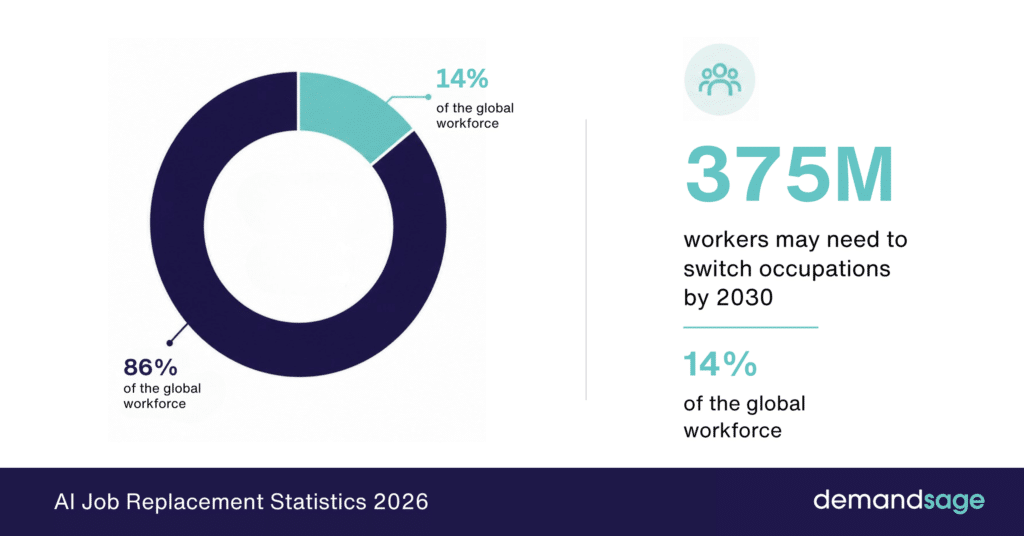
- McKinsey estimates that up to 375 million workers globally (roughly 14% of the global workforce) may need to switch occupational categories and learn new skills by 2030 because of automation and AI.
Source: National University, Oxford Economics, IJSREM
How Many Jobs Will AI Replace By 2050?
- Around 60% (possibly up to 80%) of jobs are expected to be automated or significantly transformed by AI by 2050.
- By doing so, it will influence 26% of global GDP ($15.7 trillion).
- Sectors such as healthcare, transportation, finance, and retail are particularly susceptible to the impact of AI.
Source: LinkedIn, Forbes
What Jobs Will AI Replace by Industry
The following table provides an overview of industries and job roles most affected by AI automation, along with their projected risk or percentage of automation.
| Sr. No. | Job Role | Industry | Automation % / Risk |
|---|---|---|---|
| 1 | Customer Service Representatives | Customer Service | 80% (2025) |
| 2 | Data Entry and Administrative Support | Administration | 95% (Risk of Automation) |
| 3 | Retail Cashiers and Checkout Workers | Retail | 65% (2025) |
| 4 | Transportation and Logistics | Logistics/Trucking | N/A (1.5M jobs lost by 2030) |
| 5 | Manufacturing Workers | Manufacturing | 50%+ (By 2030, more than half) |
| 6 | Financial Services | Banking & Finance | 70% (2025); 54% (High risk) |
| 7 | Legal Support Staff | Legal | 80% Paralegals by 2026 & 65% Researchers by 2027 |
| 8 | Healthcare Support Roles | Healthcare | 99% Medical transcription & 40% Medical coding by 2025 |
| 9 | Content Creation and Media | Media & Marketing | 50% Writers & 30% Reporters by 2030 |
| 10 | Human Resources Support | HR | 85% Recruitment screening & 90% Benefits admin between 2025 & 2027 |
Customer Service Representatives
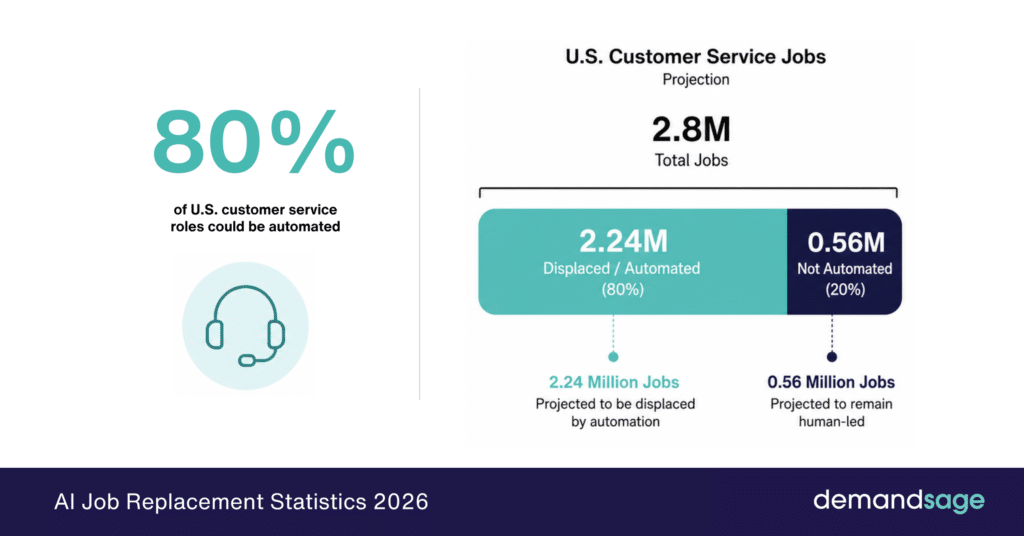
- 80% of customer service roles are projected to be automated, resulting in the displacement of 2.24 million out of 2.8 million U.S. jobs.
- The adoption of AI chatbots is expected to save businesses $8 billion annually in operational costs.
Source: SSRN
Data Entry and Administrative Support
- AI automation could eliminate 7.5 million data entry and administrative jobs by 2027.
- Manual data entry clerks face a 95% risk of automation, as AI systems can process over 1,000 documents per hour with an error rate of less than 0.1%, compared to 2-5% for humans.
Source: SSRN
Retail Cashiers and Checkout Workers
- In the retail sector, 65% of cashier and checkout jobs are expected to face automation by 2025.
- Walmart’s self-checkout expansion could replace 8,000 positions, while Sam’s Club’s AI verification rollout is projected to eliminate 12,000 cashier jobs across its stores.
Source: SSRN
Transportation and Logistics
- The U.S. trucking industry could lose 1.5 million professional driving jobs by 2030 as autonomous vehicles advance.
- At the same time, automation is expected to reduce operating costs per mile by 38% and cut road safety incidents by 50%.
Source: SSRN
Manufacturing Workers
- Manufacturing is forecasted to lose 2 million jobs due to the integration of robotics and AI.
- By 2030, more than half of assembly line, packaging, and quality control positions may be automated, with assembly line employment projected to decline from 2.1 million in 2024 to just 1.0 million by 2030.
- Since 2000, automation has already led to the loss of 1.7 million manufacturing jobs.
Source: National University, SSRN
Financial Services
- In banking and finance, 70% of basic operations are projected to be automated.
- Meanwhile, loan processing automation is expected to increase from 35% today to 60% in 2025 and 80% by 2030.
- Approximately 200,000 jobs are expected to be cut from Wall Street banks over the next 3-5 years.
- As much as 54% of banking jobs have high potential for AI automation.
- Major banks are expected to see an average workforce reduction of 3%.
- At least 80% of bank executives expect a 5% productivity boost from AI.
Source: Tradersmagzine, SSRN, Bloomberg, Bobsguide
Legal Support Staff
- AI tools are expected to replace a significant portion of legal support roles, with paralegals facing an 80% risk of automation by 2026 and legal researchers facing a 65% risk of automation by 2027.
Source: SSRN
Healthcare Support Roles
- In healthcare, medical transcription is already 99% automated, and 40% of medical coding is projected to be automated in 2025.
- Radiology technicians performing routine scans are also at risk of being replaced by AI by 2030.
- The employment of medical transcriptionists in the US is projected to decline by 4.7% from 2023 to 2033.
Source: National University, SSRN
Also read: How AI in healthcare is affecting work globally.
Content Creation and Media
- The media industry is undergoing rapid transformation, with jobs for digital marketing content writers projected to decline by 50% by 2030, and reporter and writer positions expected to shrink by 30% over the same period.
- Surveys show that 81.6% of digital marketers already fear being replaced by AI.
Source: SSRN
Human Resources Support
- In human resources, 85% of recruitment screening and 90% of benefits administration functions are expected to be automated between 2025 and 2027, potentially replacing large portions of HR support staff.
Source: SSRN
AI’s Impact On the Current Job Market
- Since Challenger, Gray & Christmas started tracking AI as a layoff reason in 2023, the technology has been cited in over 71,800 total job cut announcements in the U.S. The full-year 2025 total alone was 54,836, a sharp jump from 5,824 in 2023.
- Entry-level job postings have dropped 15% year over year.
- In 2026, 54% of tracked tech layoff events (173 out of 322) explicitly cite AI, automation, or machine learning as a contributing factor, impacting roughly 170,945 workers.
- Employers referencing “AI” in job descriptions have surged by 400% over the past two years.
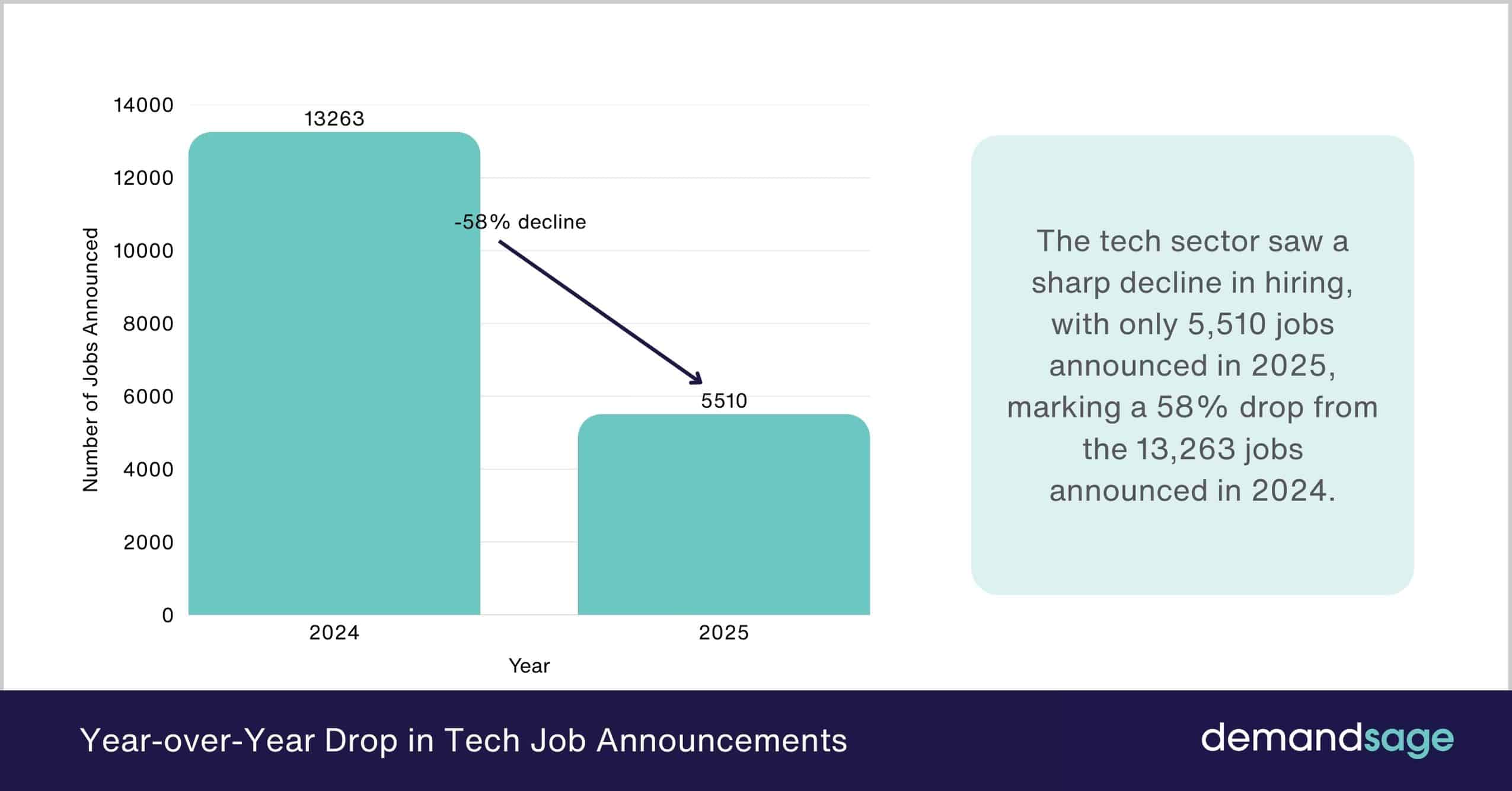
- Hiring in the tech sector has declined drastically, with 5,510 jobs announced in 2025, representing a 58% decrease from the 13,263 jobs announced in 2024.
Source: Challenger Gray, Yahoo, Final Round AI
- When it comes to job cuts, the tech sector led private-sector job cuts with 154,445 in 2025, a 15% increase from 133,988 in 2024. There has been a 36% increase since 2024, when it was 65,863 for the same period.
- By the end of 2025, 54,836 job cuts were explicitly attributed to Artificial Intelligence, up from just 5,824 in 2023 when tracking first began.
Source: Fortune, Challenger Gray
AI Job Replacement Demographics
- There has been a 13% decline in employment for workers aged 22-25 in AI-exposed jobs since late 2022.
- North America is expected to lead the adoption of automation at 70% in 2025.
- A Gallup survey from Q1 2026 found that 62% of laid-off workers were non-users of AI, while workers who use AI regularly were less likely to be laid off. Despite this, only 1% of laid-off workers cited AI or automation as the primary reason for their job cuts.
Source: SSRN, Stanford, Fox Business
AI Job Replacement By Gender
- In high-income countries, jobs most vulnerable to AI-driven task automation make up 9.6% of female employment, which is almost three times the proportion for male jobs (3.2%).

- Globally, 4.7% of female jobs fall into the highest-risk category, compared with 2.4% for males.
Source: UN News
- In the U.S., 79% of employed women work in jobs that are at high risk of automation, compared to 58% of men.
Source: National University
AI Job Replacement By Type
The table below highlights broader workforce trends, showing how AI affects white-collar, blue-collar & trade professions.
| Sr. No. | Finding | Industry | % / Impact |
|---|---|---|---|
| 1 | AI may cut entry-level jobs | White-collar (Entry) | 10-20% (1-5 yrs) |
| 2 | Concern about automation | White-collar 67% | Blue-collar: Transport 60%, Retail 59% |
| 3 | Graduates choosing trade work | University Graduates | 40% (by 2025) |
| 4 | Trade work is less vulnerable | Professionals | 52% agree |
| 5 | AI reduces the low-skill employment share | Lower-skilled workers | -0.001% per AI unit |
| 6 | Jobs at risk in OECD | OECD (21 countries) | 9% of jobs |
- AI poses a risk of eliminating 10-20% of entry-level white-collar jobs within the next one to five years.
Source: Axios
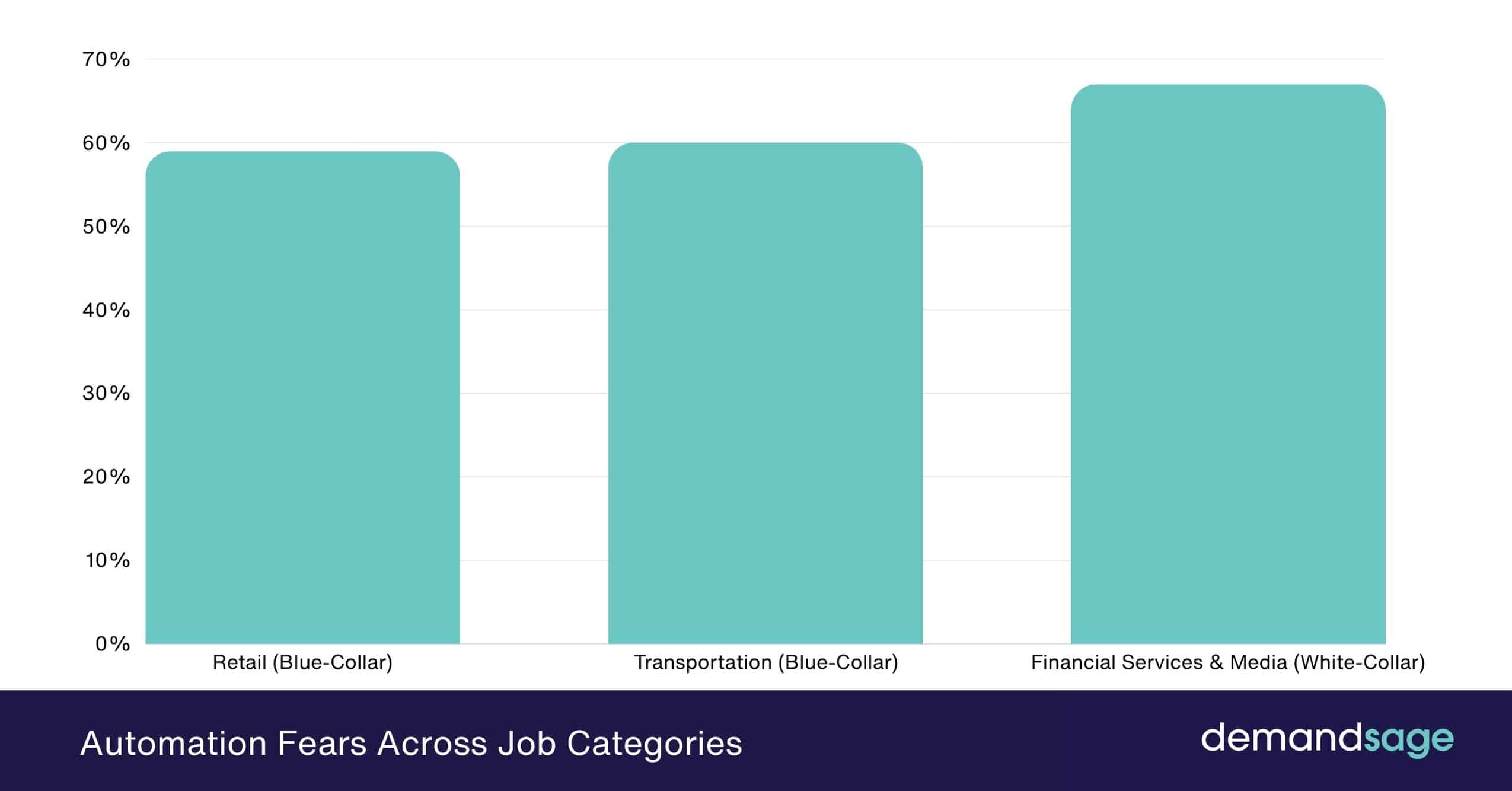
- White-collar workers in industries such as financial services and media now express higher levels of concern about automation (67%) than their counterparts in blue-collar sectors, including transportation (60%) and retail (59%).
Source: Oliver Wyman
- In 2025, 40% of young university graduates are choosing careers such as plumbing, construction, and electrical work, which cannot be automated.
Source: YouTube
- Trade work is viewed as less vulnerable to AI than white-collar roles by 52% of professionals.
Source: Skywork
- Each one-unit increase in AI leads to a 0.001% decline in the employment share of lower-skilled workers, resulting from the replacement effect.
Source: PMC
- Approximately 9% of jobs across 21 OECD countries are expected to be automated, with lower-skilled workers likely to bear the brunt of potential job losses.
Source: PMC 2
Jobs That AI Can’t Replace
AI is least likely to affect jobs that involve physical tasks and human emotions.
- Jobs least likely to be affected by AI, including teaching, caring, coaching, or physical tasks, account for 23% of workers.
Source: PEW
- Skilled trades remain in high demand, with 94% of construction companies reporting difficulty in sourcing workers, underscoring that AI cannot replace them.
- Only 0.4% of total wages in the U.S. can be economically replaced by AI vision-based tasks.
Source: MIT

Here is a tabular view of the top 10 AI-proof jobs :
| Sr. No. | Occupation | Annual Wage |
|---|---|---|
| 1 | Chief executives | $262,930 |
| 2 | Physician assistants | $136,900 |
| 3 | Nurse practitioners | $132,000 |
| 4 | Physical therapists | $102,400 |
| 5 | Nursing instructors and teachers, postsecondary | $87,090 |
| 6 | Marriage and family therapists | $72,720 |
| 7 | Athletes, coaches, umpires, and related workers | $68,880 |
| 8 | Substance abuse, behavioral disorder, and mental health counselors | $65,100 |
| 9 | Dancers and choreographers | $62,740 |
| 10 | Coaches and scouts | $58,910 |
Source: US Bureau
You might like to read: AI statistics 2025
AI Job Creation: The Other Side Of The Coin
- In Q1 2025, 35,445 AI-related positions existed, representing a 25.2% increase from Q1 2024.
- AI/Machine Learning Engineer roles are experiencing 13.1% quarterly growth and 41.8% yearly growth.
- Data Scientist roles grew 4.2% quarter-over-quarter and 10% year-over-year.
- Median annual salary for AI roles in Q1 2025 rose to $156,998.
Source: Veritone
- AI-related positions such as prompt engineers and AI ethics officers are expected to grow, with an estimated 350,000 new roles projected.
Source: SSRN 2
- AI is creating an entirely new class of jobs that were non-existent five years back.
- The fastest-growing of them, an AI engineer, has seen a 143.2% year-over-year increase in demand.

Here are the top 10 fastest-growing AI job titles:
| Rank | Job Title | Growth Rate (%) |
|---|---|---|
| 1 | AI Engineer | 143.20% |
| 2 | AI Content Creator | 134.50% |
| 3 | AI Solutions Architect | 109.30% |
| 4 | Prompt Engineer | 95.50% |
| 5 | AI Systems Designer | 92.60% |
| 6 | AI Product Manager | 89.70% |
| 7 | AI Coach | 57.70% |
| 8 | AI Compliance Manager | 46.00% |
| 9 | Machine Learning Engineer | 35.30% |
| 10 | AI Strategist | 34.80% |
Source: Autodesk
- Workers with AI skills are now earning wages that are, on average, 25% higher than those without such expertise.
- Jobs exposed to AI are undergoing skill changes at a rate 66% faster than before, a significant increase from the 25% rate observed in 2024.
Source: PWC 2
- The rise of AI could lead to the elimination of as many as 92 million jobs by 2025, while simultaneously creating around 170 million new ones, resulting in a net gain of 78 million jobs.
Source: Coursera
- AI agents and robots could generate close to $2.9 trillion in annual economic value for the U.S. alone by 2030. However, up to 30% of work hours could be automated through AI agents, robots, and drones, pushing workers into supervisory, validation, and decision-making roles instead.
Source: McKinsey
Did you know that the global market size of AI recruitment is $661.56 million?
Know more such facts in our detailed report on AI Recruitment Statistics
Other AI Job Replacement Statistics
- Productivity growth nearly quadrupled in industries most exposed to AI, rising from 7% to 27% between 2018 and 2024.

- Industries least exposed to AI saw a decline in productivity from 10% to 9%.
Source: PWC
- AI could contribute up to $19.9 trillion to the global economy by 2030.
Source: Strategic Market Research
- Banks could collectively see pretax profits rise by 12% to 17% by 2027, resulting in a total of $180 billion in profit.
Source: Bloomberg
- Exposure to GenAI reaches 34% of jobs in high-income countries, compared with just 11% in low-income countries.
Source: UN News
AI Jobs & Replacement in 2026 (Future Outlook)
- Professionals with specialized AI skills now command salaries up to 56% higher than peers in identical roles without those skills.
- By the end of 2026, 20% of organizations will use AI to flatten their hierarchy, which is projected to eliminate over 50% of current middle management positions.
- Approximately 40% of enterprise applications will include autonomous “AI Agents” by late 2026, moving from simple assistance to executing entire business workflows independently. This marks the shift from AI that “talks” to AI that “does.”
- Currently, 37% of business leaders report they expect to replace human workers with AI by the close of 2026 as they move from experimental pilots to full-scale automation.
Source: PWC, Gartner, Index.de, GSD Council
