
Samsung is a large technology company in the world, earning revenues from areas including smartphones, televisions, semiconductors, and heavy industry.
With a market capitalization of $772.29 billion in 2026 and over 1 billion smartphone users, Samsung has been very successful in the technology industry.
With these data-backed Samsung statistics, we’ll examine some key numbers, including revenue, employee count, global presence, and its industrial reach.
Top Samsung Statistics of 2026
- Samsung’s current net worth is $772.29 billion.
- Around 1.033 billion users use Samsung phones.
- Samsung holds a 30.7% market share of the total Android market.
- Samsung globally holds a 19.9% market share for smartphones.
- By the middle of 2025, Samsung registered 276,869 patents worldwide.
- 37 million units of Galaxy S25 were sold in 2024.
- Samsung leads the semiconductor sector with a 10.6% global market share.
- The consolidated 2025 revenue of Samsung was ₩333.6 trillion ($230.13 billion).
- Samsung employs 262,647 people globally, with 125,297 of them based in Korea.
- Samsung spent a total of ₩35 trillion on research and development (R&D) in 2024.
- Samsung shipped a total of 60.5 million smartphones in Q1 2025 and 57.5 million in Q2.
Key Facts About Samsung
Here’s a table with some key facts about Samsung:
| Founded In | 1938 |
| Founder | Lee Byung-Chull |
| Samsung Net Worth in 2026 | $772.29 billion |
| CEO | Jun Young-hyun |
| Headquarters | Suwon-si, South Korea |
| Revenue | $230.13 billion (2025) |
| Type of Company | Public multinational corporation; listed on Korea Exchange (KRX: 005930.KS, 005935.KQ) |
| Sectors | Consumer Electronics, IT & Mobile Communications (DX), Semiconductors (DS), Display Panels (SDC), Automotive Tech & Audio (Harman), Shipbuilding |
Samsung Users 2026: How Many People Have Samsung Phones?
- Out of the total 7.21 billion smartphone users worldwide, around 1.033 billion people across the globe currently use Samsung smartphones. (Source: Finances Online)
- Samsung shipped 58 million smartphones worldwide in the second quarter of 2025. (Source: IDC)
- Out of the 3.6 billion Android users, Samsung holds a 30.7% market share. (Source: AppBrain)
- The company has big plans, aiming to roll out its Galaxy AI features to 400 million devices by the end of 2025. (Source: Samsung News)

Here’s a table showing the total smartphones shipped by the top smartphone companies:
| Sr. No. | Company | Q2 25 Shipments | Q2 24 Shipments | Year-Over-Year Change |
|---|---|---|---|---|
| 1 | Samsung | 58 million | 53.8 million | 7.9% |
| 2 | Apple | 46.4 million | 45.7 million | 1.5% |
| 3 | Xiaomi | 42.5 million | 42.3 million | 0.6% |
| 4 | vivo | 27.1 million | 25.9 million | 4.8% |
| 5 | Transsion | 25.1 million | 25.5 million | -1.7% |
| 6 | Others | 96.1 million | 99.1 million | -3.1% |
| 7 | Total | 295.2 million | 292.2 million | 1.00% |
Source: IDC
Samsung Smartphone Market Share
- Samsung has secured a 19.9% share of the global smartphone market (data recorded in mid 2025).
Source: Samsung H1
- Samsung’s global smartphone market share has declined from 30.92% in 2015 to just 18.9% in 2025.
The sharpest drop occurred in 2023 when the market share dropped by 3.23%.
Samsung’s market share has seen an overall decline since 2020, primarily due to global disruption caused by the COVID-19 pandemic.

The table below shows Samsung’s share changes in the global smartphone market:
| Sr. No. | Date | Samsung’s Share |
|---|---|---|
| 1 | 2015-12 | 30.92% |
| 2 | 2016-12 | 33.63% |
| 3 | 2017-12 | 31.65% |
| 4 | 2018-12 | 30.91% |
| 5 | 2019-12 | 31.37% |
| 6 | 2020-12 | 29.14% |
| 7 | 2021-12 | 26.93% |
| 8 | 2022-12 | 27.38% |
| 9 | 2023-12 | 24.15% |
| 10 | 2024-12 | 23.3% |
| 11 | 2025-12 | 20.3% |
Source: StatCounter
Samsung Users By Region/Countries
- Samsung holds 34.6% of the African Mobile Vendor Market.
It maintains a relatively stable market across both regions, with a 32.43% share in both Europe and South America.
Apple controls over half (53.51%) of the North American market. Samsung, Apple’s closest competitor, holds only 22.52%, which is still less than half of Apple’s market share.
With a market capitalization of $3.9 trillion, Apple effectively showcases its current dominance in both market capitalization and customer loyalty.

This table shows the distribution of Samsung’s global smartphone share across various regions:
| Sr. No. | Region | Samsung Market Share % |
|---|---|---|
| 1 | Asia | 15.26% |
| 2 | Africa | 34.60% |
| 3 | Oceania | 26.64% |
| 4 | North America | 22.52% |
| 5 | South America | 32.43% |
| 6 | Europe | 32.43% |
Source: StatCounter
- Samsung’s share of the US smartphone market rose from 23% in Q2 2024 to 31% in 2025 Q2, an increase of 34.8%.
Samsung’s shipments around the world increased by 38% from 6 million in Q2 2024 to 8.3 million in Q2 2025.
Apple remains at the top with a 49% share of the market, though the company suffered an 11% drop in shipments, which has enabled Samsung to narrow the distance.
A breakdown of top smartphone vendors by shipments in the U.S. smartphone industry:
| Vendor | Q2 2025 shipments (million) | Q2 2024 shipments (million) | Annual growth |
|---|---|---|---|
| Samsung | 8.3 | 6 | 38% |

Now, let us have a look at the changes in the annual smartphone market share in the US:
| Vendor | Q2 2024 market share | Q2 2024 marketshare |
|---|---|---|
| Samsung | 31% | 23% |
Source: Canalys
Samsung Sales
- In the first half of 2025, Samsung’s DX (Device eXperience) division accounted for ₩95,287.4 billion (62%) of total sales. The DS (Device Solution) division followed with ₩53,006.1 billion (34.5%).
To put this into perspective, there are 358.7 million businesses globally, and Samsung stands out as one of the most dominant players.
Source: Samsung H1
- For Q2 2025, Samsung Electronics reported a consolidated revenue of ₩74.6 trillion.
Source: Samsung News 2
- In 2024, Samsung Electronics hit consolidated sales of ₩300.9 trillion, with an operating profit of ₩32.7 trillion.
Source: Samsung Facts & Figures
- Looking at Samsung’s smartphone sales, the company shipped 60.5 million units in Q1 2025 and 58.0 million in Q2 2025.
Source: LiveMint, IDC
- The Galaxy S24 series performed exceptionally well, selling 37 million units in 2024. This was a 19% increase compared to the S23 series.
Source: SammyGuru
Despite smartphones having eased out so many tasks, we have also become addicted to them. 57% of Americans say they have been addicted to their phone.
How Much Is Samsung Worth (Samsung Revenue)
- Samsung’s valuation stood at $772.29 billion in 2026, up by 42.46% from the last year.
- Samsung is recognized as the 18th most valuable firm worldwide.
Note: Rankings change daily. The 18th rank is highly plausible, but not definitive.
Being considered as one of the market leaders, Samsung has witnessed its valuation successfully scale 4.82 times from $78.61 billion in 2007 to $542.11 billion in 2025.
The highest and lowest differences along the way were a 95.41% increase in 2009 and a 41.33% decrease in 2008.
Growth is recorded for Samsung over 10 years out of 17, indicating its solid footing in the global market.

Yearly changes in Samsung’s market capitalization are shown here:
| Year | Marketcap | Change |
|---|---|---|
| 2026 | $772.29 billion | 42.46% |
| 2025 | $542.11 billion | 123.11% |
| 2024 | $242.97 billion | -39.49% |
| 2023 | $401.54 billion | 37.04% |
| 2022 | $293.00 billion | -33.72% |
| 2021 | $442.07 billion | -11.73% |
| 2020 | $500.83 billion | 56.64% |
| 2019 | $319.73 billion | 38.79% |
| 2018 | $230.36 billion | -27.84% |
| 2017 | $319.26 billion | 56.51% |
| 2016 | $203.99 billion | 32.65% |
| 2015 | $153.77 billion | -12.85% |
| 2014 | $176.45 billion | -6.85% |
| 2013 | $189.44 billion | -8.98% |
| 2012 | $208.13 billion | 59.29% |
| 2011 | $130.66 billion | 19.52% |
| 2010 | $109.32 billion | 21.30% |
| 2009 | $90.12 billion | 95.41% |
| 2008 | $46.12 billion | -41.33% |
| 2007 | $78.61 billion | – |
- Samsung’s current trailing twelve-month revenue is $230.13 billion in 2025.
In 2012, the revenue in the company grew by 26.07%, reaching 184.22 billion, from 146.13 billion in 2011.
However, in 2019, the record of the maximum decline that year saw revenues drop by 10.59%, from 221.67 billion to 198.19 billion.

These annual revenue trends highlight Samsung’s financial growth:
| Year | Revenue | Change |
|---|---|---|
| 2025 | $230.13 billion | 5.13% |
| 2024 | $218.90 billion | 11.28% |
| 2023 | $196.70 billion | -15.66% |
| 2022 | $233.23 billion | -3.31% |
| 2021 | $241.22 billion | 18.32% |
| 2020 | $203.86 billion | 2.86% |
| 2019 | $198.19 billion | -10.59% |
| 2018 | $221.67 billion | 3.24% |
| 2017 | $214.70 billion | 22.33% |
| 2016 | $175.50 billion | 0.29% |
| 2015 | $175.00 billion | -10.47% |
| 2014 | $195.46 billion | -7.36% |
| 2013 | $210.99 billion | 14.53% |
| 2012 | $184.22 billion | 26.07% |
| 2011 | $146.13 billion | 8.80% |
| 2010 | $134.31 billion | 17.81% |
| 2009 | $114.01 billion | 8.48% |
| 2008 | $105.10 billion | -1.53% |
| 2007 | $106.73 billion | – |
Source: Companies Market Cap
Samsung Electronics Statistics
- Samsung has a 19.9% share in the global smartphone market, which has grown from a dip of 18.3% in 2024.
It held half of the smartphone panel market in 2023, with a 50.1% share, which has decreased to 39.9% in H1 2025.
The share in the global TV market has remained steady at 28.9% in H1 2025, a slight increase from 2024’s 28.3%
Samsung also lost its top spot in the global DRAM market, having led for three consecutive years. From holding 42.2% in 2023 and 41.5% in 2024, it has dropped sharply to 32.7% in the first half of 2025.
Here’s a look at Samsung’s market share across various products from 2023 to H1 2025:
| Sr. No. | Product | 1H25 | 2024 | 2023 |
|---|---|---|---|---|
| 1 | TV | 28.90% | 28.30% | 30.10% |
| 2 | Smartphone | 19.90% | 18.30% | 19.70% |
| 3 | DRAM | 32.70% | 41.50% | 42.20% |
| 4 | Smartphone panels | 39.90% | 41.00% | 50.10% |
Source: Samsung H1
- Samsung is among the most popular brands in the tablet space and holds the second-highest market share of 18%. It is well behind Apple, whose share is 37%, more than double that of Samsung.
Samsung’s market share was down 2.6 percentage points in Q1 2025, from 20.6% in Q1 2024.
Insight into Samsung’s tablet market share from 2024 to 2025:
| Sr. No. | Vendor | Q1 2025 market share | Q1 2024 market share |
|---|---|---|---|
| 1 | Samsung | 18.00% | 20.60% |
Now let’s have a look at Samsung’s tablet shipments from 2024 to 2025:
| Sr. No. | Vendor | Q1 2025 shipments | Q1 2024 shipments |
|---|---|---|---|
| 1 | Samsung | 6,633,000 | 7,000,000 |
Source: GSMArena
Samsung Company Employee Count
- According to the latest available data from 2024, Samsung has a total of 262,647 employees worldwide, with 125,297 based in Korea.
Since 2022, the total number of employees has decreased by 2.82%, from 270,278 to 262,647.
Here’s a table showing the number of Samsung’s employees:
| Sr. No. | Number of employees | 2022 | 2023 | 2024 |
|---|---|---|---|---|
| 1 | Global (Excluding Korea) | 152,351 | 147,104 | 137,350 |
| 2 | Korea | 117,927 | 120,756 | 125,297 |
| 3 | Total Number of employees | 270,278 | 267,860 | 262,647 |
Samsung Employees By Gender
Although complete gender data is unavailable, female hiring shares provide insight into workforce representation:
- South Korea recorded a change regarding fresh female workers, and their proportion rose from 27.9% in 2022 to 29.5% in 2024.
At the global level, the percentage of new female hires decreased slightly, from 29.4% in 2022 to 28.4% in 2023, before recovering to 30% in 2024.
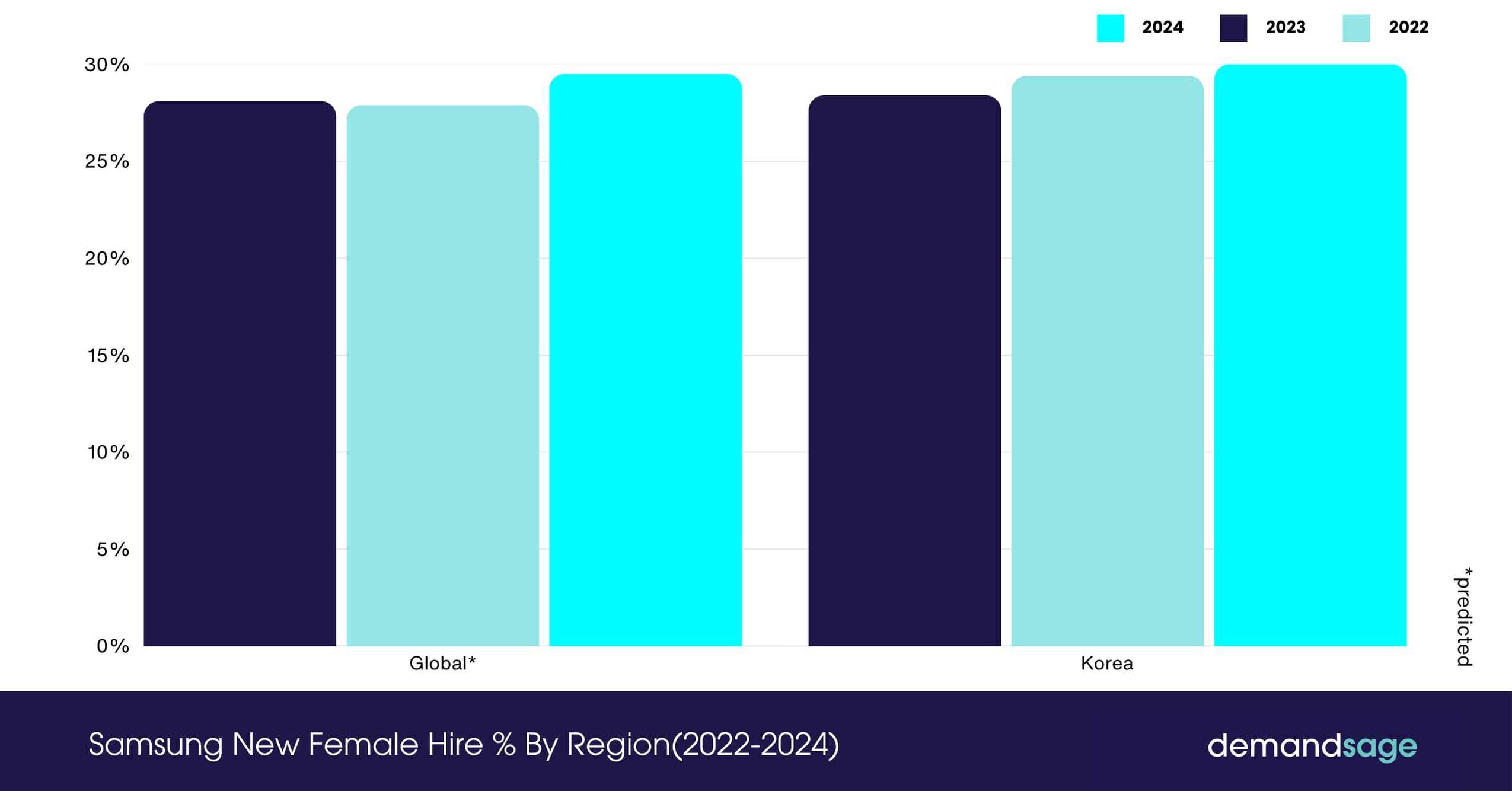
The female employee population in Samsung between the years 2022 and 2024 is presented in the following diagram:
| Sr. No. | Number of employees | 2022 | 2023 | 2024 |
|---|---|---|---|---|
| 1 | Global* | 27.9% | 28.1% | 29.5% |
| 2 | Korea | 29.4% | 28.4% | 30% |
The data shows a trend of decreasing global employment, while the number of employees in Korea has been increasing each year.
Samsung Employees By Age Group
- The majority of Samsung employees are in their 30s, with 114,035 individuals.
There are currently 63,531 employees aged 30 or younger, and this number is consistently decreasing, indicating a decline in the youth population in the workforce.
Individuals aged 40 account for 85,081 of the total employees, and this number is increasing annually, indicating a peculiar increase in middle-aged and older individuals.
Employee count segmented by age group over three years:
| Sr. No. | Number of employees by age group | 2022 | 2023 | 2024 | Trends |
|---|---|---|---|---|---|
| 1 | Under 30 | 83,155 | 72,525 | 63,531 | Decreasing |
| 2 | 30s | 111,607 | 113,874 | 114,035 | Slightly Increasing/Stable |
| 3 | 40 and above | 75,516 | 81,461 | 85,081 | Increasing |
Samsung Employees By Region
- Samsung has its highest number of employees in Asia, totaling 2,20,798 (Combining Korea).
The central portion of Samsung’s workforce resides in Korea, with 125,297 employees in 2024. That number continues its consistent rise, establishing that it is truly dominant in its home country.
Asia (excluding Korea) had 95,501 employees in 2024. Despite Korea being Samsung’s home country, the number of Samsung employees is consistently decreasing.
In 2024, Samsung had 4461 employees in the Middle East & Africa and 788 in the CIS region. These numbers are decreasing annually.
Regional breakdown of Samsung’s employees between 2022 and 2024:
| Sr. No. | Number of employees by region | 2022 | 2023 | 2024 |
|---|---|---|---|---|
| 1 | Korea | 117,927 | 120,756 | 125,297 |
| 2 | Asia (Southeast Asia, Southwest Asia, China, Japan) | 106,790 | 100,938 | 95,501 |
| 3 | North America and Latin America | 27,166 | 27,882 | 25,100 |
| 4 | Europe | 11,709 | 12,001 | 11,500 |
| 5 | CIS (Commonwealth of Independent States) | 1,756 | 1,611 | 788 |
| 6 | Middle East and Africa | 4,930 | 4,672 | 4,461 |
Number Of Employees By Job Type
- Samsung had 105,571 employees in the manufacturing department, making it the largest department in terms of headcount.
The unit’s employment losses increased to 4,151 in 2024 from the previous year’s figure of 7,468.
The development unit is in rapid expansion mode, having added 3,306 people in 2023 and another 5,255 in 2024.
See how Samsung’s workforce is divided by job roles from 2022 to 2024:
| Sr. No. | Number of employees by job type | 2022 | 2023 | 2024 |
|---|---|---|---|---|
| 1 | Development | 80,423 | 83,729 | 88,984 |
| 2 | Manufacturing | 117,190 | 109,722 | 105,571 |
| 3 | Quality assurance and EHS | 19,763 | 21,386 | 18,731 |
| 4 | Sales and marketing | 24,703 | 25,136 | 23,466 |
| 5 | Others | 28,199 | 27,887 | 25,895 |
Source: Samsung Facts & Figures
Samsung Semiconductor Market Share
- Samsung’s worldwide semiconductor vendor ranking is number one, thanks to the company’s 10.6% market share in 2024.
Compared to the previous $40.9 billion from 2023, the figure for 2024 was $66.5 billion, which represents an increase of 62.5%
Samsung’s standing in the global semiconductor market is shown here:
| Rank | Vendor | 2024 Revenue (million $) | 2023 Revenue (million $) |
|---|---|---|---|
| 1 | Samsung Electronics | $66,524 | $40,942 |
| 2 | Intel | $49,189 | $49,117 |
| 3 | NVIDIA | $45,988 | $25,053 |
| 4 | SK hynix | $42,824 | $23,027 |
| 5 | Qualcomm | $32,358 | $29,225 |
| 6 | Micron Technology | $27,843 | $16,123 |
| 7 | Broadcom | $27,641 | $25,613 |
| 8 | AMD | $23,948 | $22,307 |
| 9 | Apple | $18,880 | $18,052 |
| 10 | Infineon Technologies | $16,001 | $17,022 |
| 11 | Others (outside top 10) | $274,775 | $263,483 |
| – | Total Market | $625,971 | $529,964 |
Now, let’s have a look at the semiconductor market share of each company:
| Rank | Vendor | 2024 Market Share |
|---|---|---|
| 1 | Samsung Electronics | 10.6% |
| 2 | Intel | 7.9% |
| 3 | NVIDIA | 7.3% |
| 4 | SK hynix | 6.8% |
| 5 | Qualcomm | 5.2% |
| 6 | Micron Technology | 4.4% |
| 7 | Broadcom | 4.4% |
| 8 | AMD | 3.8% |
| 9 | Apple | 3% |
| 10 | Infineon Technologies | 2.6% |
| 11 | Others (outside top 10) | 43.9% |
| Total Market | 100% |
Source: Gartner
Samsung Stock Price
- Samsung’s last quoted stock price was $57.31 (recorded in September 19, 2025), which is higher by 60.58% compared to the end of 2024, closing at $35.7.
There are wild, volatile moves in Samsung stock, including its 2009-made +95.57% record and its 2000-based -48.28%.
There were also some solid bullish years for Samsung – 2020 with 62.11%, 2017 with 61.38%, and 2012 with 53.32%.
Out of 26 years, only 10 were negative years, like 2024 (-40.03%), 2022 (-32.50%), and 2008 (-36.72%).
Track how Samsung’s stock price has evolved:
| Sr. No. | Year | Performance |
|---|---|---|
| 1 | 2025 | 58.19% |
| 2 | 2024 | -40.03% |
| 3 | 2023 | 40.62% |
| 4 | 2022 | -32.50% |
| 5 | 2021 | -11.97% |
| 6 | 2020 | 62.11% |
| 7 | 2019 | 42.28% |
| 8 | 2018 | -25.52% |
| 9 | 2017 | 61.38% |
| 10 | 2016 | 47.42% |
| 11 | 2015 | -9.92% |
| 12 | 2014 | -1.60% |
| 13 | 2013 | -11.34% |
| 14 | 2012 | 53.32% |
| 15 | 2011 | 7.82% |
| 16 | 2010 | 17.97% |
| 17 | 2009 | 95.57% |
| 18 | 2008 | -36.72% |
| 19 | 2007 | -11.92% |
| 20 | 2006 | 2.37% |
| 21 | 2005 | 49.93% |
| 22 | 2004 | 17.72% |
| 23 | 2003 | 44.66% |
| 24 | 2002 | 12.54% |
| 25 | 2001 | 76.58% |
| 26 | 2000 | -48.28% |
Source: Companies Market Cap
Other Samsung Facts & Statistics
- The Samsung sites in Suwon, Gumi, Giheung, Hwaseong, Pyeongtaek, Onyang, and Cheonan have now been designated as “Green Enterprises.”
Samsung is also engaged in shipbuilding under the name Samsung Heavy Industries.
It is one of the largest shipbuilders globally and one of South Korea’s “Big Three” shipbuilders. In 2024, their operating revenue reached ₩9.9 trillion ($7.615 billion).
Source: iMarine
Samsung R&D Spending
- Samsung spent ₩18.064.1 billion on research and development in the first half of 2025.
Of that total, ₩18.052 billion was identified as expenditure, and ₩12.1 billion was released from government contribution.
In 2024, the expenditure on R&D was ₩35,021.5 billion and ₩28,352.8 billion in 2023
The company spent ₩35,021.5 billion on R&D in 2024 and ₩28,352.8 billion in 2023.
The ratio of R&D expenditure to revenue was 11.8% in H1 2025, compared to 11.6% in 2024 and 10.9% in 2023.
Let’s have a look at R&D spending trends at Samsung (In ₩ million)
| Sr. No. | Category | 1H25 | 2024 | 2023 |
|---|---|---|---|---|
| 1 | Total R&D expenditures | ₩18,064,124 | ₩35,021,531 | ₩28,352,769 |
| 2 | (Government subsidies) | ₩12,093 | ₩23,389 | ₩13,045 |
| 3 | R&D expenditures | ₩18,052,031 | ₩34,998,142 | ₩28,339,724 |
| 4 | R&D expenses/revenue ratio | 11.80% | 11.60% | 10.90% |
Patents and Intellectual Property
- In H1 2025, Samsung held 276,869 patents worldwide.
Of these, the majority was held in the US with 102,269 patents.
Samsung filed 5,005 new patents in Korea and 4,594 new ones in the US.
Samsung also registered 202 design patents in the US during the first half of 2025.
Patent counts and country-wise distribution reflect Samsung’s innovation efforts:
| Sr. No. | Country | Patents | % Share |
|---|---|---|---|
| 1 | Korea | 65,831 | 23.77% |
| 2 | US | 102,269 | 36.96% |
| 3 | Europe | 49,543 | 17.89% |
| 4 | China | 30,602 | 11.05% |
| 5 | Japan | 8,800 | 3.17% |
| 6 | Others | 19,824 | 7.16% |
| 7 | Total No. of patents | 276,869 | – |
ESG and Sustainability Metrics
- In H1 2025, Samsung holds six valid green technology certifications and has certified 118 models that incorporate green technologies.
- Samsung was awarded an ‘A’ rating in the 2023 and 2024 MSCI ESG Ratings.
- In 2024, Samsung’s domestic operations emitted 13,962,940 tCO₂-eq of greenhouse gases and consumed 264,060 TJ of energy.
- In the first half of 2025, Samsung contributed ₩ 11.38 billion in matching funds to support youth education and vulnerable groups.
- The company also paid out ₩ 48.9 billion in performance incentives to DS Division suppliers.
- Additional contributions included ₩4.11 billion to the UNDP, ₩2.25 billion to WorldSkills, and ₩1.85 billion for wildfire relief, among other initiatives.
Source: Samsung H1
