
Looking to get the data on the fastest-growing cities in the US? Well, this page has it all.
With the dynamic shifts in the US population, certain cities have emerged as the hub spots for population growth.
Texas has attracted residents at a large pace, and 7 of the 15 fastest-growing cities are from Texas, with Princeton being the epicenter.
The population in Princeton City grew by 30.6% between July 2023 and July 2024. With the vast increase in population, the median home price in the city has also increased and is recorded to be $350,000 as of 2024.
In this post, I have listed the top 15 fastest-growing cities in the United States and covered the latest facts and figures about their populations.
| Rank | City, State | Population Change 2023-2024 | Median Home Prices 2024 |
|---|---|---|---|
| 1 | Princeton, Texas | 30.6% | $300,000 |
| 2 | Fulshear, Texas | 26.9% | $519,000 |
| 3 | Leesburg, Florida | 18.5% | $329,250 |
| 4 | Celina, Texas | 18.2% | $679,999 |
| 5 | Anna, Texas | 14.6% | $427,500 |
| 6 | Haines City, Florida | 12.1% | $338,000 |
| 7 | Foley, Alabama | 12.0% | $282,400 |
| 8 | Fate, Texas | 11.4% | $339,500 |
| 9 | Rosemount, Minnesota | 10.6% | $370,900 |
| 10 | Garner, North Carolina | 10.4% | $380,300 |
| 11 | Melissa, Texas | 10.0% | $339,500 |
| 12 | Sugar Hill, Georgia | 9.5% | $374,700 |
| 13 | Hutto, Texas | 9.4% | $339,500 |
| 14 | Leland, North Carolina | 9.4% | $380,300 |
| 15 | Erie, Colorado | 9.2% | $640,000 |
Note: This data is according to the 2024 Census.
Source: United States Census Bureau, NewYork Post.
Population Data Of The United States (2026)
The total population of the United States grew by 1.0% between July 2024 and July 2025, reaching approximately 342.03 million.
Here is an overview of the US population and other data about the country:
| Statistic | Value |
|---|---|
| 2026 Population | 348,212,369 |
| Population change between July 2024 & July 2025 | 0.58% |
| Square miles | 3.797 million sq mi |
| Average temp | 55.5°F (13°C) |
| Median age | 39.1 years |
| Median House Price (2024) | $420,800 |
| Median household income (2024) | $74,580 |
| Average Family Size | 3.16 |
| Housing units | 145 million (approx) |
| Housing unit occupied | 140.3 million |
| Owner-occupied housing units | 86.1 million |
| Poverty | 11.5% |
| Employment Rate | 59.7% |
| Unemployment Rate | 4.1% |
Source: National Center for Environmental Information, United States Census Bureau, Wikipedia, The Motley Fool.
Top 15 Fastest-Growing Cities In The US
The country’s top 4 cities with the fastest growth are located in Texas, while the 5th fastest-growing city is in California.
Let’s examine the top 5 fastest-growing cities in the United States, their demographic distribution, average salary, and more.
1. Princeton, Texas

| Statistic | Value |
|---|---|
| 2024 Population | 37,019 |
| Population change between July 2023 & July 2024 | 30.6% |
| Square miles | 10.16 sq mi |
| Median age | 32.2 years |
| Median House Price 2024 | $300,000 |
| Median household income | $96,766 |
| Average Family Size | 3.56 members |
| Housing units | 5,494 |
| Housing unit occupied | 5,294 |
| Owner-occupied housing units | 8.7% |
| Poverty Rate | 5.26% |
| Employment Rate | 71.3% |
According to the 2024 Census report, Princeton city’s population was 37,019, representing a remarkable 30.6% growth rate, making it the fastest-growing city in the United States. Princeton increased its population by nearly one-third in just one year and has more than doubled it since 2020, from roughly 17,000 to 37,000.
Once a tiny town in Texas is expected to grow by 100K in population in the next five years.
Here are further details about the distribution of residents of Princeton according to their ethnicity:
- White (Non-Hispanic): 45.01%
- White (Hispanic): 9.11%
- Black or African American (Non-Hispanic): 21.25%
- Black or African American (Hispanic): 0.31%
- Asian (Non-Hispanic): 3.51%
- Asian (Hispanic): 0.3%
- Multiracial (Hispanic): 8.35%
- Multiracial (Non-Hispanic): 1.85%
- American Indian & Alaska Native (Hispanic): 0.76%
- Other (Non-Hispanic): 1.2%
- Other (Hispanic): 6.39%
The median earnings of men in the city is $53,099, while the median earnings of women is $48,800.
Source: CBS News, World Population Review
2. Fulshear, Texas
| Statistic | Value |
|---|---|
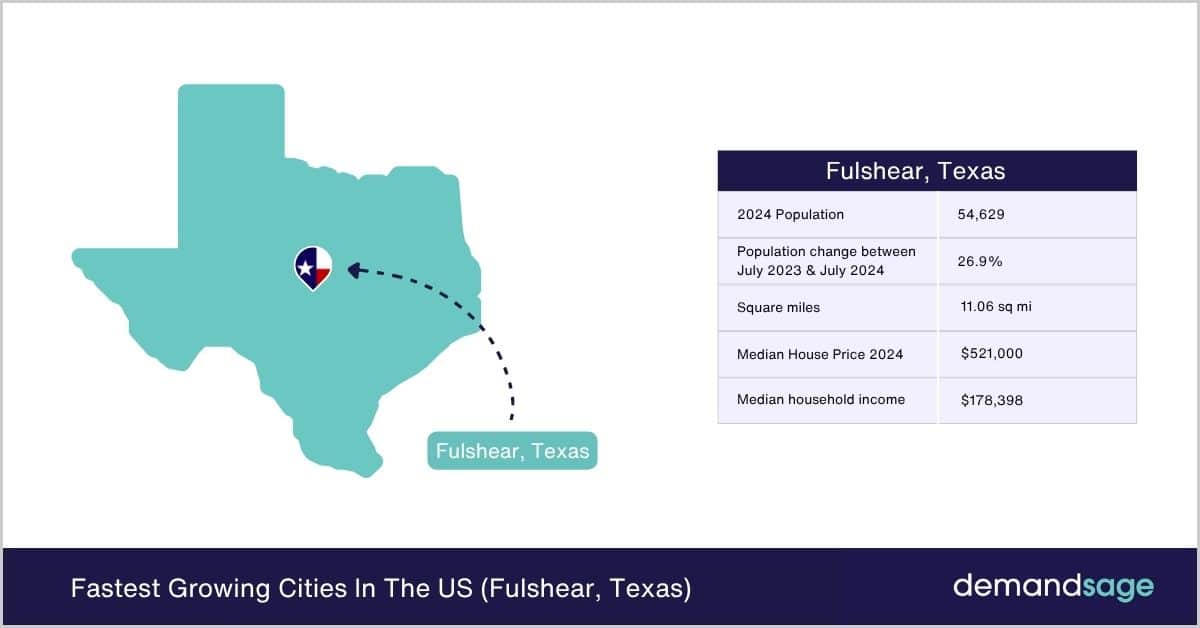
| 2024 Population | 54,629 |
| Population change between July 2023 & July 2024 | 26.9% |
| Square miles | 11.06 sq mi |
| Median age | 38.4 years |
| Median House Price 2024 | $521,000 |
| Median household income | $178,398 |
| Average Family Size | 3.36 members |
| Housing units | 5,353 |
| Housing unit occupied | 4,990 |
| Owner-occupied housing units | 2.7% |
| Employment rate | 60.1% |
| Poverty | 2.41% |
In 2024, the population of Fulshear, Texas, was estimated to be 54.6k, representing a 26.9% growth rate. Of these, 89.3% are citizens, while 31.5% are from outside the country.
In 2022, the share of white non-Hispanic citizens in the country was 2.92 times higher than the residents belonging to other races and ethnicities. Meanwhile, 25.1% of the residents were Hispanic.
Here are further details about the distribution of the residents in the city according to race and ethnicity:
- White (Non-Hispanic): 53.76%
- White (Hispanic): 5.6%
- Black or African American(Hispanic): 0.46%
- Black or African American (Non-Hispanic): 6.43%
- Asian (Non-Hispanic): 11.93%
- Multiracial (Hispanic): 10.12%
- Multiracial (Non-Hispanic): 5.75%
- American Indian & Alaska Native (Hispanic): 0.63%
- Native Hawaiian & Other Pacific Islander (Non-Hispanic): 0.5%
- Other (Non-Hispanic): 4.61%
- Other(Hispanic): 5.1%
On the other hand, the median earning of men in the city is $149,159, while the median earning of women in the city is recorded to be $58,792.
Source: United States Census Bureau, Data USA, United States Census Bureau, InnovationMap, WorldPopulationReview
3. Leesburg, Florida
| Statistic | Value |
|---|---|
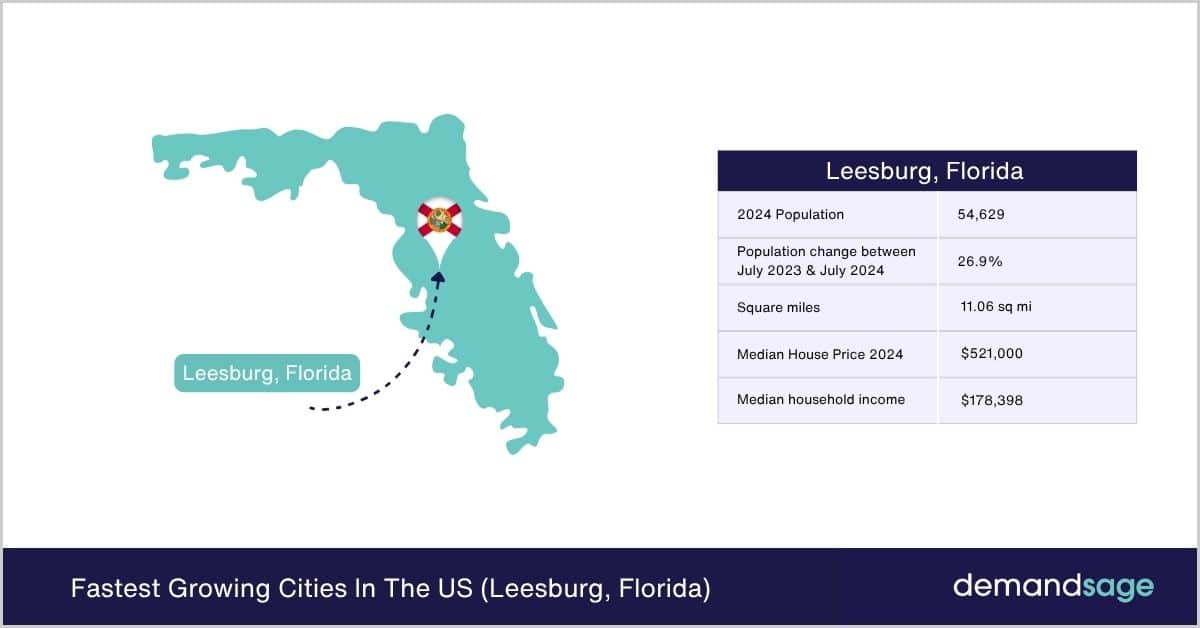
| 2024 Population | 37,815 |
| Population change between July 2023 & July 2024 | 18.5% |
| Square miles | 41.94 sq mi |
| Median age | 43.6 years |
| Median House Price 2024 | $329,250 |
| Median household income | $47,506 |
| Average Family Size | 2.94 members |
| Housing units | 13,109 |
| Housing unit occupied | 11,348 |
| Owner-occupied housing units | 5.7% |
| Poverty | 16.22% |
| Employment Rate | 44.9% |
The population of Leesburg, Florida, was 37.8k in 2024, representing an 18.5% growth rate, making it the third fastest-growing city in the United States and the fastest-growing city in Florida.
Here is the distribution of residents of Leesburg according to their ethnicity:
- White (Non-Hispanic): 51.99%
- White (Hispanic): 7.66%
- Black or African American (Non-Hispanic): 21.75%
- Black or African American (Hispanic): 0.18%
- Asian (Non-Hispanic): 1.71%
- Multiracial (Hispanic): 7.66%
- Multiracial(Non-Hispanic): 3.2%
- Native Hawaiian or Pacific Islander (Non-Hispanic): 0.41%
- Native American (Non-Hispanic): 0.1%
- Other(Non-Hispanic): 0.6%
- Other (Hispanic): 5.36%
According to the last recoded data in 2023, the median income of men in Leesburg, FL was $38,966, while women’s income was $0,084.
Source: Census, World Population Review, NeilsBerg
4. Celina, Texas
| Statistic | Value |
|---|---|
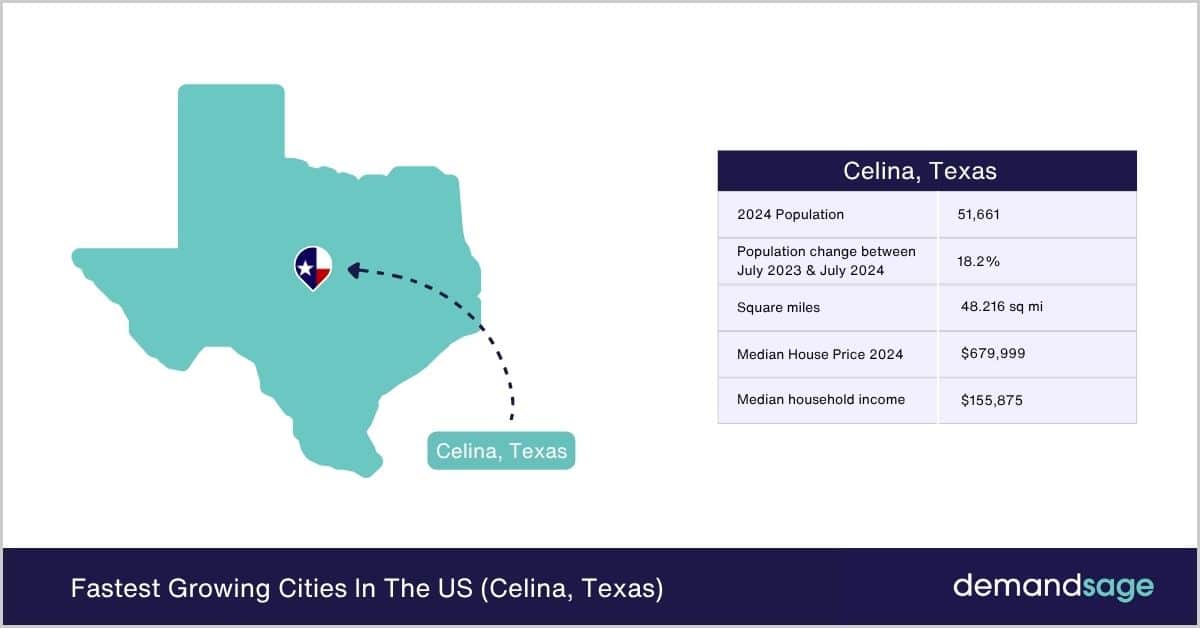
| 2024 Population | 51,661 |
| Population change between July 2023 & July 2024 | 18.2% |
| Square miles | 48.216 sq mi |
| Median age | 36.1 years |
| Median House Price 2024 | $679,999 |
| Median household income | $155,875 |
| Average Family Size | 3.25 members |
| Housing units | 5,421 |
| Housing unit occupied | 4,983 |
| Owner-occupied housing units | 7.9% |
| Poverty Rate | 6.07% |
| Employment Rate | 67.8% |
As of 2024, 51.7k people resided in Celina, Texas, representing an 18.2% growth rate. According to the 2022 census report, the number of White non-Hispanic residents was 7.62 times greater than that of any other race. The largest ethnic groups in Celina were white, Asian, and White Hispanic.
Here are further details about the distribution of residents of Celina according to their ethnicity:
- White (Non-Hispanic): 53.25%
- White (Hispanic): 6.75%
- Black or African American (Non-Hispanic): 11.06%
- Black or African American (Hispanic): 0.47%
- Asian (Non-Hispanic): 11.91%
- Multiracial (Hispanic): 5.94%
- Multiracial (Non-Hispanic): 6.28%
- Native American (Non-Hispanic): 0.42%
- Native American (Hispanic): 0.04%
- Native Hawaiian & Other Pacific Islander (Non-Hispanic): 0.27%
- Other (Non-Hispanic): 0.84%
- Other (Hispanic): 0.93%
The median earnings of men in the city are $92,308, while the median earnings of women is $58,663.
Source: United States Census Bureau, USA.com, BizJournals, Data USA, United States Census Bureau
5. Anna, Texas
| Statistic | Value |
|---|---|
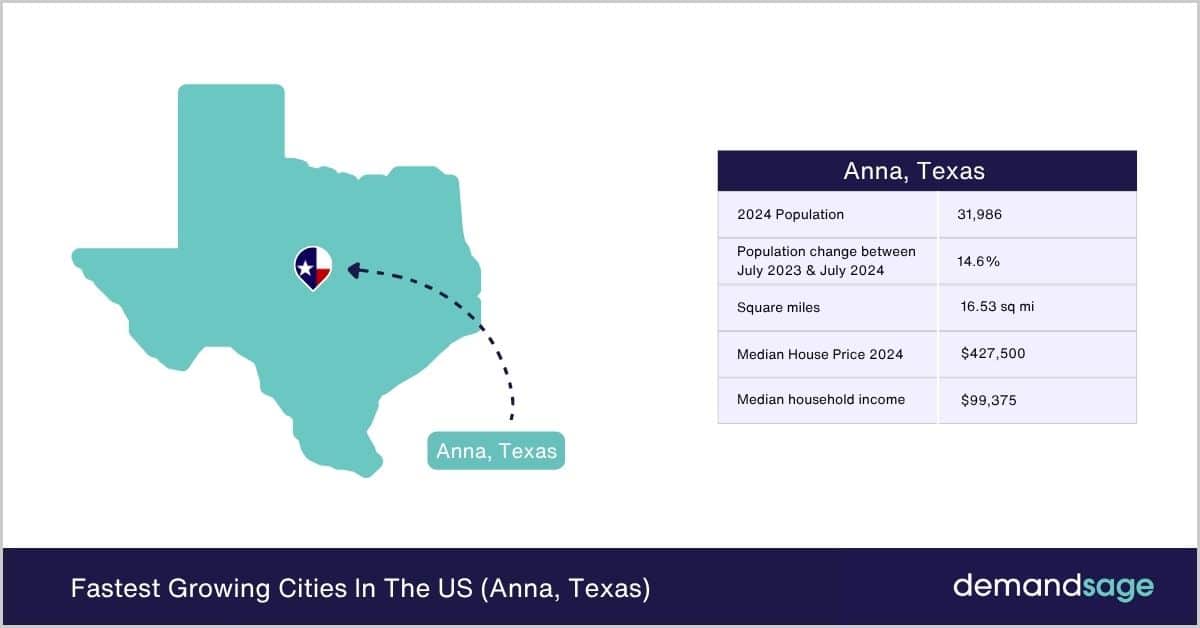
| 2024 Population | 31,986 |
| Population change between July 2023 & July 2024 | 14.6% |
| Square miles | 16.53 sq mi |
| Median age | 32.4 years |
| Median House Price 2024 | $427,500 |
| Median household income | $99,375 |
| Average Family Size | 4.6 |
| Housing units | 6,546 |
| Housing unit occupied | 61,53 |
| Owner-occupied housing units | 13.1% |
| Poverty | 10.15% |
| Employment Rate | 69.0% |
As of 2024, 32.0k people resided in Anna, Texas, representing a 14.6% growth rate. The majority of the residents were White non-Hispanic, accounting for 3.62 times more residents belonging to other races and ethnicities.
Here are further details about the distribution of the residents in the city according to race and ethnicity:
- White (Non-Hispanic): 60.35%
- White (Hispanic): 12.72%
- Black or African American (Non-Hispanic): 16.21%
- Asian (Non-Hispanic): 0.89%
- Multiracial (Hispanic): 3.44%
- Multiracial (Non-Hispanic): 2.8%
- Native American (Non-Hispanic): 0.31%
- Native American (Hispanic): 0.36%
- Other (Hispanic): 2.93%
The median earnings of the men in the city are $65,892, while those of women are $42,171.
Source: United States Census Bureau, Data USA, United States Census Bureau.
6. Haines City, Florida
| Statistic | Value |
|---|---|
| 2024 Population | 42,073 |
| Population change between July 2023 & July 2024 | 12.1% |
| Square miles | 20.10 sq mi |
| Median age | 37.3 years |
| Median House Price 2024 | $337,000 |
| Median household income | $79,726 |
| Average Family Size | 3.58 members |
| Housing units | 11,006 |
| Housing unit occupied | 8,988 |
| Owner-occupied housing units | 2.5% |
| Poverty | 16.9% |
| Employment Rate | 55.7% |
Source: World Population Review, Zillow
7. Foley, Alabama
| Statistic | Value |
|---|---|
| 2024 Population | 28,043 |
| Population change between July 2023 & July 2024 | 12.0% |
| Square miles | 33.33 sq mi |
| Median age | 53.3 years |
| Median House Price 2024 | $282,400 |
| Median household income | $67,346 |
| Average Family Size | 2.16 |
| Poverty | 11.8% |
| Employment Rate | 74.9% |
Source: Census Bureau, World Population Review.
8. Fate, Texas
| Statistic | Value |
|---|---|
| 2024 Population | 27,467 |
| Population change between July 2023 & July 2024 | 11.4% |
| Square miles | 11.84 sq mi |
| Median age | 31.8 years |
| Median House Price 2024 | $339,500 |
| Median household income | $129,500 |
| Average Family Size | 3.3 |
| Housing units | 6,160 |
| Housing unit occupied | 5975 |
| Owner-occupied housing units | 89% |
| Poverty | 3.8% |
| Employment Rate | 91.90% |
Source: Census Reporter, BestNeighborhood, World Population Review
9. Rosemount, Minnesota
| Statistic | Value |
|---|---|
| 2024 Population | 30,581 |
| Population change between July 2023 & July 2024 | 10.6% |
| Square miles | 33.25 sq mi |
| Median age | 38.7 years |
| Median House Price 2024 | $370,900 |
| Median household income | $127,247 |
| Average Family Size | 2.8 |
| Housing units | 9,797 |
| Housing unit occupied | 9,503 |
| Owner-occupied housing units | 87% |
| Poverty | 2.9% |
| Employment Rate | 97.45% |
Source: World Population Review, Census Reporter
10. Garner, North Carolina
| Statistic | Value |
|---|---|
| 2024 Population | 39,345 |
| Population change between July 2023 & July 2024 | 10.4% |
| Square miles | 19.15 sq mi |
| Median age | 37.6 |
| Median House Price 2024 | $392,400 |
| Median household income | $77,496 |
| Average Family Size | 2.5 |
| Housing units | 13,961 |
| Housing unit occupied | 12,983 |
| Owner-occupied housing units | 65% |
| Poverty | 7.3% |
| Employment Rate | 93.85% |
Source: Zillow, United States Census Bureau
11. Melissa, Texas
| Statistic | Value |
|---|---|
| 2024 Population | 26,194 |
| Population change between July 2023 & July 2024 | 10.0% |
| Square miles | 11.45 sq mi |
| Median age | 36.5 years |
| Median House Price 2024 | $339,500 |
| Median household income | $137,875 |
| Average Family Size | 3.3 |
| Housing units | 5,481 |
| Housing unit occupied | 5,316 |
| Owner-occupied housing units | 88% |
| Poverty | 2.6% |
| Employment Rate | 96.21% |
Source: World Population Review, Census Reporter, BestNeighborhood.
12. Sugar Hill, Georgia
| Statistic | Value |
|---|---|
| 2024 Population | 28,598 |
| Population change between July 2023 & July 2024 | 9.5% |
| Square miles | 11.17 sq mi |
| Median age | 36.3 years |
| Median House Price 2024 | $374,700 |
| Median household income | $99,479 |
| Average Family Size | 3.2 |
| Housing units | 20,204 |
| Housing unit occupied | 18,991 |
| Owner-occupied housing units | 75% |
| Poverty | 9.3% |
| Employment Rate | 46.80% |
Source: Census Reporter, Trading Economics, World Population Review
13. Hutto, Texas
| Statistic | Value |
|---|---|
| 2024 Population | 42,661 |
| Population change between July 2023 & July 2024 | 9.4% |
| Square miles | 13.93 sq mi |
| Median age | 35% |
| Median House Price 2024 | $339,500 |
| Median household income | $115,149 |
| Average Family Size | 3 |
| Housing units | 17,896 |
| Housing unit occupied | 17,359 |
| Owner-occupied housing units | 79% |
| Poverty | 5.3% |
| Employment Rate | 95.94% |
Source: World Population Review, Census Reporter, BestNeighborhood.
14. Leland, North Carolina
| Statistic | Value |
|---|---|
| 2024 Population | 34,451 |
| Population change between July 2023 & July 2024 | 9.4% |
| Square miles | 22.32 sq mi |
| Median age | 48 years |
| Median House Price 2024 | $380,300 |
| Median household income | $88,576 |
| Average Family Size | 2.3 |
| Housing units | 11,995 |
| Housing unit occupied | 11,275 |
| Owner-occupied housing units | 82% |
| Poverty | 5.8% |
| Employment Rate | 96.2% |
Source: World Population Review, Census Reporter, BestNeighborhood.
15. Erie, Colorado
| Statistic | Value |
|---|---|
| 2024 Population | 38,594 |
| Population change between July 2023 & July 2024 | 9.2% |
| Square miles | 20.73 sq mi |
| Median age | 37.6 years |
| Median House Price 2024 | $640,000 |
| Median household income | $163,644 |
| Average Family Size | 2.9 |
| Housing units | 11,277 |
| Housing unit occupied | 11,051 |
| Owner-occupied housing units | 88% |
| Poverty | 3% |
| Employment Rate | 96.45% |
Source: World Population Review, Census Reporter, BestNeighborhood.
Conclusion: Princeton, Texas, Is The Fastest-Growing City In The United States
The city’s population grew by 30.6% compared to 2023. Other fastest-growing cities in the United States were Fulshear, Leesburg, and Celina. Most of these cities are from Texas and Florida.
The majority of the growth in these cities is driven by migrations, natural births, and decreased death rates. Plus, these cities have good schools and quality services compared to other cities in the country.
