
More than 5.12 billion people will own smartphones in 2026. Additionally, it is projected that smartphone mobile network subscriptions will reach 7.3 billion globally.
In the United States, around 91% of the population uses smartphones. Mostly, the 18 to 29 age group of young adults tends to use smartphones more in the US.
Further in this article, you will find all the breakdowns of total Smartphones, their users, market share, usage statistics, and much more.
Smartphone Statistics 2026 (At A Glance)
- Globally, 5.12 billion people will own a smartphone.
- The total number of smartphone subscriptions worldwide is estimated to have reached 7.3 billion.
- In the U.S., 91% of the population is smartphone users.
- Android leads the global smartphone market with a 71.77% share, while iOS holds 27.77%.
- Most Americans spend approximately 3 hours and 15 minutes daily on their smartphones.
Number Of Smartphone Users
Over 1 in 2 people worldwide own a smartphone. These devices are always in our hands or our pockets, and it is impossible to imagine a life today without them.
How Many Smartphone Users Are There?
As of the latest data, approximately 4.69 billion people around the world own a smartphone.

Approximately 440 million new users added between 2024-2025.
| Year | Smartphone Users Worldwide |
|---|---|
| 2026* | 5.12 billion |
| 2025 | 4.69 billion |
| 2024 | 4.25 billion |
| 2023 | 3.77 billion |
| 2022 | 3.39 billion |
| 2021 | 2.95 billion |
| 2020 | 2.58 billion |
| 2019 | 2.16 billion |
| 2018 | 1.84 billion |
| 2017 | 1.58 billion |
| 2016 | 1.4 billion |
| 2015 | 1.22 billion |
| 2014 | 1.03 billion |
Source: Statista
The smartphone user base grew by 10.35% from 2024 to 2025. This shows that the growth rate is continuously growing with the adoption of smartphones by users worldwide.
Projected Smartphone Users Worldwide (2026 – 2028)
From 2026, the number of smartphone owners is expected to go beyond 5.12 billion. There might be around 1.14 billion new users over the next 4 years.

| Year | Projected Smartphone Users |
|---|---|
| 2026* | 5.12 billion |
| 2027* | 5.49 billion |
| 2028* | 5.83 billion |
Source: Statista
Note: All data marked with an asterisk (*) represents forecasted projections
The growth rate can fluctuate once the market matures and reaches a higher penetration. However, the number of smartphone owners is expected to continue increasing.
How Many Smartphone Subscriptions Are There?
The global smartphone subscription count is expected to have reached 7.38 billion.
From 2024 to 2025, there is an increase of 251.67 million new subscriptions in just one year. This represents a 3.53% growth rate compared to the previous year.
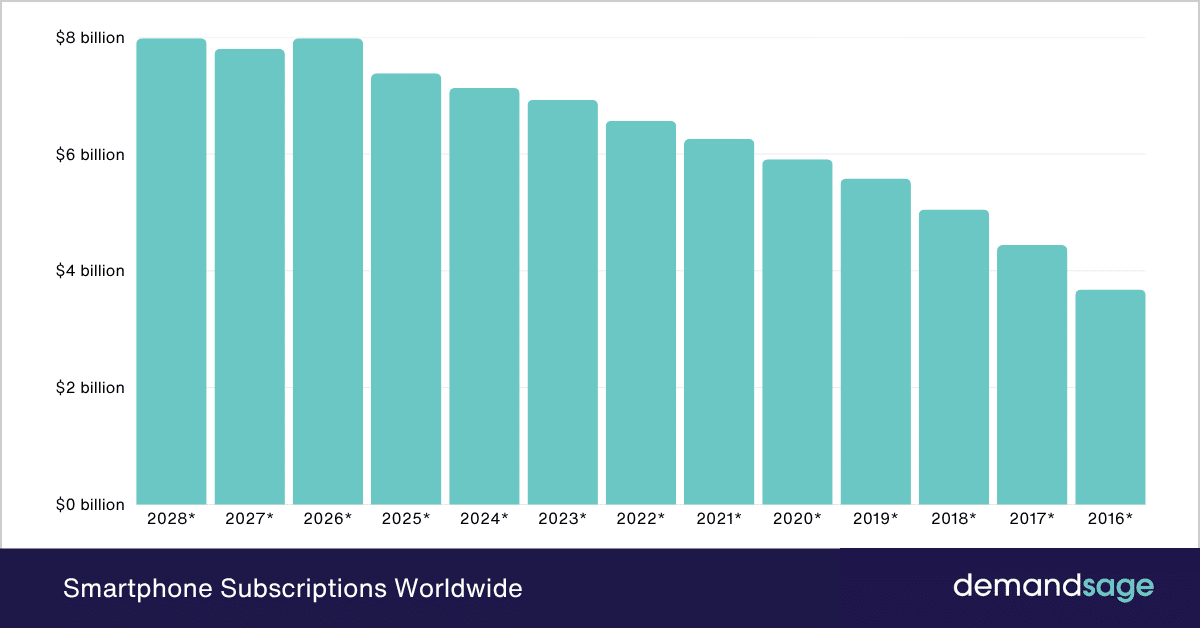
The following table displays the number of smartphone subscriptions recorded over the years.
| Year | Smartphone Subscriptions Worldwide |
|---|---|
| 2025 | 7.38 billion |
| 2024 | 7.13 billion |
| 2023 | 6.93 billion |
| 2022 | 6.57 billion |
| 2021 | 6.26 billion |
| 2020 | 5.91 billion |
| 2019 | 5.58 billion |
| 2018 | 5.05 billion |
| 2017 | 4.44 billion |
| 2016 | 3.68 billion |
Source: Statista
However, the number of smartphone subscriptions is expected to reach 7.59 billion in 2026, 7.80 billion in 2027, and 7.98 billion in 2028 globally.
Overall, there are more subscriptions of users than the owners of smartphones.
How Many People Use Smartphones In The United States?
Overall, 91% of the U.S. population use smartphones, reflecting the technology’s widespread adoption nationwide.
The largest group of users falls within the 18 to 29 age bracket, making younger adults the primary drivers of smartphone usage in the U.S.
| Age Group | Smartphone Ownership |
|---|---|
| 18-29 | 98% |
| 30-49 | 97% |
| 50-64 | 91% |
| 65+ | 79% |
| Overall | 91% |
Source: Pew Research
How Many Android Users Are There?
There are around 3.6 billion Android users worldwide. This number was around 3.3 billion in 2022.
The United States alone has 144.01 million Android smartphone users, but Android is more popular in Brazil, Indonesia, India, and Turkey.
Source: App My Site
How Many iOS Users Are There?
There are over 1.46 billion active iPhone users worldwide.
According to the predictions, 1.56 billion users will own iPhones worldwide by the end of 2024.
Smartphone Market Share By Operating Systems
Android dominates the global smartphone market with a 71.77% share, while iOS holds 27.77%.
Android’s popularity can be attributed to its open-source nature and affordability, making it accessible to a wider audience. On the other hand, iOS is favored for its intuitive user interface and strong focus on security.
Other operating systems, such as Samsung’s proprietary OS, KaiOS, and Linux, account for smaller portions of the market, with shares of 0.31%, 0.03%, and 0.01%, respectively, in 2024.
The following table displays the Android vs iOS Market share.
| Year | Android Market Share | iOS Market Share |
|---|---|---|
| 2024 | 71.77% | 27.77% |
| 2023 | 70.48% | 28.8% |
| 2022 | 72.37% | 26.98% |
| 2021 | 70.01% | 29.24% |
| 2020 | 72.48% | 26.91% |
| 2019 | 74.13% | 24.79% |
| 2018 | 75.16% | 21.98% |
| 2017 | 73.54% | 19.91% |
Source: Statscounter
Smartphone Revenue
Smartphones Are Estimated To Generate A Global Revenue Of $542.47 Billion By 2028.
In 2023, the smartphone segment generated a revenue of $479.03 billion.
Further, the revenue generated worldwide is forecasted to increase by $63.4 billion between the forecasted period of 2023 to 2028. That’s an approximate increase of 13.24% in revenue within four years.
Hence, by 2028, the smartphone segment is expected to generate a revenue of $542.47 billion.

The following table displays the revenue generated by the Smartphone segment over the years.
| Year | Smartphone Revenue |
|---|---|
| 2028* | $542.47 billion |
| 2027* | $522.67 billion |
| 2026* | $503.06 billion |
| 2025* | $485.34 billion |
| 2024* | $467.6 billion |
| 2023 | $479.03 billion |
| 2022 | $453.88 billion |
| 2021 | $481.2 billion |
| 2020 | $423.59 billion |
| 2019 | $453.7 billion |
| 2018 | $422.89 billion |
Source: Statista
Smartphone Shipment
The Global Smartphone Shipments Reached 1.17 Billion Units In 2023.
That’s an increase of 3.2% in the shipment units compared to 2022. Further, the shipments are estimated to increase by 3% in 2024 and reach 1.20 billion.
The global smartphone market witnessed exceptional growth between 2009 and 2016. During this time, smartphone shipments increased from 173 million to 1.47 billion.

The following table displays the smartphone shipments recorded over the years.
| Year | Number Of Smartphone Shipments |
|---|---|
| 2023 | 1,166.9 million |
| 2022 | 1,205.5 million |
| 2021 | 1,354.8 million |
| 2020 | 1,281.2 million |
| 2019 | 1,372.6 million |
| 2018 | 1,404.9 million |
| 2017 | 1,465.5 million |
Source: Statista, Counterpoint Research
Smartphone Market Share By Vendor
Apple holds the highest smartphone vendor market share at 29.32%.
Samsung follows Apple with 23.69% of the market share, while Xiaomi managed to grab 11.91% of the smartphone vendor market.

The following table displays the market share of different vendors in the smartphone market.
| Vendor | Market Share |
|---|---|
| Apple | 29.32% |
| Samsung | 23.69% |
| Xiaomi | 11.91% |
| Oppo | 5.61% |
| Vivo | 5.02% |
| Realme | 3.64% |
| Huawei | 3.58% |
| Motorola | 2.16% |
| Others | 15.07% |
Source: Statscounter.
Smartphone Market Share US
Here are insights into the smartphone vendor and operating system markets of the United States.
iOS Dominates The Smartphone OS Market In The United States, With 61.3% Of The Share
Meanwhile, Android owns just 38.21% of the Smartphone OS market in the United States. Other OS used in the country are Samsung, Windows, and Linux.
The following table displays the market share of different smartphone Operating systems.
| Smartphone OS | Market Share |
|---|---|
| iOS | 61.3% |
| Android | 38.21% |
| Samsung | 0.29% |
| Windows | 0.08% |
| Linux | 0.03% |
| Others | 0.09% |
Source: Stats Counter.
Apple Owns The Highest Share Of 61.3% In The Mobile Vendor Market In The United States
Samsung follows Apple with a share of 22.06%. Other popular Smartphone vendors in the United States are Motorola, Google, and Xiaomi, with a market share of 3.5%, 2.37%, and 1.16%, respectively.
Source: Stats Counter.
5G And Foldable Smartphone Statistics
5G is the fifth generation of the mobile network, which is now adopted globally. It is designed to connect almost everyone and everything, including machines, objects, and devices.
Let’s uncover further details about 5G smartphones and foldable smartphones.
780.7 Million 5G Smartphones Are Estimated To Be Shipped In 2024
5G smartphones have a penetration rate of 59% as of 2023. This number is predicted to reach 82%, and over one billion 5G smartphones will be shipped by 2027.
Factors like urbanization, rising population, and increased awareness are the major drivers that have led to an increased adoption of 5G smartphones worldwide, leading to increased shipments.
The following table displays the volume of 5G smartphone shipments worldwide.
| Year | 5G Smartphone Shipments |
|---|---|
| 2027* | 1,031.8 million |
| 2026* | 980.3 million |
| 2025* | 883.5 million |
| 2024* | 780.7 million |
| 2023 | 657.6 million |
| 2022 | 629.2 million |
| 2021 | 545.8 million |
| 2020 | 238.8 million |
Source: Statista.
North America Is Leading The 5G Adoption Worldwide, With An Estimated 61% Subscription Penetration Rate
Other regions like North East Asia, GCC countries, and Western Europe had a 5G penetration rate of 41%, 34%, and 25%, respectively.
Besides, India is witnessing a higher-than-expected 5G penetration rate of 11%.
North American and GCC countries are forecasted to have the highest 5G penetration rates of 92% and 85% by 2029.
Source: Ericsson
Foldable Smartphone Shipments Increased By 16% YoY In The First Half Of 2023
10 vendors in the worldwide market have launched foldable smartphone models, and 17 different models have been launched so far in the market.
Source: Ericsson.
Time Spent On Smartphones
An Average Person Spends 3 Hours And 15 Minutes On Their Smartphone Daily.
Meanwhile, 20% of smartphone users spend more than 4.5 hours on average on their smartphones.
Besides, an average American spends 5 hours and 24 minutes daily on their mobile device, while less than 5% spend less than an hour on their smartphones.
Source: Rescue Time, Gitnux.
Smartphone Usage Statistics
On average, Americans check their phones 144 times a day. This has decreased by 58% compared to 2022.
74.7% Of Smartphone Users Prefer Using Their Smartphones To Chat Or Send Messages
Most people worldwide prefer to use their smartphones for socializing, entertainment, managing their finances, and more.
Meanwhile, some users use their smartphones for online shopping, e-commerce, education, acquiring new skills, etc.
The following table displays how users spend their time on smartphones.
| How Users Use Their Smartphones | Percentage Of Smartphone Users |
|---|---|
| Chatting or sending messages | 74.7% |
| E-mailing | 70.95% |
| Online banking | 62.9% |
| Listening to music | 61.7% |
| Watching videos | 61.1% |
| Searching for products | 56.7% |
| Buying products | 56.6% |
| Uploading videos or photos | 54.55% |
| Reading news pages | 52.3% |
| Making internet calls | 47.45% |
| Using online map/navigation services | 46.7% |
| Watching movies/series | 44.85% |
Source: Statista.
7 In 10 People Sleep With Their Phones At Night
55% of smartphone users said that they needed their smartphones on the nightstand while sleeping, while 13% slept with their smartphones in bed.
As a result, 89% of people check their phones within 10 minutes of waking up.
This excessive usage has led to phone addiction in over half of smartphone users worldwide, which leads to mental health as well as physical health problems.
Source: CNET, Bank of America, CBS News.
Users Check Their Smartphones 58 Times Per Day
That’s equal to checking their smartphones almost two and a half times per hour. Most people check their smartphones every 15 minutes, even if they do not receive a notification.
Source: Fortune Well, ecoATM.
Conclusion: Over 4.69 Billion People Own Smartphones Worldwide
By the end of 2026, it is projected that there will be more than 5.12 billion smartphone owners; however, it is also anticipated that the subscriptions of these smartphone networks will exceed 7.38 billion.
The 18- to 29-year-old age group has more smartphones compared to other age groups. Additionally, the United States has the highest number of smartphone users, with approximately 91% of its population owning one.
As per the facts, the number of smartphone owners might increase in the future with the adoption of new technologies in devices and the needs of individuals.
