
Immigration has become a major reason for population growth and economic changes in the US. With over 51 million foreign-born residents, the US remains the world’s top destination for immigrants, even as current years show shifting trends.
Rising deportations, fluctuating unauthorised populations, and evolving policies under different administrations have greatly influenced national demographics. At the same time, immigrants play a crucial role in the workforce and contribute billions to the US economy.
This article breaks down the latest data, statistics, and impacts shaping immigration today.
US Immigrants Statistics 2026: Key Highlights
- The US had 51.9 million immigrants in June 2025, about 15%.
- Unauthorised immigrants reached 14 million in 2023, the highest ever.
- The US foreign-born population has grown by over 2,000% since 1850.
- ICE deported 271,000 immigrants in 2024, the highest since 2014.
- Over 2 million illegal immigrants left the US in 2025.
- Immigration is expected to increase U.S. GDP by $8.9 trillion over the 2024-2034 period.
- Immigration is projected to increase the US GDP by a cumulative $8.9 trillion over the 2024–2034 period
- Immigrants make up 77.1% of the US workforce aged 16-64.
How Many Immigrants Are In The US?
As per the latest data, there are 51.9 million immigrants in the US, which represents 15.4% of the entire US population.
At the beginning of 2025 (January), there were 53.3 million immigrants in the US, representing 15.8% of the total population, the highest percentage to date.
The decline occurred because US authorities deported more immigrants, and more immigrants chose to leave the country.
The foreign-born population has steadily grown for more than 50 years until this drop.
However, the US still has the largest number of immigrants compared to Germany (17 million), Canada (22% immigrant population), and the UAE (~75% residents foreign-born).
Between 1850 and 2023, the immigrant population in the US has increased by a staggering ≈2031.3%.

The table below shows the gradual growth of the immigrant population in the US:
| Year | Number of Immigrants |
|---|---|
| 2023 | 4,78,31,400 |
| 2022 | 4,61,82,200 |
| 2021 | 4,52,70,100 |
| 2019 | 4,49,32,900 |
| 2018 | 4,47,28,700 |
| 2017 | 4,45,25,900 |
| 2016 | 4,37,39,300 |
| 2015 | 4,32,90,400 |
| 2014 | 4,23,91,800 |
| 2013 | 4,13,48,100 |
| 2012 | 4,08,24,700 |
| 2011 | 4,03,77,900 |
| 2010 | 3,99,55,900 |
| 2000 | 3,11,07,900 |
| 1990 | 1,97,67,300 |
| 1980 | 1,40,79,900 |
| 1970 | 96,19,300 |
| 1960 | 97,38,100 |
| 1950 | 1,03,47,400 |
| 1940 | 1,15,94,900 |
| 1930 | 1,42,04,100 |
| 1920 | 1,39,20,700 |
| 1910 | 1,35,15,900 |
| 1900 | 1,03,41,300 |
| 1890 | 92,49,500 |
| 1880 | 66,79,900 |
| 1870 | 55,67,200 |
| 1860 | 41,38,700 |
| 1850 | 22,44,600 |
Source: Migration Policy, Pew Research Centre 1
Top Destination Countries For Immigrants
The United Arab Emirates (UAE) has just a quarter of its population being its native citizens.
On the other hand, Saudi Arabia’s 40.3% migrant population indicates migration is mostly concentrated in the Middle East.
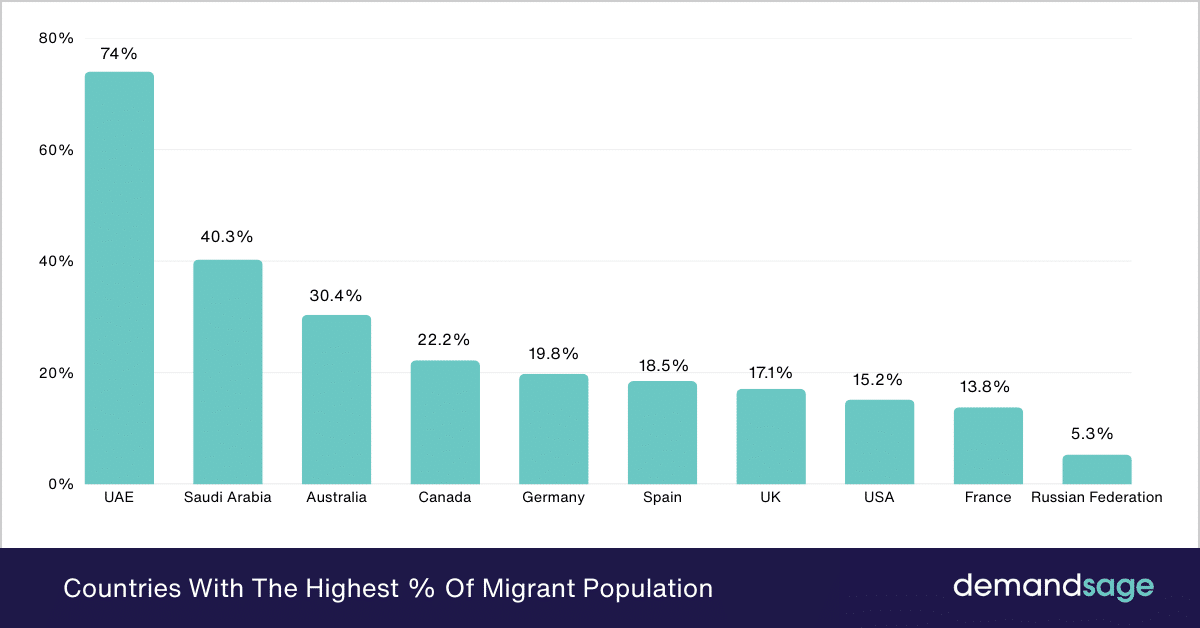
| Country | Migrants as % of Population (mid-2024) |
|---|---|
| United Arab Emirates | 74.0% |
| Saudi Arabia | 40.3% |
| Australia | 30.4% |
| Canada | 22.2% |
| Germany | 19.8% |
| Spain | 18.5% |
| United Kingdom | 17.1% |
| United States | 15.2% |
| France | 13.8% |
| Russian Federation | 5.3% |
Source: Migration Data Portal
How Many Illegal Immigrants Are In The US?
In 2023, the US had 14 million unauthorised immigrants, which was the highest number of unauthorised immigrants in that year.
Of the 51.8 million foreign-born population in the US in 2024, 14 million, about 27% were unauthorised.
The table below shows the number of illegal immigrants from 1990 to 2023:
| Year | Illegal Immigrants (millions) |
|---|---|
| 2023 | 14 |
| 2022 | 11.8 |
| 2021 | 10.5 |
| 2019 | 10.2 |
| 2015 | 11 |
| 2007 | 12.2 |
| 2000 | 8.6 |
| 1995 | 5.7 |
| 1990 | 3.5 |
Almost half (46%) of the US’s foreign-born population has now acquired naturalised citizenship.
In total, lawful immigrants accounted for 73% of the total US foreign-born population.
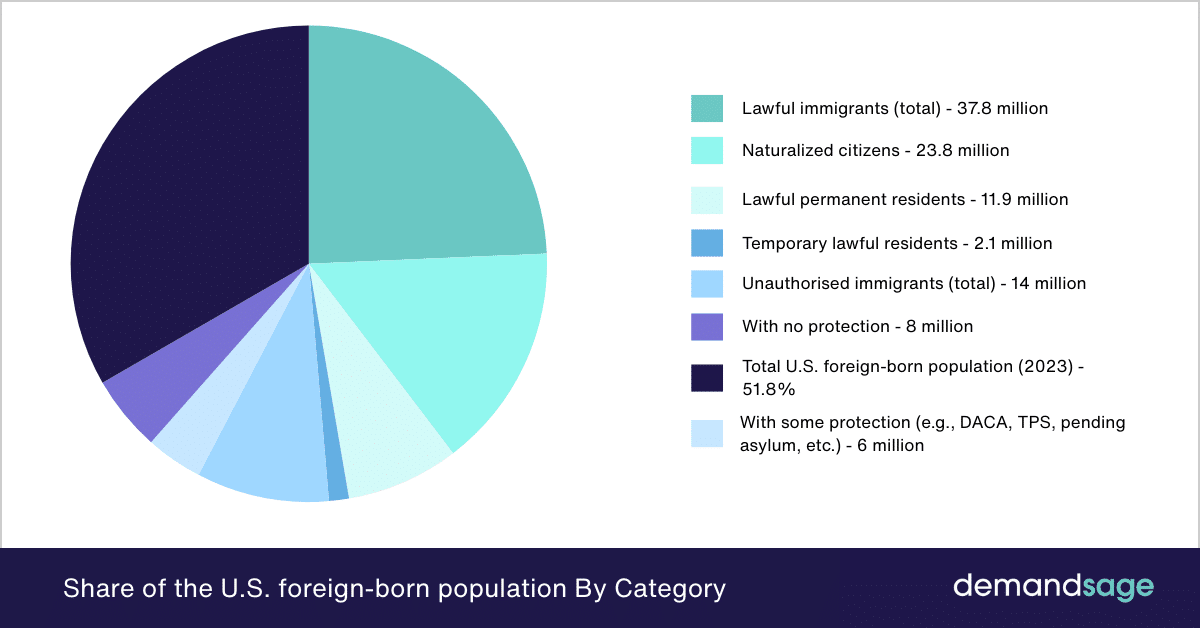
Here’s a table on the share of citizens, residents, and immigrants in the US in 2023:
| Category | Population (millions) | Share of the U.S. foreign-born population |
|---|---|---|
| Lawful immigrants (total) | 37.8 | 73% |
| Naturalized citizens | 23.8 | 46% |
| Lawful permanent residents | 11.9 | 23% |
| Temporary lawful residents | 2.1 | 4% |
| Unauthorised immigrants (total) | 14 | 27% |
| With some protection (e.g., DACA, TPS, pending asylum, etc.) | 6 | — |
| With no protection | 8 | — |
| Total U.S. foreign-born population (2023) | 51.8 | 100% |
Source: Pew Research Centre 2
How Many People Have Been Deported From The US Till Now?
About 34% of the 9 million deportations that occurred between 1892 and 2022 took place during the Obama administration, earning him the nickname “deporter-in-chief”.
Source: Texas Tribune
Similarly, ICE deported 271,484 noncitizens in the fiscal year 2024.
Source: ICE
The 271,484 figure surpasses the Trump-era record of 267,000 deportations that ICE carried out in FY 2019.
Source: CBS News
ICE logged 3.1 million deportations during Obama’s eight-year administration.
Source: TRAC
Some sources claim a total of 5.3 million deportations took place during his regime.
According to the Center for Immigration Studies, the figures for 1960–2009 represent combined removals and returns, totaling approximately 51 million immigration enforcement actions. Of these, about 12.2 million occurred during the Clinton administration.
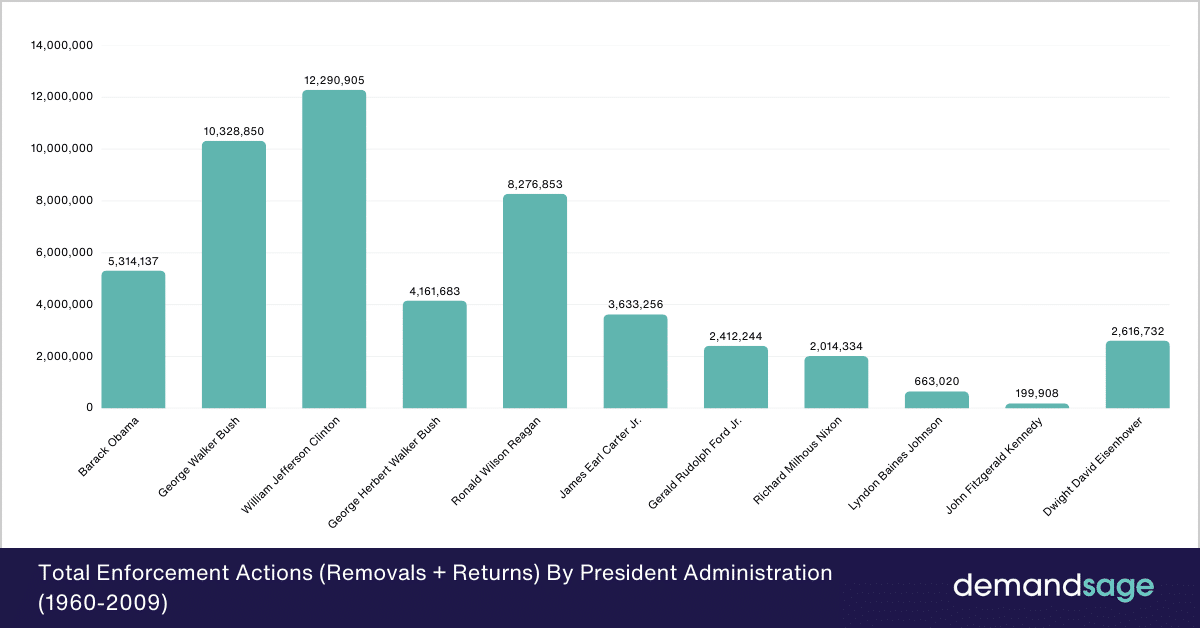
Below are the total removals + returns recorded during the administrations of different U.S. presidents.
| Presidents | Total Enforcement Actions (Removals + Returns) | Administration Period |
|---|---|---|
| Barack Obama | 5,314,137 | 2009-2016 |
| George Walker Bush | 10,328,850 | 2001-2008 |
| William Jefferson Clinton | 12,290,905 | 1993-2000 |
| George Herbert Walker Bush | 4,161,683 | 1989-1992 |
| Ronald Wilson Reagan | 8,276,853 | 1981-1988 |
| James Earl Carter Jr. | 3,633,256 | 1977-1980 |
| Gerald Rudolph Ford Jr. | 2,412,244 | 1974-1976 |
| Richard Milhous Nixon | 2,014,334 | 1969-1973 |
| Lyndon Baines Johnson | 663,020 | 1964-1968 |
| John Fitzgerald Kennedy | 199,908 | 1961-1963 |
| Dwight David Eisenhower | 2,616,732 | 1953-1960 |
Source: CIS
How Many People Have Been Deported In 2025?
Since President Donald Trump’s return to the White House, over 2 million “illegal aliens” have left the US, including 1.6 million who voluntarily self-deported and 527,000 who were deported.
Source: DHS
Separately, immigration judges have issued 470,213 removal orders in FY 2025 by August.
Source: TRAC Immigration
Deportations By Year
As per the latest information available, the Department of Homeland Security removed 359,885 “aliens” in 2019.
The table below shows removals from 2000 to 2019:
| Year | Removals |
|---|---|
| 2019 | 359,885 |
| 2018 | 328,716 |
| 2017 | 287,093 |
| 2016 | 331,717 |
| 2015 | 325,328 |
| 2014 | 405,090 |
| 2013 | 432,228 |
| 2012 | 415,607 |
| 2011 | 390,423 |
| 2010 | 382,449 |
| 2009 | 379,739 |
| 2008 | 359,795 |
| 2007 | 319,382 |
| 2006 | 280,974 |
| 2005 | 246,431 |
| 2004 | 240,665 |
| 2003 | 211,098 |
| 2002 | 165,168 |
| 2001 | 189,026 |
| 2000 | 188,467 |
Source: OHSS
In the fiscal year 2024, the US Immigration and Customs Enforcement (ICE) deported more than 271,000 unauthorised immigrants, marking the highest total since fiscal year 2014.
In the fiscal year 2014, under the Obama administration, ICE deported 316,000 and 267,000 unauthorised immigrants under the Trump Administration.
In the fiscal year 2021, during the early months of the Biden administration, ICE deported a record-low 59,000 unauthorised immigrants, primarily due to the COVID-19 pandemic and policies that shielded most unauthorised immigrants from deportation.
Source: CBS News
ICE Detention Statistics
ICE deported approximately 380,000 immigrants under the second Trump administration as of November 2025.
It held approximately 66,000 detainees as of November 2025.
Moreover, ICE held a peak of 56,000 detainees during the first Trump administration.
Source: CBS News
In addition to this, ICE conducted a total of 8,877 US immigration flights from January to September 2025.
Source: Human Rights First
ICE also arrested 21,293 of the 24,755 people booked into detention by ICE during September 2025.
The table below shows the total number of people booked into detention and by ICE:
| Date | Total | ICE |
|---|---|---|
| Sep-25 | 24,755 | 21,293 |
| Dec-24 | 22,122 | 7,884 |
| Dec-23 | 21,084 | 7,736 |
| Dec-22 | 17,610 | 5,983 |
| Dec-21 | 30,422 | 3,675 |
| Dec-20 | 8,621 | 6,068 |
| Dec-19 | 23,907 | 9,900 |
| Dec-18 | 44,418 | 10,818 |
Immigration and Customs Enforcement held 46,015 individuals in ICE detention as of September 21, 2025, according to current data.
The table below shows the total number of people ICE detained:
| Date | Total | ICE |
|---|---|---|
| 09/21/2025 | 59,762 | 46,015 |
| 12/29/2024 | 39,152 | 14,320 |
| 12/31/2023 | 37,131 | 10,870 |
| 12/18/2022 | 23,060 | 8,168 |
| 12/19/2021 | 20,623 | 4,629 |
| 12/30/2020 | 15,350 | 10,789 |
| 12/21/2019 | 41,933 | 17,887 |
Source: TRAC
US Immigrant Demographics
According to 2023 data, immigrants make up 77.1% of the US workforce (ages 16-64), highlighting their key role in the labour market.
In 2025, about 27.5% of the American workforce worked from home, a shift that has expanded employers’ hiring pools and increased opportunities for immigrants with remote-capable skills.
Foreign-born individuals represent 18% of those aged 65+ and 4.9% of those 0-15, showing immigration spans all age groups.
The table here shows how the US-born and foreign-born population is spread across the age groups in the US:
| Age Group | Foreign-Born Population | U.S.-Born Population |
|---|---|---|
| 0-15 | 4.90% | 21.40% |
| 16-64 | 77.10% | 60.90% |
| 65+ | 18.00% | 17.70% |
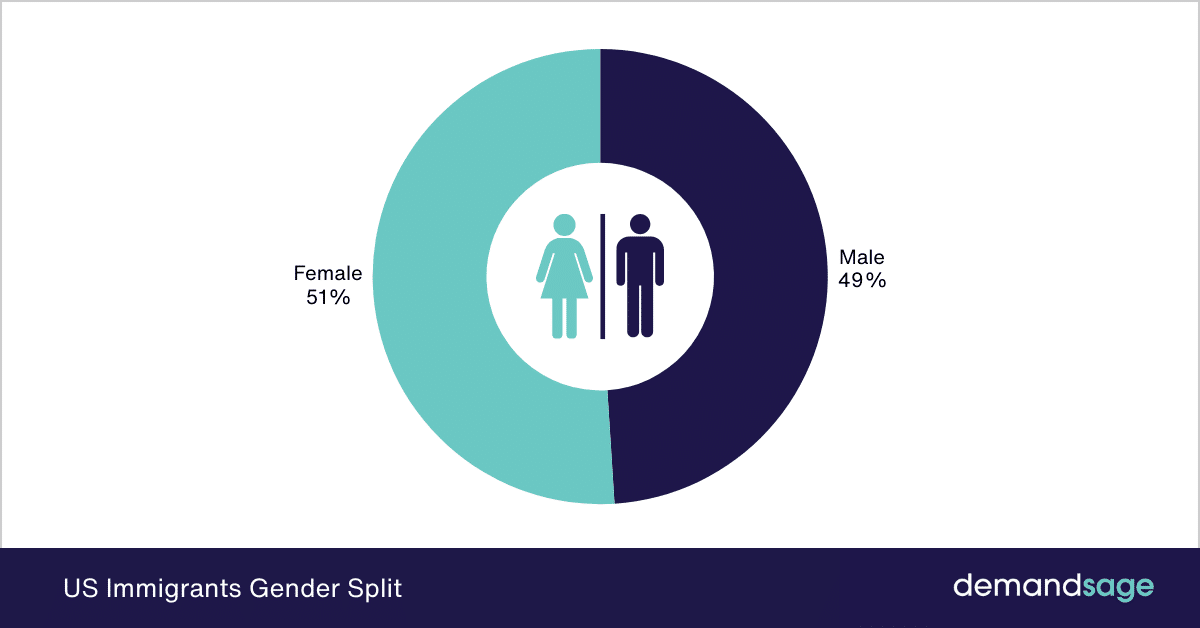
Among the 47.8 million immigrants, 51.0% were female and 49.0% male.
Out of all, Mexico had the largest share of immigrants with a 22.8% share.
Collectively, many other countries had a 59% immigrant share.
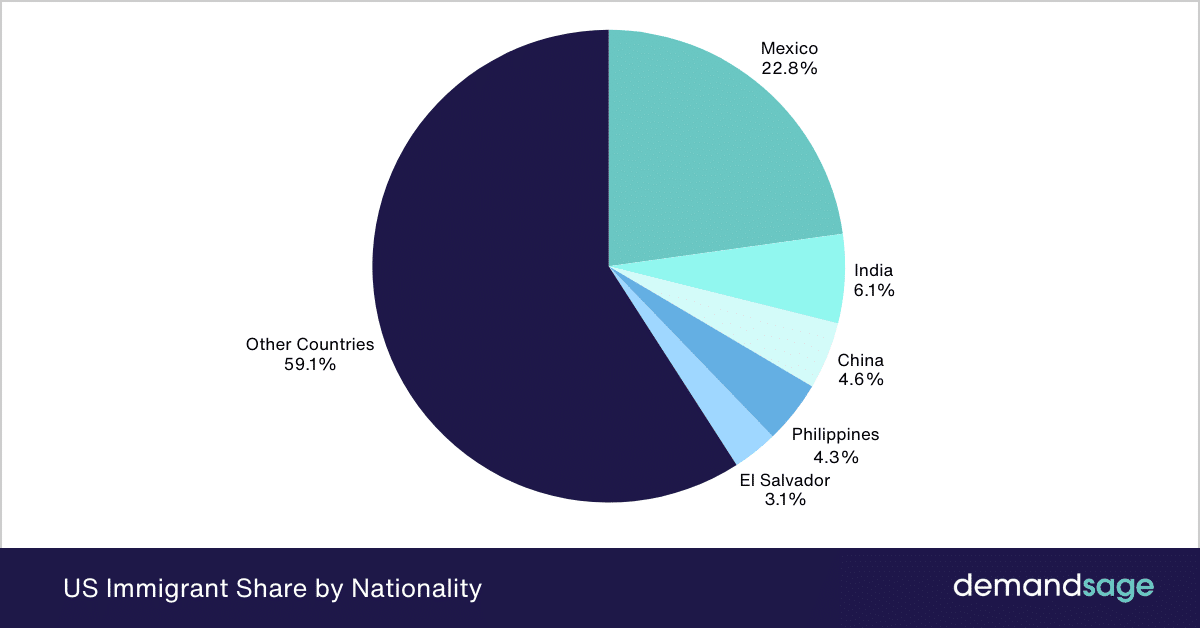
The table below shows countries with the highest immigration share:
| Country | Immigrant Share |
|---|---|
| Mexico | 22.8% |
| India | 6.1% |
| China | 4.6% |
| Philippines | 4.3% |
| El Salvador | 3.1% |
| Other Countries | 59.1% |
Source: American Migration Council
Economic Impact Of The US Immigration
The Congressional Budget Council (CBC) estimates that the greater level of immigration expected between 2024 & 2034 will boost gross domestic product (GDP) by $8.9 trillion.
Experts expect the total US population to grow by about 10 million by 2034 because of immigrants and their US-born children.
The immigration surge will add another $1.2 trillion in federal revenues by 2034.
Furthermore, analysts estimate that by 2034, annual federal revenue will be $167 billion higher because of immigration.
Source: CBO
The global gig economy, which is roughly 435 million gig workers in 2025, offers flexible entry points into employment for many immigrants who face barriers to formal hiring.
However, Trump’s immigration policies on illegal & legal immigration are projected to reduce the workforce by 6.8 million by 2028, and 15.7 million by 2035.
These immigration policies risk the potential loss of 19 million worker years by 2028 and 102 million worker years by 2035 to the US economy.
The policies would also reduce the projected US GDP by $1.9 trillion ($5,612/person) by 2028 & $12.1 trillion ($34,369/person) by 2035, substantially increasing the federal debt.
The U.S. average annual income was $62,192 in 2025, which is a useful benchmark when assessing immigrants’ earnings, tax contributions, and fiscal impact.
Source: NFAP
