
According to recent analyses, 12,195 confirmed data breaches were recorded globally, marking the highest total ever reported. From large-scale sensitive leaks to ransomware-driven healthcare disruptions, organizations faced unusual exposure, financial losses, and operational risk.
These Data breach statistics highlight the scale of today’s threat landscape and underscore why faster detection, stronger defenses, and improved incident response remain critical for businesses worldwide.
Top Data Breach Statistics for 2026
- A total of 12,195 confirmed data breaches occurred globally in 2025.
- Cyberattacks now happen approximately every 39 seconds worldwide.
- A massive collection of 16 billion leaked credentials was uncovered in 2025.
- Healthcare remained the most frequently breached industry worldwide.
- The average cost of a healthcare data breach reached $7.42 million.
- System intrusion accounted for 53% of all data breaches.
- The five largest breaches in the US exposed over 131 million records.
- Supply chain breaches averaged nearly one million records per incident.
- The United States accounted for 56% of global data breaches.
- The global average cost of a data breach stood at $4.4 million.
- In H1 2025, 1,732 U.S. data breaches exposed 165.7 million records, about 95,700 per breach.
Source: Bright Defence, Verizon, ITRC, IBM, Security Scorecard, Microsoft, James Clark, cybernews
How Many Data Breaches Occurred In 2025?
Verizon’s 2025 Data Breach Investigations Report analyzed 22,052 security incidents across 139 countries and confirmed 12,195 data breaches, marking the most extensive caseload recorded to date.
Cybersecurity incidents reached record levels, with global cyberattacks rising by 30%, reflecting the growing sophistication and persistence of threat actors worldwide.
At the same time, the Identity Theft Resource Center reported 2,563 data breach-related compromises in the first three quarters of 2025 alone. This represents a notable decline compared to 2024, yet the overall exposure remained substantial.
The United States accounted for 835 compromises in Q3 2025, resulting in more than 23 million victim notices.

The table below shows data breaches that occurred in the US:
| Year | Compromises | YoY Difference | YoY Difference % |
|---|---|---|---|
| 2025 (as of Q3) | 2,563 | -595 | -18.85% |
| 2024 | 3,158 | -44 | -1.37% |
| 2023 | 3,202 | 1,404 | 78.09% |
| 2022 | 1,798 | -61 | -3.28% |
| 2021 | 1,859 | 752 | 67.93% |
| 2020 | 1,107 | -171 | -13.38% |
| 2019 | 1,278 | – | – |
Beyond confirmed breaches, the broader threat environment remained extremely active.
Research from the University of Maryland indicates that a cyberattack is initiated approximately every 39 seconds, resulting in more than 2,200 attacks each day. Supporting this scale, Microsoft reported detecting over 600 million hostile signals daily in 2024.
Meanwhile, Amazon Web Services tracked nearly 750 million instances of malicious activity per day. During Q2 2025, Cloudflare alone mitigated roughly 7.3 million DDoS attacks, underlining the intensity of ongoing cyber threats.
Source: James Clark, Microsoft, LinkedIn, Cloudflare, ITRC 1, ITRC 2, Verizon
Most Recent Data Breaches
In June 2025, researchers identified a massive compilation of nearly 16 billion usernames, emails, and passwords, aggregated from infostealer malware logs and previously breached datasets, making it one of the largest credential collections ever documented.
The United States alone recorded 18.4 billion leaked data points, including 2.28 billion password-related exposures.
The table below highlights the biggest data breaches of 2025, detailing affected organizations, exposure scale, compromised data types, and the primary causes behind each incident:
| Entity/Incident | Date | Records Affected | Data Exposed | Description |
|---|---|---|---|---|
| UnitedHealth | January 2025 | 190 million | Health insurance info, medical records, and financial details | A ransomware attack by the BlackCat group led to $3.09 billion in losses, disrupted healthcare services, and exposed sensitive PHI. |
| TalkTalk | January 2025 | 18.8 million | Names, emails, IP addresses, phones | Third-party supplier breach; hacker sold data online. |
| PowerSchool | January 2025 | 60 million+ | Names, addresses, SSNs, medical info, grades | Compromised credentials exposed student and staff data; breach contained after detection. |
| Yale New Haven Health System | March 2025 | 5.5 million | Names, DOB, addresses, phones, emails, SSNs, medical records | A third-party file transfer vulnerability led to an $18 million lawsuit settlement. |
| Blue Shield of California | April 2025 | 4.7 million | Names, policy numbers, demographics, medical claims | Google Analytics misconfiguration transmitted data to third parties. |
| AT&T | May 2025 | 31 million | Names, DOB, tax IDs, contacts, IP addresses | As the hackers claimed, the leaked dataset affected customer metadata. |
| SK Telecom | April 2025 | 27 million | SIM data, IMSI numbers, authentication keys | Remote access trojan (BPFDoor) on Linux servers; led to a $96.9 million fine; suspected state-sponsored. |
| Zoomcar | June 2025 | 8.4 million | Names, mobiles, emails, addresses, vehicle details | Unpatched API weakness exploited. |
| Qantas | June 2025 (also noted October) | 5.7 million | Names, emails, phones, frequent-flyer details | Third-party Salesforce integration exploited by Scattered Lapsus$ Hunters; data leaked after ransom deadline. |
| Massive Credentials Leak (Google, Facebook, Apple, etc.) | June 2025 | 16 billion | Usernames, passwords, and emails from various platforms | A compilation of stolen credentials from infostealer malware and prior breaches was leaked, affecting billions of accounts across major tech platforms. Attributed to aggregated malware campaigns, one of the largest credential dumps ever. |
| Chinese Surveillance Network | June 2025 | 4 billion | WeChat data, bank details, Alipay profiles, phone numbers, addresses, behavioral profiles | A massive unsecured database was discovered, exposing PII on nearly every Chinese citizen for surveillance purposes. Considered one of China’s most significant leaks; no password protection on the 631GB database. |
| Aflac | June 2025 (clarified December) | 22.65 million | Names, contacts, DOB, SSNs, health info, insurance IDs | A scattered Spider-linked actor stole data for extortion, a significant hit in the insurance industry. |
| McDonald’s | July 2025 | 64 million | Names, emails, phones, resumes, birthdates | A compromise of the default password for the applicant tracking system led to data exfiltration. |
| TransUnion | July 2025 (also noted August) | 4.4 million | Names, SSNs, credit data | Misconfigured API in Salesforce integration; ShinyHunters is responsible. |
| Gmail Accounts | October 2025 | 183 million | Emails, passwords, metadata | Infostealer logs exposed via malware; part of broader credential theft trends. |
| Pornhub Premium (via Mixpanel) | December 2025 (disclosed in November) | 201 million | Emails, user histories, analytics data | ShinyHunters breached Mixpanel analytics, leading to extortion; the affected Pornhub users’ data was leaked after the ransom was unmet. |
Source: Cybernews, Spy Cloud, Kaspersky, Malwarebytes, Yahoo, ITRC, SC Media, Reuters, The Hipaa Journal, Cyber Press, Bitdefender, The Guardian, Security Week, Yale News, Bitdefender
Data Breaches By Industry
While data breaches affected nearly every sector, specific industries experienced disproportionately higher exposure.
Healthcare remained the most targeted industry overall, with breach activity peaking at 811 incidents in 2023, more than double the number recorded in 2022. Although the total declined in 2024 (by 275), healthcare continued to lead all sectors in breach volume.
Financial services also experienced a sharp escalation after 2021. Breaches increased from 269 in 2022 to 742 in 2023 and remained at a similarly elevated level in 2024 (737).
Additionally, manufacturing saw steady long-term growth in breach incidents, rising from 70 cases in 2020 to 317 in 2024, reflecting increased digitization across industrial operations.
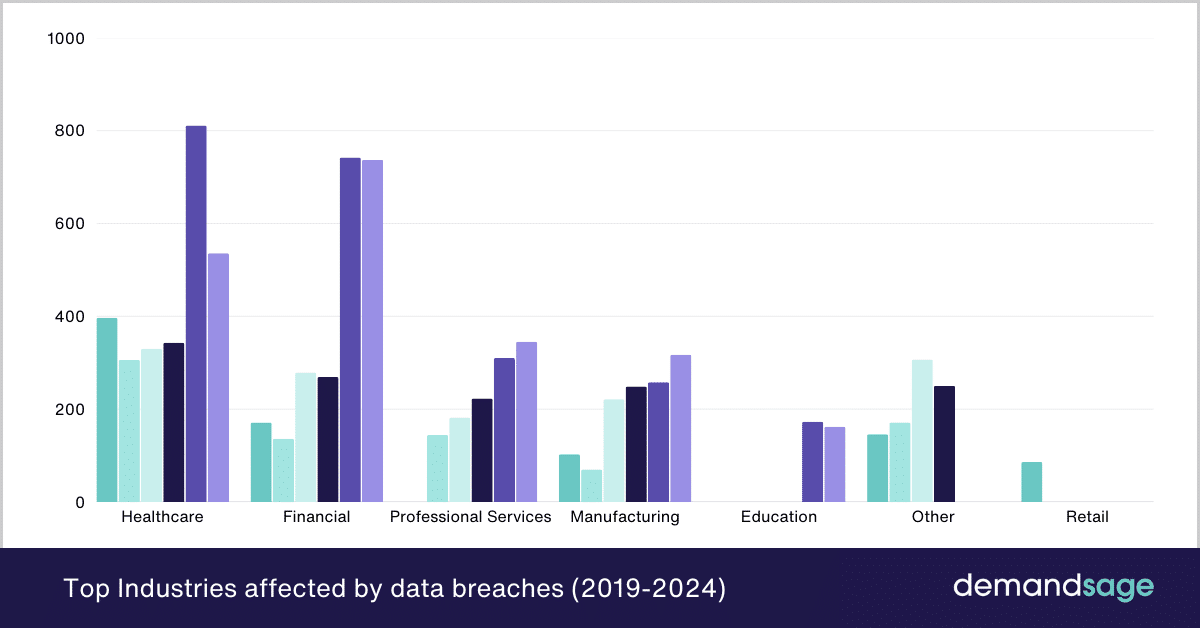
The table below presents the top industries affected by data breaches from 2019 through 2024:
| Industry | 2019 | 2020 | 2021 | 2022 | 2023 | 2024 |
|---|---|---|---|---|---|---|
| Healthcare | 397 | 306 | 330 | 343 | 811 | 536 |
| Financial | 171 | 136 | 279 | 269 | 742 | 737 |
| Professional Services | – | 144 | 182 | 223 | 310 | 345 |
| Manufacturing | 103 | 70 | 221 | 249 | 258 | 317 |
| Education | – | – | – | – | 173 | 162 |
| Other | 146 | 171 | 307 | 250 | – | – |
| Retail | 86 | – | – | – | – | – |
Source: ITRC
Healthcare Data Breaches Statistics: The Most Affected Sector
Healthcare continued to experience the most severe operational and financial consequences from data breaches. In 2025, the average cost of a healthcare data breach was $7.42 million. That’s a 24.05% decrease from 2024. Despite lower costs, healthcare breaches still took the longest to identify and contain, averaging 279 days.
In the United States, the health insurance market is expected to expand to nearly $318.41 billion by 2025, making the healthcare sector a desirable and vulnerable target for cyberattacks.
The Change Healthcare ransomware attack stands as the largest healthcare data breach in US history. The breach exposed the personal and medical data of an estimated 190 million individuals, impacting more than half of the US population.
Given that Change Healthcare processes roughly 15 billion healthcare transactions each year, the breach disrupted nearly one-third of all US patient records.
The operational fallout was severe. Delayed claims totaled approximately $14 billion, and surveys revealed that 80% of affected clinicians experienced revenue losses. More than half reported using personal funds to keep their practices operating during the disruption.
Here are some of the major healthcare data breaches of 2025:
| Year | Entity | State | Entity Type | Individuals Affected | Type of Breach |
|---|---|---|---|---|---|
| 2025 | Conduent Business Services | NJ | Business Associate | 10,515,849 | Hacking/IT Incident |
| 2025 | Yale New Haven Health System | CT | Healthcare Provider | 5,556,702 | Hacking/IT Incident |
| 2025 | Episource, LLC | CA | Business Associate | 5,418,866 | Hacking/IT Incident |
| 2025 | Blue Shield of California | CA | Business Associate | 4,700,000 | Hacking/IT Incident |
| 2025 | DaVita Inc. | CO | Healthcare Provider | 2,689,826 | Hacking/IT Incident |
| 2025 | Anne Arundel Dermatology | MD | Healthcare Provider | 1,905,000 | Hacking/IT Incident |
Source: The HIPAA Journal, Daily Journal, IBM
Data Breaches By Attack Type
System Intrusion accounted for 53% of all data breaches, making it the most common attack type. This category primarily includes ransomware, vulnerability exploitation, and multi-stage intrusion campaigns.
Social Engineering was responsible for 17% of breaches, reflecting the continued effectiveness of phishing, pretexting, and human manipulation tactics in breaching organizational defenses.
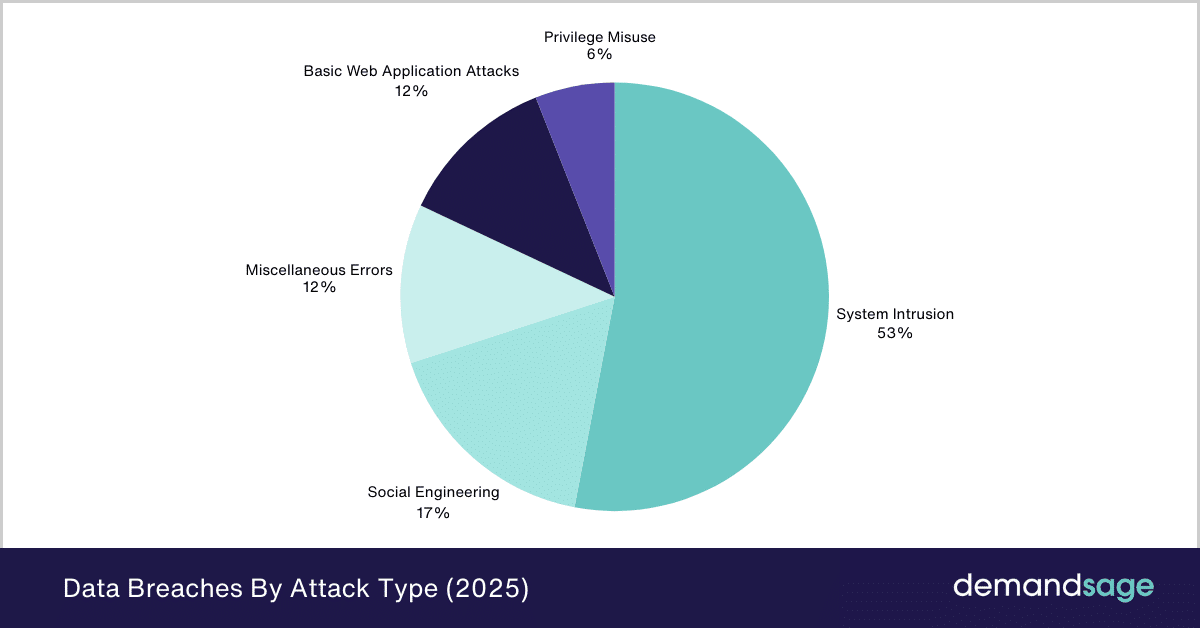
| Attack Type | Percentage of Data Breaches (2025) |
|---|---|
| System Intrusion | 53% |
| Social Engineering | 17% |
| Miscellaneous Errors | 12% |
| Basic Web Application Attacks | 12% |
| Privilege Misuse | 6% |
Source: Verizon
Records Exposed Per Breach
In H1 2025, 1,732 data breaches exposed 165,745,452 records in the US, with an average of approximately 95,700 records per breach, highlighting the continued scale of individual incidents.
Large-scale breaches heavily skew exposure levels, as the top five incidents alone accounted for over 131 million exposed records, meaning a small number of breaches caused the majority of total data exposure.
Supply chain attacks greatly increased records exposed per breach, with just 79 incidents impacting 78.3 million records, averaging nearly 991,000 records per incident, far exceeding the overall breach average.
Source: ITRC
Global vs. US Data Breach Statistics
The United States third-party breach rate stands at 30.9%, which is 4.6 percentage points below the global average of 35.5%. This counterintuitive finding, given the US’s leading position in total breach volume, reflects the dominance of direct attacks (particularly in healthcare) over supply chain compromises.
Of the 1,000 breaches analyzed by SecurityScorecard, the US accounted for 56% of all global breaches but only 48.7% of the third-party violations, demonstrating a disproportionate share of non-third-party incidents.
| Country | Share of All Breaches | Share of Third-Party Breaches | Third-Party Rate |
|---|---|---|---|
| United States | 56% | 48.7% | 30.9% |
| Japan | 9.4% | 15.8% | 60.0% |
| Netherlands | 2.7% | 5.4% | 70.4% |
| United Kingdom | 4.3% | 4.5% | 37.2% |
| Australia | 3.2% | 4.5% | 50.0% |
| Canada | 3.0% | 3.7% | 43.3% |
| Philippines | 2.9% | 2.5% | 31.0% |
| Germany | 1.7% | 2.3% | 47.1% |
| India | 2.0% | 2.0% | 35.0% |
| Singapore | <1% | 1.4% | 71.4% |
| Taiwan | <1% | 1.1% | 57.1% |
| Global Average | 35.5% |
Source: Security Scorecard
Cost Of A Data Breach
The average cost of a data breach worldwide is $4.4 million.
But in the US, the average cost of a data breach is $10.22 million.
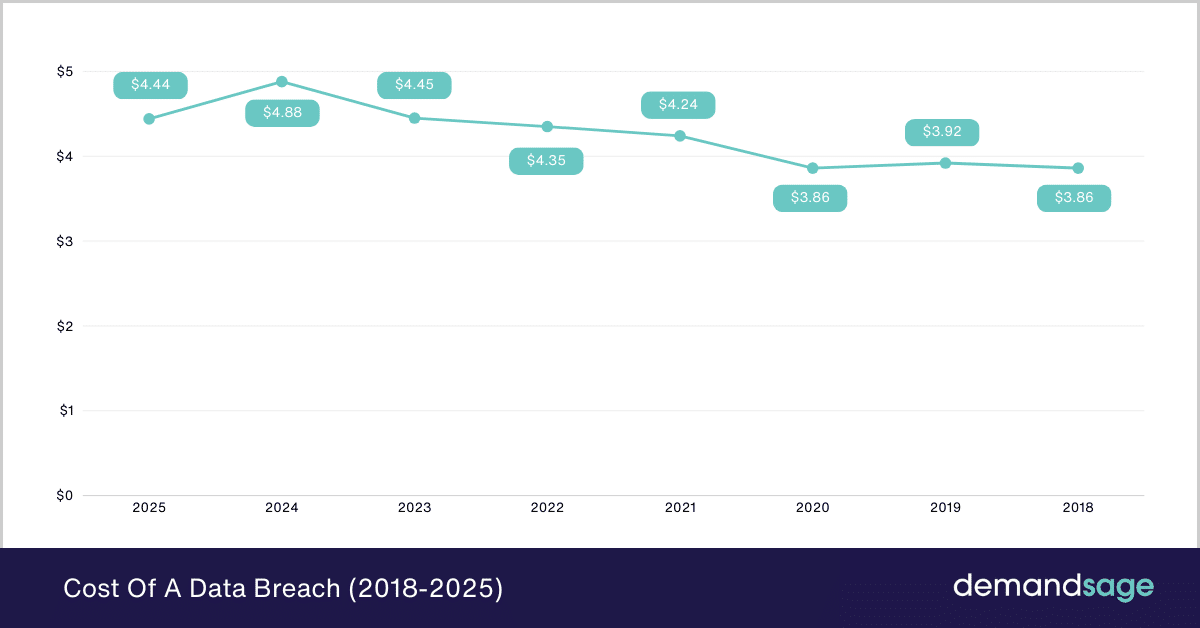
The table below shows growth in the average data breach cost from 2018 to 2025:
| Year | Value (billion) | YoY Difference ($ billion) | YoY Difference (%) |
|---|---|---|---|
| 2025 | $4.44 | -0.44 | -9.02% |
| 2024 | $4.88 | 0.43 | 9.66% |
| 2023 | $4.45 | 0.1 | 2.30% |
| 2022 | $4.35 | 0.11 | 2.59% |
| 2021 | $4.24 | 0.38 | 9.84% |
| 2020 | $3.86 | -0.06 | -1.53% |
| 2019 | $3.92 | 0.06 | 1.55% |
| 2018 | $3.86 | – | – |
Source: IBM
Did you Know? Among Data breaches, identity theft was among the most expensive, accounting for a loss of $12.5 billion in 2024.
In the US, the average cost of a data breach is $10.22 million, higher than the global average of $4.4 million as seen above.
The United States has seen a 9.19% increase in data breach costs.
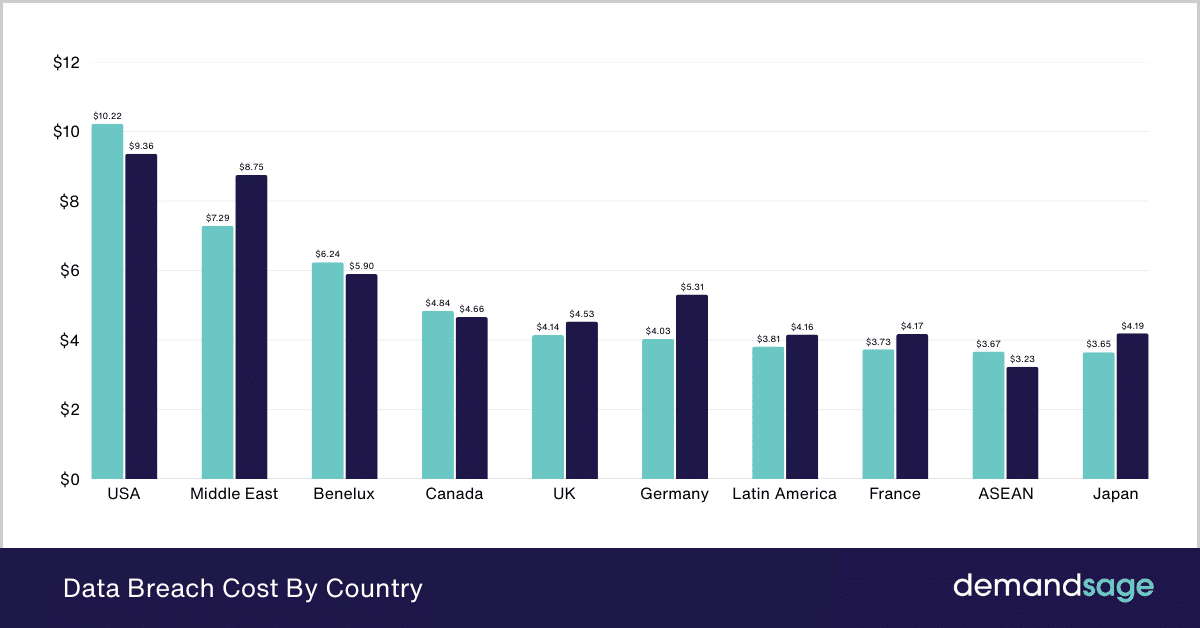
| Country | 2025 Data Breach Cost (Billion) | 2024 Data Breach Cost (Billion) | YoY Growth |
|---|---|---|---|
| United States | $10.22 | $9.36 | 9.19% |
| Middle East | $7.29 | $8.75 | -16.69% |
| Benelux | $6.24 | $5.9 | 5.76% |
| Canada | $4.84 | $4.66 | 3.86% |
| United Kingdom | $4.14 | $4.53 | -8.61% |
| Germany | $4.03 | $5.31 | -24.11% |
| Latin America | $3.81 | $4.16 | -8.41% |
| France | $3.73 | $4.17 | -10.55% |
| ASEAN | $3.67 | $3.23 | 13.62% |
| Japan | $3.65 | $4.19 | -12.89% |
Source: IBM
Data Breach Prevention & Recovery Statistics
Faster detection and response continued to drive meaningful cost reductions in 2025. The mean time to identify a breach dropped to 181 days, while the mean time to contain fell to 60 days. This combined 241-day lifecycle represents a nine-year low and reflects growing adoption of AI-driven security tools.
Speed directly correlates with cost savings. Breaches with a lifecycle under 200 days averaged $3.87 million, compared to $5.01 million for breaches exceeding 200 days, a $1.14 million differential representing 29% cost reduction. Organizations achieving detection in under 200 days save an average of $1.14 million compared to slower detection cycles.
According to a report, 30% of surveyed organizations extensively used AI for data breach prevention. Of them, 43% used AI in a limited capacity, and 27% had no AI integration for data breach prevention.
In the United States, just over half of organizations (51%) were able to fully recover from ransomware attacks within one week, at an average recovery cost of USD 1.91 million.
Germany reported a higher recovery rate, with 64% of organizations regaining operations within a week and incurring an average cost of USD 1.56 million.
In Japan, recovery timelines were similar to those in the U.S., with 50% of organizations achieving full recovery within one week, and average recovery costs were significantly lower at USD 0.67 million.
Organizations in the United Arab Emirates demonstrated relatively strong resilience, with 63% recovering within one week and an average recovery cost of USD 1.41 million.
On the other hand, Switzerland showed moderate recovery performance, with 58% of organizations back to normal operations within one week at an average cost of USD 1.04 million.
India experienced a slightly slower recovery overall, with 48% of organizations recovering within one week and average recovery costs reaching USD 1.01 million.
Source: Bright Defence, Baker Donelson, Total Assure
