
SEO has evolved, and there’s no arguing about it. We went from finding tips on how to rank on SERPs to now tips on how to rank on ChatGPT.
All because people now use ChatGPT to get their answers. And citing your website by ChatGPT doesn’t happen magically. It requires equal or even more effort than we used on traditional rankings on Google.
While you might hear about “guaranteed methods” that work to rank your business on ChatGPT, this might not be true. You need to be aware of the factors that ChatGPT actually considers to evaluate if a source is to be cited as part of the response.
Even then, you can only increase your chances of ranking for ChatGPT search, but not guarantee it. Let’s uncover all the details!
How Does ChatGPT Rank and Cites (Features) Content?
Ever since ChatGPT search was introduced in October 2024, it is known that the sources that ChatGPT uses in its responses are dependent on:
- The quality of the sources
- Right information
In the majority, ChatGPT relies on pretrained data for any query that is not very recent, and also relies on real-time information for the asked query.
It also states that the information it provides is based on the users asking questions more naturally and conversationally. While that’s the beginning of getting an answer to a particular question, ChatGPT will also consider you asking any question as a follow-up related to it.
This signals that ChatGPT highly supports conversational queries, as well as a well-structured piece of information on a website or a blog.
Here’s a snapshot from their SearchGPT release announcement:
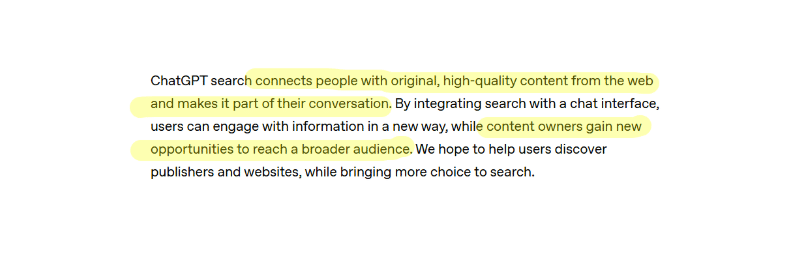
It further states that,
“ChatGPT search leverages third-party search providers, as well as content provided directly by our partners, to provide the information users are looking for.”
While the above is a theoretical explanation of how ChatGPT operates in terms of citing sources as part of its response, here is a practical example to show how ChatGPT ranks content:
I asked ChatGPT a basic question that had always made me curious about the details of users using ChatGPT. I knew this involved statistical data and bifurcation of users from different countries, revenue, and demographics.
So, as a website manager, I need to understand this part and cover my website or page in such a way that all the reader’s questions that may be long-form queries are answered.
In the screenshot below, I am asking ChatGPT a longer question rather than a static standard keyword that works best for Google, given the conversational nature of ChatGPT and the user intent.
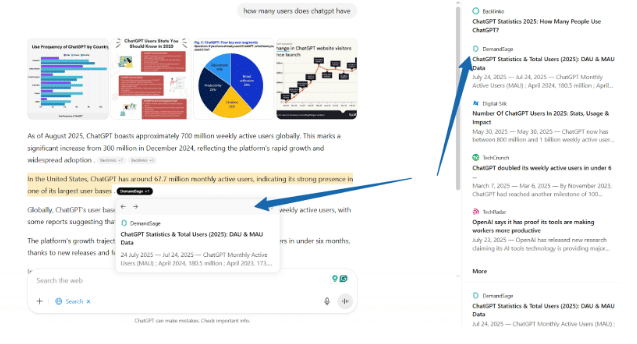
I further went on to ask ChatGPT what its reasons were to cite Demandsage as a response, and what the factors it considers while using any source as part of the solution.
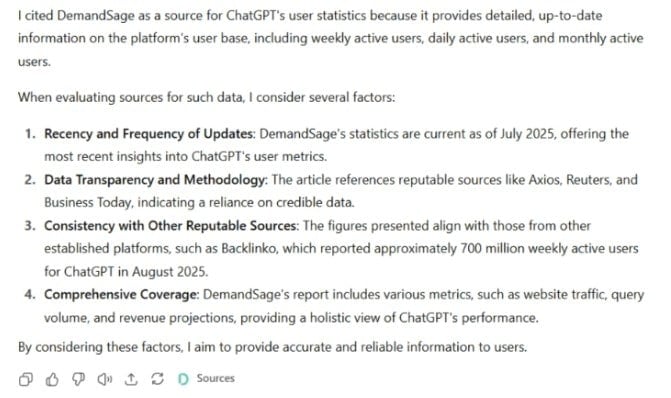
ChatGPT states that, for this instance, it considered the relevance, credibility, and timelines.
To get an explanation further, I asked ChatGPT if these factors are considered for each query that it answers.
Here is what ChatGPT answered:
“I checked the website and its content to see if it directly answers the reader’s question. I also checked if the page provides actual factual information or a working way to get further action on the reader’s query.”
Universal Factors That ChatGPT Uses To Cite A Website In Its Response
Upon further conversation with the latest ChatGPT 5 model, it states that the four key factors that it always considers to rank any website in its responses are:
- Relevance
- Crediblity
- Freshness of the content
- Cross verification
Supporting factors that we noticed that have been working for us when ChatGPT cites us in its responses are:
- Coupon/deal info – Timeliness is critical.
- Legal/regulatory info – Authority is critical.
- Opinion or strategy articles – Relevance and author expertise matter more
While this is not just our take, a lot of website owners have been of the same opinion that ChatGPT actually favors semantically structured websites that actually answer the reader’s questions without being vague.
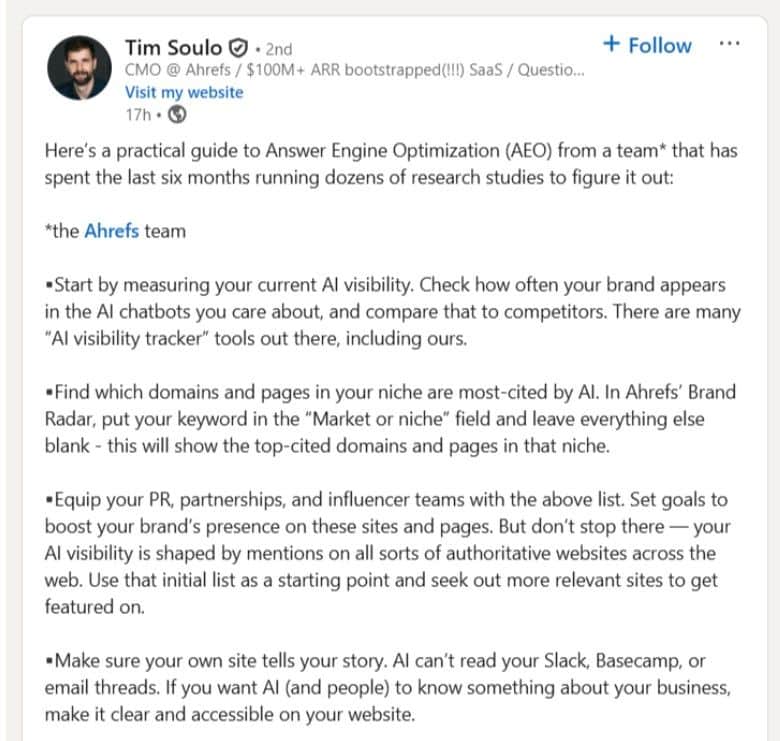
1. Example #1 – Tim Soulo (CMO @Ahrefs)
Tim suggests covering emerging topics early and building clusters of related questions around a given topic, amongst many other things, from this LinkedIn post.
2. Example #2 – Steve Toth (Top SEO Expert)
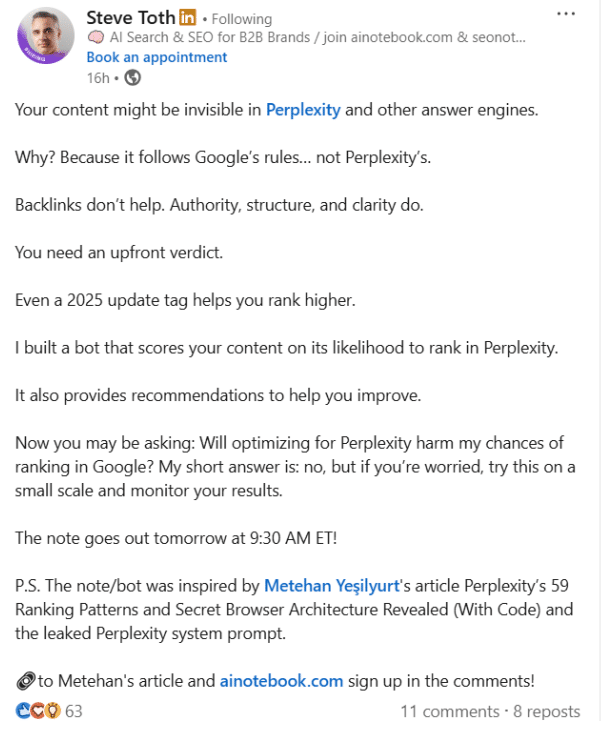
In this recent post, Steve explains how Perplexity (another answer engine) works as compared to Google.
Read this post to understand how ChatGPT vs Perplexity works in terms of ranking your website.
3. Example #3 – Matt Diggity (CEO @Diggitymarketing)
Next, this is a post on X by Matt Diggity that talks about a lot of things, and mentions a key point we discussed as well, where he says, “Speak like a human. Write like one too.”
AI search doesn’t play by Google’s rules.
— Matt Diggity (@mattdiggityseo) August 14, 2025
But it’s way easier to game.
Unlike traditional SEO, you can show up in AI search results in days… if you know what you’re doing.
The kicker?
Customers from AI recs are 4.4x more valuable than your average Google click (source:…
Here is a list of the top SEO experts to follow and be updated about more such insights on working towards optimizing for Answer Engines.
Can You Guarantee To Rank On ChatGPT?
I’ve seen a lot of posts on LinkedIn by many SEO professionals claiming to have ‘cracked the code’ for ranking on ChatGPT. However, this is not entirely true; you cannot guarantee rankings on ChatGPT.
Nobody can actually claim to guarantee mentions in ChatGPT responses for user queries. As someone in the quest for ranking keywords and pages on Google for the past 10 years, I have realized that ChatGPT vs Google are two different things.
While Google has ‘Google Search Central,’ where it regularly shares supporting data on how it updates its algorithms and what changes it is introducing to its search engine, we don’t have anything of that sort from ChatGPT.
Whatever data we have right now is purely experimental and based on industry experts and their tests. So, ideally, it is not fair to believe that there is a direct way to guarantee rankings on ChatGPT.
I recently was able to get 15,000+ sessions from ChatGPT alone for one of our projects, and I aim to reach more.
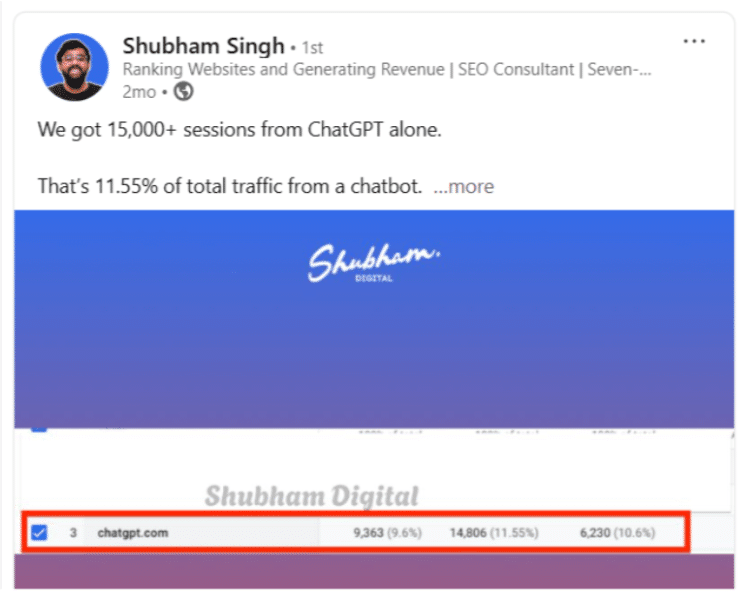
We are still in the testing phase and trying to figure out how to maximize the mentions from ChatGPT
5 Best Practices To Optimize Your Content for AI Readability and Citation?
Ever since ChatGPT started having its share in our website traffic, we have been A/B testing for the past year and have developed a kit to position our content better for AI crawling and citation.
While these are not practices that guarantee rankings, doing this has surely helped us in many ways.
1. Structured & Semantic Content
The first and the most basic trick from the handbook of web content writing is to cover content semantically and have a clear heading structure utilizing H1, H2 & H3 tags effectively.
Next is to cover the content of your website that is easy for the AI to scan and navigate. Think of adding bullet points and numbered lists wherever possible.
Whenever planning to write content and copy for an AI citation, ask yourself three times if you are answering the reader’s question directly and are not giving a vague answer.
Lastly, cover FAQs related to your product and service well, as a direct Q&A approach is favored by AI.
2. Covering Conversational & Intent-Based Keywords
Ensure you are using conversational keywords and queries for your website. For example, if your business involves selling ‘Christmas trees,’ you should try to structure your website and its keyword usage.
In this case, the keywords that can help you cover well-optimized content can look like this:
- Best Christmas trees for small apartments
- How to decorate a Christmas tree with lights
- How long do real Christmas trees last after cutting
- How to keep a real Christmas tree fresh longer
- Best Christmas trees for outdoors with lights
A quick thumb rule to optimize your content for AI is to keep your content around these points:
- Beyond Exact Match
- Question-Based Phrases
- Semantic SEO
3. Authority & Trust Signals (E-E-A-T for AI)
This next trick takes some time to master, and if your website is relatively new, gaining authority or credibility will require a significant amount of work and will depend on several factors, including niche, content, backlinks, and the overall website health score.
You can follow these four points in order to start your journey towards a high authority website and build better trust signals for AI.
- In-Depth, Expert Answers: Provide detailed, user-centric, and well-researched content.
- Data & References: Cite sources, statistics, and industry benchmarks from credible sources.
- Real-World Examples & Case Studies: Make sure your content is tangible and verifiable.
- Brand Mentions & Backlinks: Build a strong digital footprint across various platforms (forums, directories, guest posts).
Read more about EEAT and its ranking factors from this guide from Google Search Central.
4. Technical Accessibility
Turning towards the technical soundness of the content, always keep a check on your URLs and their structures. Always keep them descriptive and short.
The Google Search Central guide on URL structure states that you should:
- Follow IETF STD 66
- Don’t use URL fragments to change content
- Always use a common encoding for URL parameters
Along with this, always ensure that your website is well optimized for mobile devices, as 63.38% of internet traffic is from mobile devices.
5. Content Freshness & Updates
Lastly, for whatever type of content you cover or website you are running, always ensure that it provides the most up-to-date data about your product or service.
As we saw above, one of the key factors that ChatGPT considers to rank something is also the recency and frequency of content being updated. From our experiments, we found that AI truly values dynamic, continuously improving resources.
What’s the Difference Between AEO and SEO?
The main difference between AEO and SEO is the ground that it covers, and also the type of queries it covers.
Here are more details about the differences between AEO and SEO:
| Parameters | AEO | SEO |
|---|---|---|
| Objective | Serving queries of users with direct answers | Working to improve website traffic and rankings |
| Users targeted | Long form and conversational queries | Standard key search terms |
| Devices & Search types involved | Mobile and voice searches, and AI assistants are focused on more | Desktops and mobile searches for standard search engines |
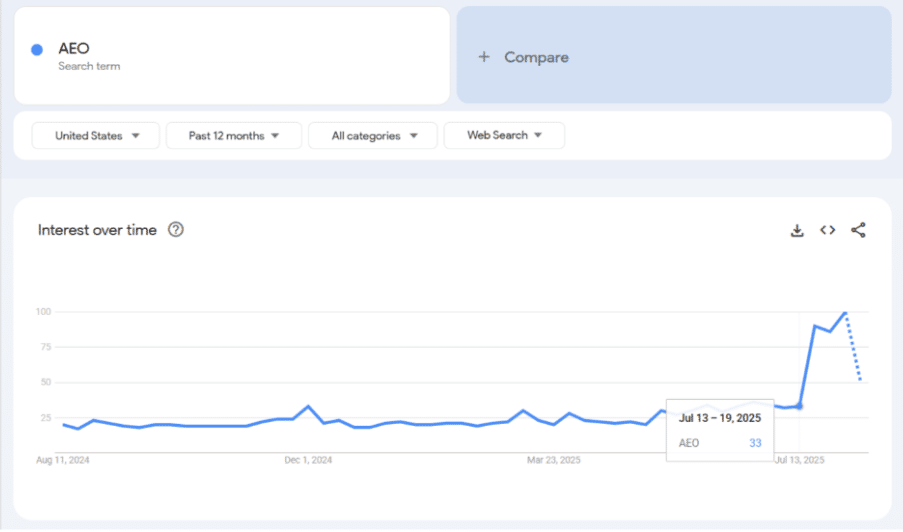
You must have heard this new term, AEO, meaning Answer Engine Optimization. This term, AEO has gained much popularity amongst users, especially in the past year.
What does Answer Engine Optimization exactly mean?
AEO simply means an evolved type of SEO that caters to answer engines, which involves optimizing online content, for it to appear as direct, concise, and yet provide authoritative answers to user queries.
As the ‘Search’ evolves, and more ways to get answers for a user are introduced, this practice of ‘optimization’ will also surely evolve into something new.
In summary, AEO is just SEO, where search engines have evolved into a direct way to get answers and get actionable responses.
Conclusion: Ranking on ChatGPT Needs You To Follow a New Strategy
The year 2026 brings us, along with every SEO professional who has been trying to catch the Google bot’s attention for a while now, another target to chase.
Ranking on ChaGPT requires you to unlearn and relearn everything you know about ranking websites and content. The ‘search’ as you knew it is changing and is more catered towards conversational queries.
To ensure you increase your chances of ranking on ChatGPT, make sure you are following all the basics correctly, and keep yourself updated on the latest trends and what’s working for marketers.
The best thing to do right now is to experiment with this and figure out what works best for your website to rank on ChatGPT!
FAQs
ChatGPT focuses on user-centric, informative content that directly answers the reader’s questions.
To improve your chances of ranking on ChatGPT, focus on covering content that caters to long-form queries, building healthy trust signals for your website, maintaining proper URL structure, and keeping the content updated.
No one can guarantee rankings from search engines, given the complex pattern they use to consider a piece of information as credible enough to cite.
