
Before we start, here is a disclaimer.
Semrush One and Profound share some similarities, but neither is built to solve the same problem in the same way.
Semrush One is a complete marketing & SEO platform with the ability of its AI Visibility toolkit. On the other hand, Profound is a purpose-built solution for AEO (Answer Engine Optimization) and AI search visibility.
So, comparing the entire Semrush One against Profound would be misleading and unfair for both platforms. So, this article does not attempt to do that.
Instead, this is an unbiased comparison of a more relevant benchmark: Semrush One’s AI Visibility capabilities vs Profound’s core AEO and AI search intelligence.

What is
Semrush One?
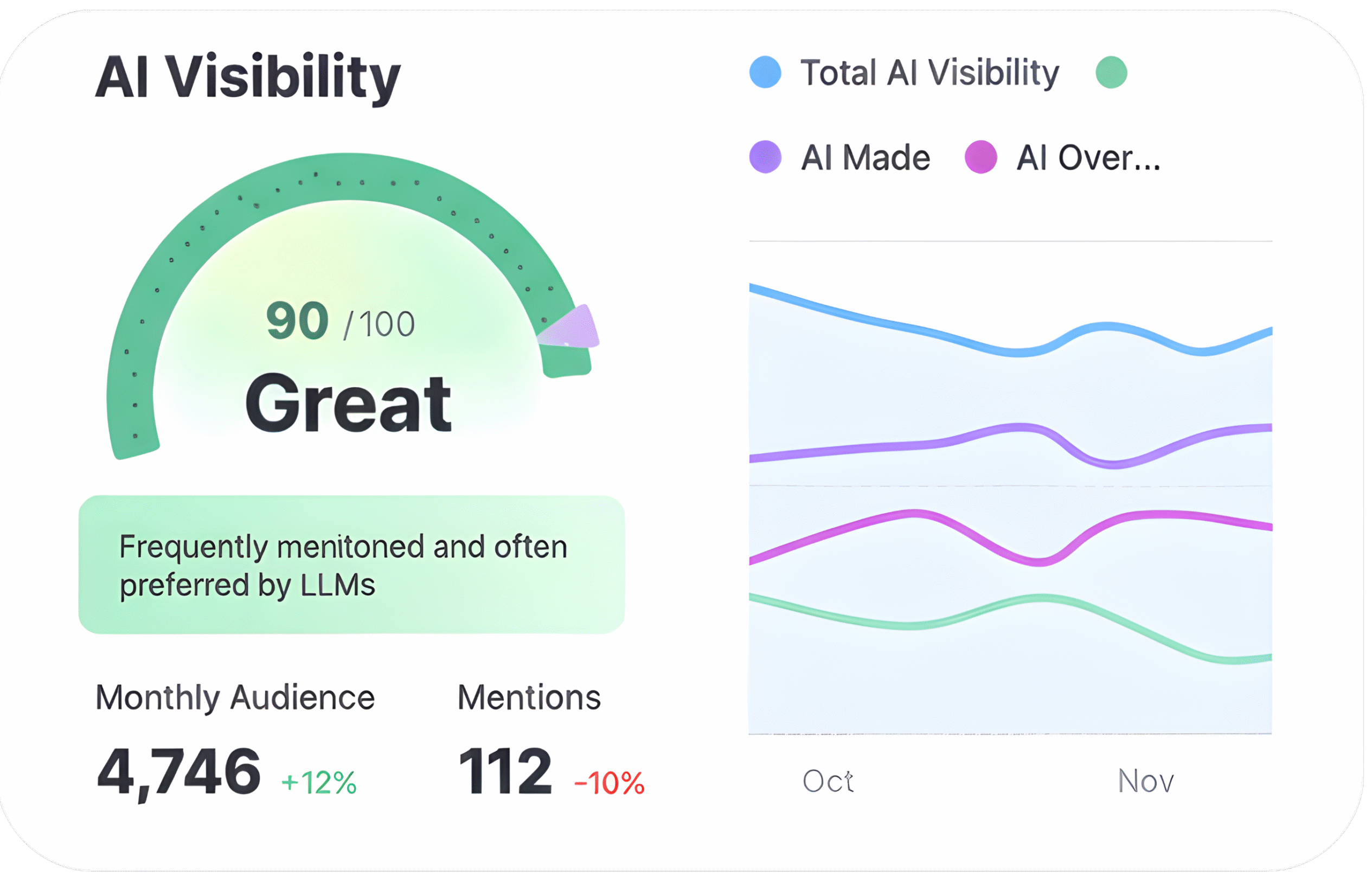
Semrush One ve Profound: A Quick Comparison
After reviewing both Semrush One and Profound, I found that both platforms have the capability to break down how AI visibility works. But both come up with different approaches and target different audiences. Here is a quick comparison to understand the differences:
| Category | Semrush One | Profound |
|---|---|---|
| Core positioning | All-in-one SEO platform with AI visibility built in | Dedicated AI search and AEO analytics platform |
| Primary focus | SEO + AI discovery in a single workflow | AI engines, answers, prompts, and agents only |
| AI search coverage | Google AIOs, Google AI Mode, ChatGPT, Gemini & Perplexity are available from Starter | Starter is ChatGPT-only; multi-LLM (10+) coverage unlocked in Growth and Enterprise |
| Prompt research | Prompt Research Report focused on topic discovery, intent, and prioritization | Prompt Volumes focused on AI search demand and trends from real conversations |
| Prompt tracking | Structured prompt tracking tied to projects and competitors | Answer-level prompt tracking with model-by-model comparisons |
| AI visibility metrics | AI Visibility Score, AI Share of Voice, trend reporting | Per-engine visibility, answer analysis, and brand benchmarks |
| Competitive analysis | Quantitative comparison based on mention frequency | Qualitative comparison based on recommendation strength and framing |
| Answer-level visibility | Limited, summarized views | Full AI answers are shown and compared directly |
| Sentiment and framing | High-level sentiment indicators | Detailed brand framing, descriptors, and narrative analysis |
| Source and citation insights | Links AI visibility back to owned content and topics | Tracks external citations and authority sources used by AI |
| Site health and AI crawlers | Site Audit with AI Search Health checks (bots, schema, crawlability) | Agent Analytics using server-side logs for AI crawler behavior |
| SEO tooling | Complete SEO toolkit included (keywords, audits, backlinks, content) | No SEO tools included |
| Agent and bot analytics | Limited to audit checks | Detailed bot IDs, IP ranges, crawl frequency, AI referrals |
| Additional AI features | Narrative drivers, questions report, topic gaps, AI KPIs | Prompt Volumes, Conversation Explorer, Profound Index, AI workflows |
| Reporting and exports | Strong built-in reports and exports for SEO + AI | Designed for BI integration, datasets, and experimentation |
| Ease of adoption | Very high for existing SEO teams | Moderate to high learning curve |
| Best suited for | SEO teams, agencies, lean in-house marketing teams | Growth, data, and enterprise AI search teams |
| Pricing Structure | AI visibility included in all plans (starting from $199/month) | Completely focused on AI visibility (Starting from $99/month) |
| Free Trial | 14 Days (Exclusive) | 7 Days |
| Entry-level value | Strong multi-LLM coverage from Starter | The starter is limited and mostly exploratory |
| Overall strength | Unified search visibility with minimal tool stretch | Deep AI behavior, demand, and agent-level analysis |
Read our in-depth Semrush One review to know more about its AI and SEO capabilities.
Now, let’s compare their AI features and accuracy in detail.
Semrush One vs Profound: AI Search & LLMs Coverage
Profound covers more LLMs than Semrush One. But it depends on which plan you are on. Semrush One’s AI & LLMs coverage is the same for all of its plans.
AI Search Coverage By Semrush One
From the Starter plan, Semrush One lets you track how your brand appears across Google AIOs & AI Mode, Perplexity, ChatGPT, and Gemini.
Semrush One is built around the idea that modern search happens across multiple surfaces, not just in classic SEO or in SERPs. Its AI Visibility toolkit is designed to sit inside the same workflow you already use for SEO.
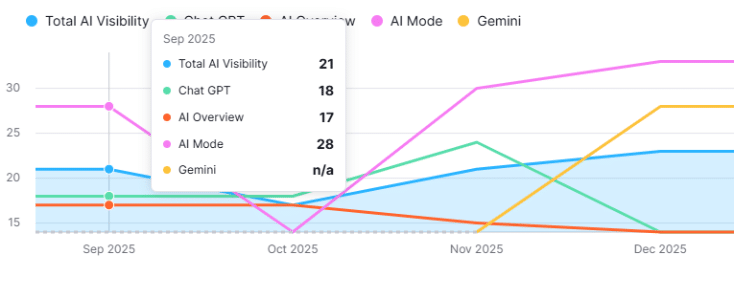
What makes this setup practical is that AI visibility is tied directly to the same URLs & domains, competitors, and projects you already track for rankings and traffic. You are not managing a separate AEO environment. AI visibility becomes another layer of discovery data inside your SEO setup.
AI Search Coverage By Profound AI
If you are using Profound, you should know that it doesn’t do SEO audits or track Google rankings at all. SEO is assumed to be handled elsewhere.
Profound is built entirely around AI engines and answer systems. It analyzes how models talk about your brand inside generated responses, not how your pages rank.
At the Starter level, Profound’s coverage is narrow. You mainly get visibility into ChatGPT, along with a limited number of tracking prompts. This is enough to understand whether your brand appears, but not enough to compare behavior across platforms.
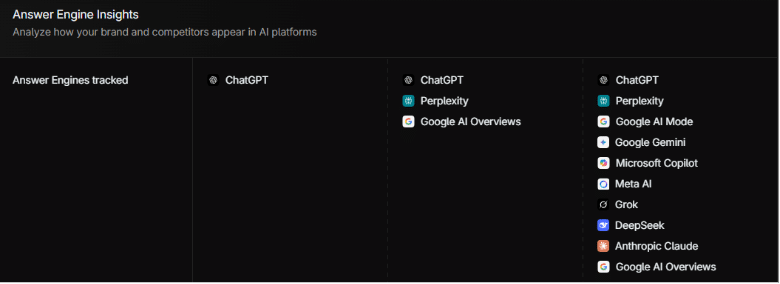
The real depth appears in higher tiers. Growth plan covers up to 3 LLMs, while Enterprise plan expands coverage to:
- ChatGPT
- Google AI Mode and AI Overviews
- Google Gemini
- Microsoft Copilot
- Perplexity
- Grok AI
- Meta AI
- Claude AI
- DeepSeek
At that point, Profound offers one of the broadest multi-LLM views available compared to popular AI & LLM tools.
Semrush One vs Profound: AI Visibility Dashboard
Let’s talk about Semrush One first. I will compare a single domain across both tools
Semrush One AI Visibility Dashboard
Inside Semrush One, the AI Visibility dashboard is built around grouped metrics. The center of attraction is the AI Visibility Score, along with:
- Brand Mentions
- Frequency Across Tracked Prompts
- Sentiment Direction
- Competitive Share.
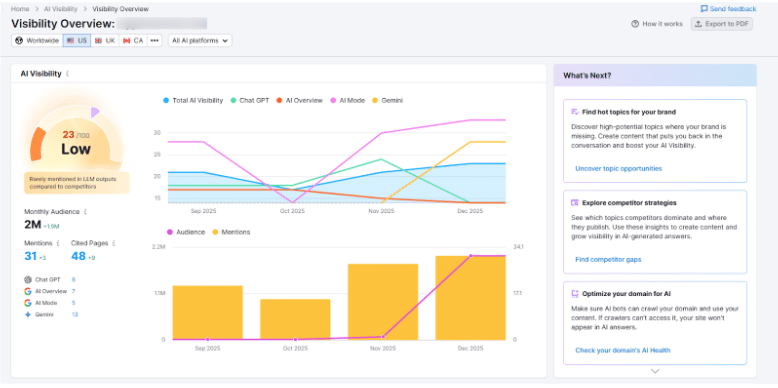
You also see trend graphs that show how visibility changes over time and how your brand compares against selected competitors.
The dashboard is designed to answer your operational questions. Like “Are you improving in Brand mentions across LLMs?” “Is sentiment moving in the right direction?” and “Where is your Share of Voice sitting among your competitors?”
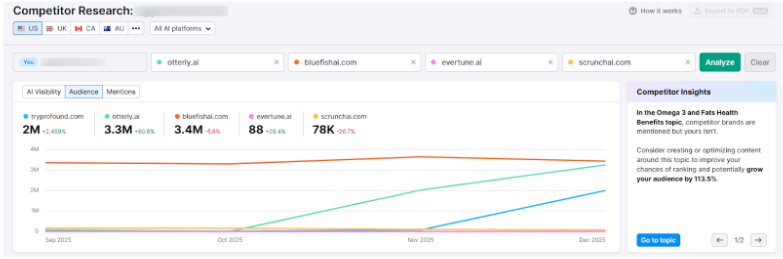
What you do not see immediately is the actual AI response that produced the score. The dashboard assumes that visibility itself is the insight, not the wording or context behind it.
If you are an SEO with no heavy AI-search optimization strategy, this will work more than fine. But if you are more focused on zero-click searches and AEO and GEO, you will need more than just quick insights.
Profound AI Visibility Dashboard
In Profound, there is no single score trying to summarize everything. The dashboard is essentially an answer intelligence feed. You see prompts, AI platforms, and the full generated responses. Brand mentions are highlighted inside the text, and competitors are visually separated.
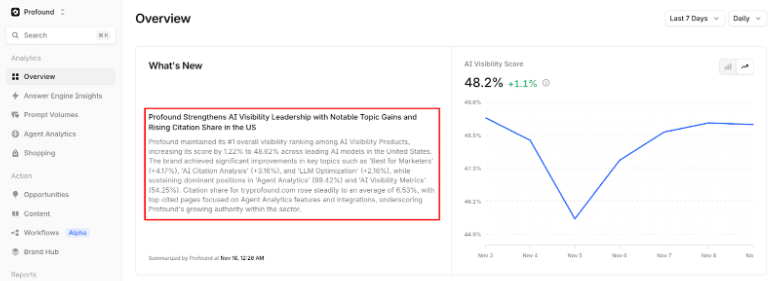
Instead of telling you that visibility changed, Profound shows you what changed. You will see:
- A recommendation order shifts through a graph bar.
- Why the site is getting cited (with gains & losses)
- AI visibility score comparison among competitors
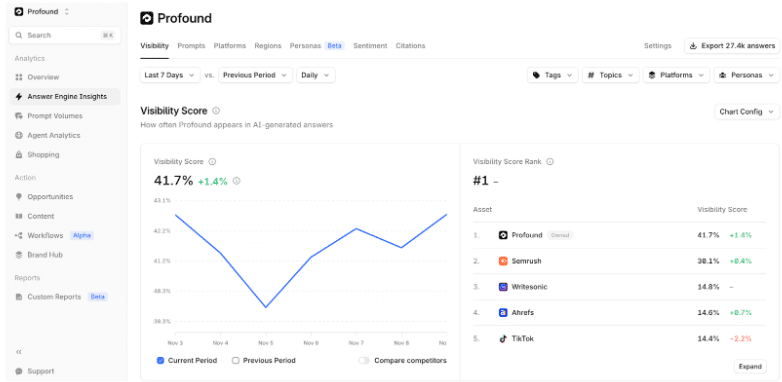
As you can see, Profound offers advanced AI analytics designed for teams that want to work directly with AI search data, not just high-level visibility metrics.
It analyzes prompt demand and trends using millions of real conversations in AI and breaks down brand visibility and citations by individual AI engines. It benchmarks brands using its proprietary Profound Index.
Beyond answers, it also tracks AI crawler activity at the server level, showing how AI agents access content. These capabilities make Profound well-suited for teams running AEO experiments, competitive research, or internal BI analysis.
Semrush One Prompt Research vs Profound Prompt Volumes
If you want to know the difference between the two tools in one line, I would say Semrush One shows a list of prompts with combined AI search volume. Whereas Profound shows AI search volume for the same keyword across different LLMs.
Semrush One Prompt Research
Semrush One’s Prompt Research Report helps you uncover the exact language and questions users are asking across AI platforms. It feels a lot like traditional keyword research repurposed for AI search.
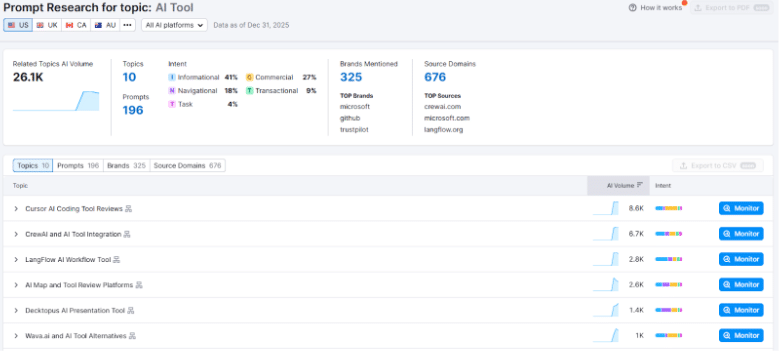
When you enter a phrase, you will get a breakdown:
- Related topics
- Actual prompts
- Estimated AI volume
- Intent types (informational, commercial, transactional)
- Brands mentioned
- Source domains that AI models rely on
From there, you can decide which prompts are relevant to your business and why they matter. You also have the option to turn relevant prompts into prompt tracking campaigns or feed them into content workflows for optimization.
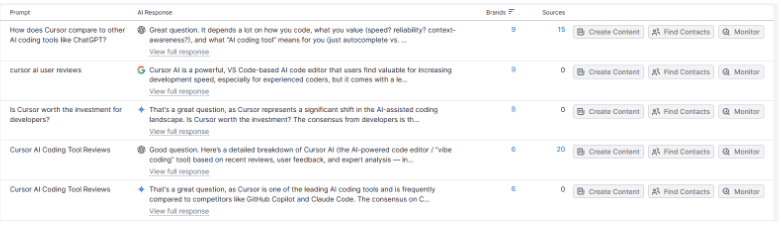
In my opinion, this is highly practical for teams that want contextual understanding of demand and real prompt examples based on intent and volume. It feels familiar to SEO professionals because it blends the planning mindset of keyword research with the needs of AI-first search optimization.
Profound Prompt Volumes
Profound’s Prompt Volumes is a data product built to quantify how often specific prompts are asked across AI conversations.

It gives you AI search volume estimates for user queries across platforms like ChatGPT and Perplexity, showing trending topics and growing demand signals from millions of masked AI interactions.
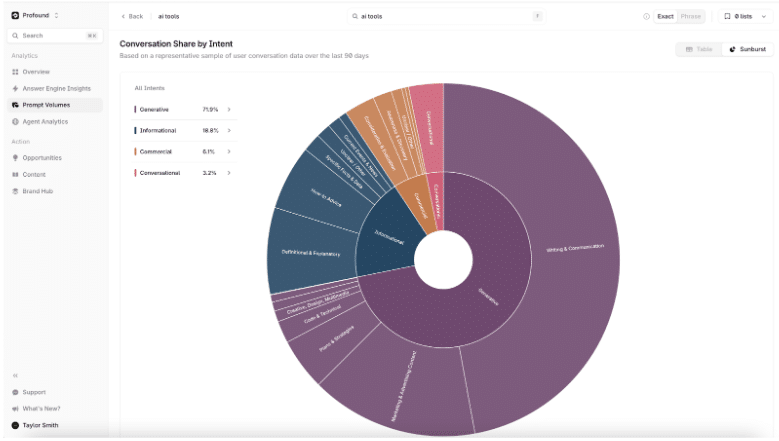
You can access this by selecting the Prompt Volumes tab, entering a topic, and seeing volume trends, demand signals, and how those prompts are evolving over time.
Unlike Semrush’s prompt research, which is anchored in topic and intent discovery, Profound’s volume insights are designed to show demand intensity and trend shifts. This is especially valuable for teams that treat AI search as its own discovery channel.
Semrush One AI Site Audit vs Profound Agent Analytics
As AI crawlers become more selective about what they read and reuse, site health is no longer just an SEO concern. The key question is whether AI systems can access your content, understand it, and reuse it safely in answers.
Both Semrush One and Profound come up with their unique approach to tackle this situation.
Semrush One AI Site Audit With Built-in Search Health
In Semrush One, AI crawler diagnostics live directly inside Site Audit, not as a separate tool. Alongside traditional SEO checks, you get an AI Search Health view that evaluates how well your website is prepared for AI-driven discovery.
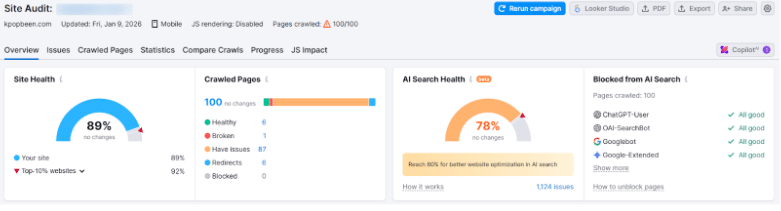
The audit checks whether major AI crawlers such as ChatGPT’s OAI-SearchBot, Perplexity, Google AI, and others are allowed to crawl your site. It flags blocked bots in robots.txt, issues with llms.txt, missing or weak structured data, internal linking problems, and crawlability issues that could prevent your pages from being used in AI answers.
The biggest advantage is workflow. AI crawling issues appear in this AI audit as broken pages, redirect chains, and indexing problems. Teams can fix technical issues once and improve both AI visibility and classic rankings, and at the same time.
Semrush One excels when you see it as an AI SEO tool, and site health managed in a single crawl and a single remediation process.
Profound Agent Analytics for AI Crawler Behavior
Profound does not attempt to replace a site audit. Instead, it focuses on what AI agents actually do when they connect with your pages and website.
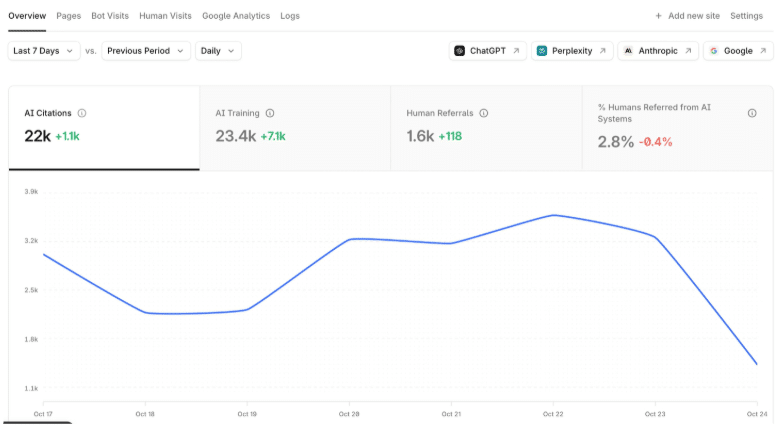
Its Agent Analytics feature works at the server level. Profound analyzes CDNs and different hosting environments to show:
- Which AI crawlers are reaching your site
- How often AI bots visit
- Which URLs do they request
- How does this whole activity connect to AI-generated referrals
This also includes identifying bot IDs, IP ranges, crawl frequency, and patterns that are invisible to JavaScript-based analytics.
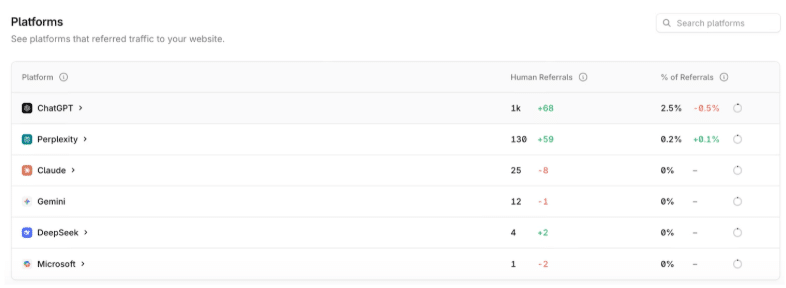
Profound can reveal issues that standard crawlers miss, such as AI bots repeatedly fetching outdated pages or ignoring sections of the site that are technically accessible but poorly referenced.
What it doesn’t do is provide an SEO audit like Semrush. You will still need a different tool to diagnose complete site health issues.
Profound excels when you need precise, verifiable records of AI crawler behavior and want to tie crawl activity directly to AI traffic and referrals.
Semrush One vs Profound: Pricing & Value for Money
As I already mentioned, Semrush One is a complete SEO and AI bundle, while Profound completely focuses on AI visibility. So there is a huge difference in both pricing structures. One is designed to bundle AI visibility into search marketing, the other to sell AI visibility as its own product.
Semrush One Pricing Plans
Semrush One has three pricing plans: Starter, Pro+, & Advanced. What matters most is that all plans include the complete Classic SEO and the AI Visibility toolkits together. All plans are available in monthly and you get 17% discount annually on purchasing upfront.
| Semrush One Plans | Monthly Pricing | Annual Pricing | Daily Prompts |
|---|---|---|---|
| Starter | $199/month | $165.17/month | 50 |
| Pro+ | $299/month | $248.117/month | 100 |
| Advanced | $549/month | $455.67/month | 200 |
From the Starter plan itself, you can track prompts, run AI SEO reports, and monitor visibility across major AI platforms such as Google AI Overviews, ChatGPT, Perplexity, AI Mode, and Gemini.
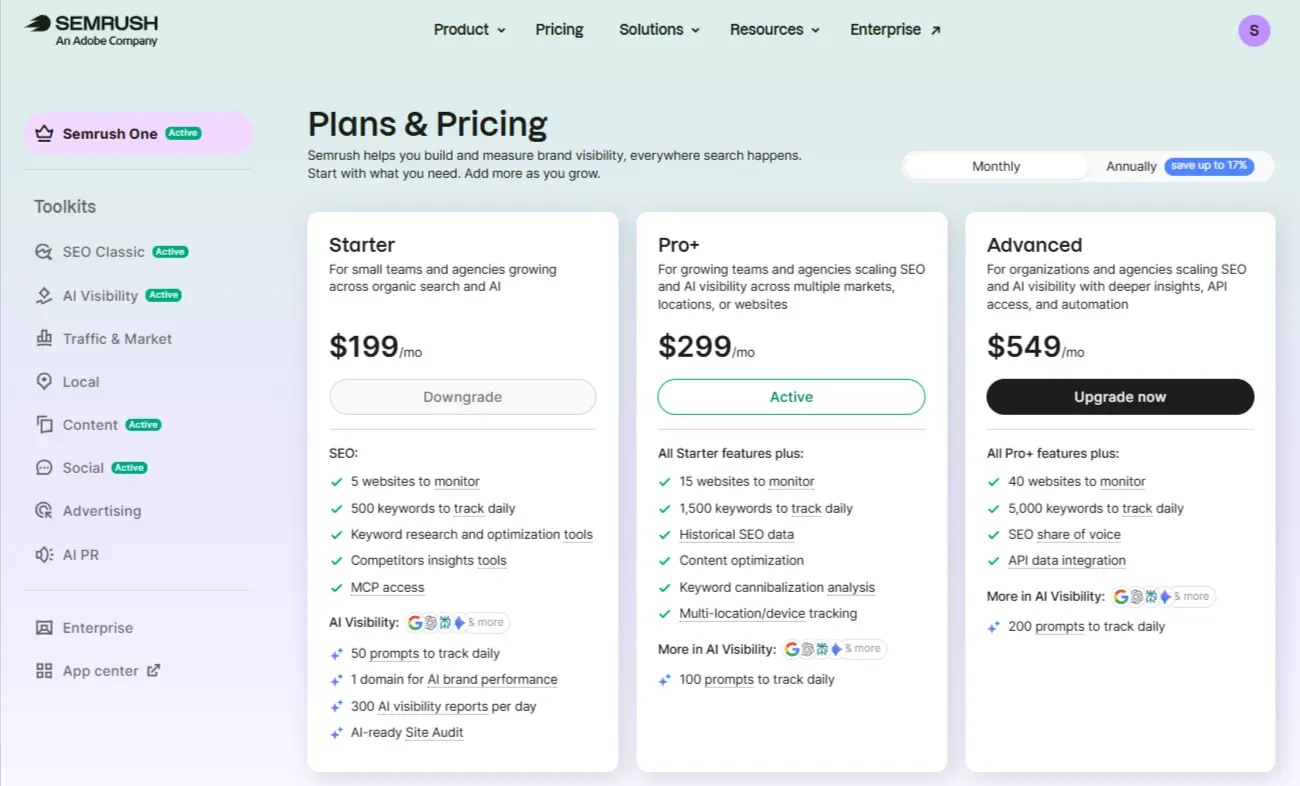
High-tier plans mainly increase the usage limits and unlock deeper SEO and digital marketing capabilities rather than gating AI features.
Semrush pricing also has an AI Visibility toolkit that you can purchase separately. It costs $99/month per domain, but there’s no option to purchase it month by month. You can only get it by paying yearly upfront with tax. And you will only get one domain to track with AI features only.
Bonus Savings Tip: The AI Visibility toolkit doesn’t offer any free trial, while you get a trial option with Semrush One. This can be a smart move for a new user as you get a free trial, and continuing with the plan saves you $40 a month. Savings get higher with bigger plans and annual purchases.
Profound Pricing Plans
Profound is sold as a standalone AI visibility platform with two tiers: Brands & Agencies. But there is only one fixed price in the Agency tier: Agency Growth at $99/month.
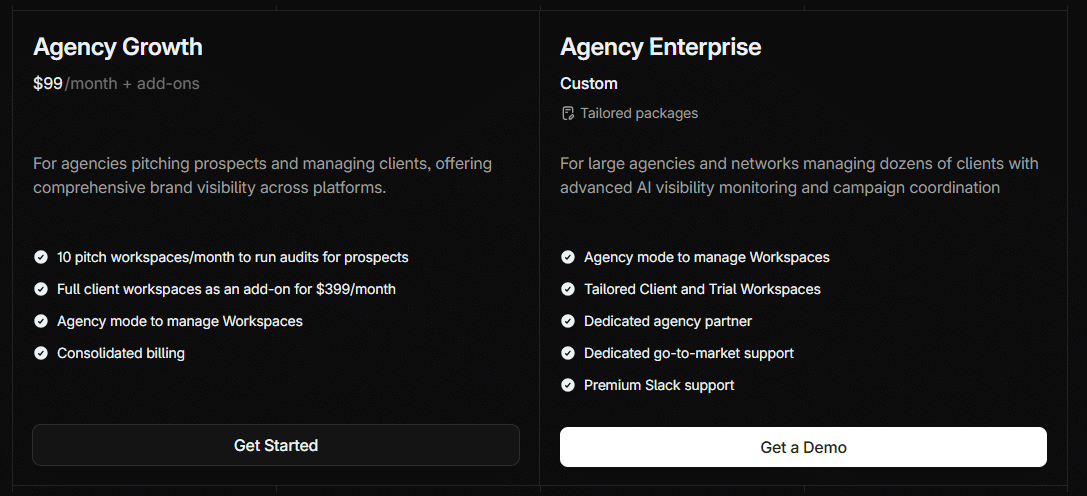
The Agency Growth plan is intentionally narrow at just $99/month. It focuses almost entirely on ChatGPT visibility with limited prompts. This works as a low-commitment entry point, but it does not represent Profound’s full capability.
The platform opens up at Growth and Enterprise. These tiers unlock multi-engine coverage, Prompt Volumes, Agent Analytics, Shopping data, API access, and enterprise features such as SSO.
The good thing is that you get a 7-day free trial as a new user.
Since I tested this tool using a free trial, I got an offer of 50% off for the first 2 months on the Growth plan. So this will be a win-win situation if you decide to continue after the free trial.
Semrush One vs Profound: Which AI Visibility Tool Should You Choose?
If your priority is deep, model-level AI and LLM tracking, Profound is the stronger choice. Profound is built specifically to analyze how AI systems generate answers.
Here’s why Profound is a better choice than Semrush:
- Purpose-built for AI search rather than adapted from SEO tooling
- Tracks visibility across multiple LLMs and answer engines, including ChatGPT, Google AI Mode, Google AI Overviews, Gemini, Copilot, Perplexity AI, Grok, and Claude
- Shows full AI-generated answers, not just visibility scores or summaries
- Breaks down brand positioning, citations, and framing by engine
- Includes Prompt Volumes to analyze real AI demand and trends at scale
- Offers Agent Analytics to track how AI crawlers access your site at the server level
- Designed for teams that treat AI visibility as a strategic discovery channel
However, businesses still prefer Semrush One for practical reasons. Semrush One bundles AI visibility into a full SEO platform. So teams can track rankings, audits, content performance, and AI discovery in one place.
Multi-LLM coverage and prompt tracking are available from entry-level plans, and insights are easy to report without adding another tool or workflow. Semrush One is better suited for teams that want AI visibility as part of their search strategy rather than a separate analytics program.
Conclusion: Semrush One Fits Best For AI + SEO
Profound beats Semrush One in AI Visibility and LLM tracking fields, but by fine margins. It does cover visibility across more LLMs and defines when & how AI bots crawl your site, but at a very high price because the entry-level plan is not worth the price and effort.
What is
Semrush One?
Semrush One sits in a great place, with simplistic AI SEO capabilities at a reasonable cost, and covers more ground than just an AI visibility tool.
It is time for you to take action. Start with Profound’s 7-day free trial if you are just looking for an AI visibility tool. And if you want the capabilities of both AI and SEO, take advantage of Semrush One’s 14-day free trial.
