
From healthcare and finance to marketing, AI has changed how businesses work with automation, speed, and new ways of doing things.
Currently, the global AI market is worth $757.58 billion, and will reach $3.68 trillion by 2034. That is a 4.86-fold growth in under a decade.
In this article, we’ll review the AI market size, industry comparisons, adoption patterns, leading companies, and the broader financial effects that shape what technology will be.
AI Market Size: Key Takeaways
- The global AI market is worth $757.58 billion currently.
- It is projected to grow with a 19.2% CAGR and reach $3.6 trillion by 2034.
- NVIDIA holds 92% of the generative AI GPU market.
- Around 78% of global companies already use AI in operations.
- U.S. postings for AI jobs rose 25.2% year-over-year.
Artificial Intelligence Market Size In 2025-2034
- The AI market is estimated to be worth $757.58 billion and is expected to reach $3.6 trillion by 2034.
- The AI market is growing at a CAGR of 19.2%.
- The latest AI trend, which began in early 2020, is set to hit the trillion-dollar market size in just 7 years.

| Sr. No. | Year | AI Market Size |
|---|---|---|
| 1 | 2024 | $638.23 billion |
| 2 | 2025 | $757.58 billion |
| 3 | 2026 | $900.00 billion |
| 4 | 2027 | $1,070.10 billion |
| 5 | 2028 | $1,273.42 billion |
| 6 | 2029 | $1,516.64 billion |
| 7 | 2030 | $1,807.84 billion |
| 8 | 2031 | $2,156.75 billion |
| 9 | 2032 | $2,575.16 billion |
| 10 | 2033 | $3,077.32 billion |
| 11 | 2034 | $3,680.47 billion |
Source: Precedence Research 2
AI Market Size Vs Other Markets
- The global e-commerce market is valued at $21.62 trillion. This sum overshadows the AI market, which holds a value of $757.58 billion.
- E-commerce will reach $75.12 trillion, and AI will grow to $3.68 trillion by 2034. AI is a smaller sector, but it is one of the fastest-growing. (Source: Precedence Research 2)
- The IT market is expected to sit at $1.61 trillion in 2025. This is more than twice the size of the AI market. By 2034, IT will reach $2.98 trillion, whereas AI will pass it with $3.68 trillion, a sign of AI’s quick growth. (Source: Precedence Research 3)
- Cloud computing is valued at $912.77 billion in 2025, which is smaller than the AI market. But by 2034, cloud will climb to $5.15 trillion, surpassing AI’s $3.68 trillion. (Source: Precedence Research 4)
- The global software market has a value of $659.17 billion in 2023, just below AI’s $757.58 billion. By 2034, software will grow to $2.24 trillion, 1.44 trillion behind AI’s $3.68 trillion. (Source: Precedence Research 5)
- The health and wellness industry is massive at $6.87 trillion in 2025, nearly nine times AI’s market size. By 2034, it’s forecasted to reach $11 trillion, still far ahead of AI. (Source: Precedence Research 6)
- The oil and gas market stood at $6.10 trillion in 2024, already far larger than AI.
- By 2034, it is projected to reach $8.79 trillion, keeping a significant lead over AI’s $3.68 trillion, but growing at a slower pace compared to AI’s rapid expansion. (Source: Yahoo Finance)
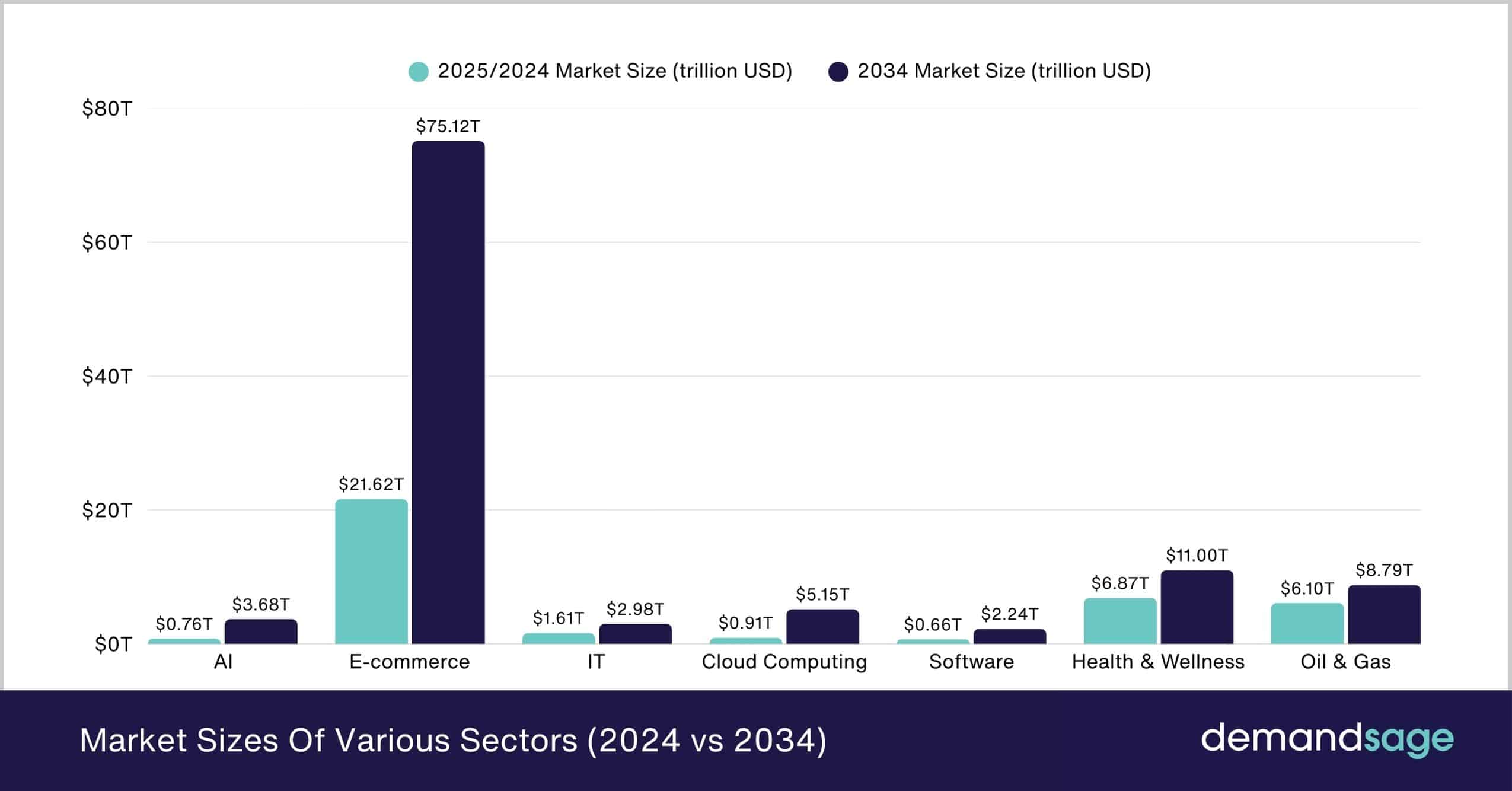
| Sr. No. | Sector | 2025/2024 Market Size (USD) | 2034 Market Size (USD) | Relative to AI in 2025 | Relative to AI in 2034 |
|---|---|---|---|---|---|
| 1 | AI | $757.58 billion | $3.68 trillion | – | – |
| 2 | E-commerce | $21.62 trillion | $75.12 trillion | Vastly larger | Still vastly larger |
| 3 | IT | $1.61 trillion | $2.98 trillion | More than double AI | Surpassed by AI |
| 4 | Cloud Computing | $912.77 billion | $5.15 trillion | Smaller than AI | Successfully surpasses AI |
| 5 | Software | $659.17 billion | $2.24 trillion | Slightly smaller than AI | Significantly smaller than AI |
| 7 | Health & Wellness | $6.87 trillion | $11 trillion | Nearly 9× AI | Still much larger than AI |
| 8 | Oil & Gas | $6.10 trillion (2024) | $8.79 trillion | Far larger | Still more than 2× AI |
AI Market Share By Company
The GPU market for generative AI work is very concentrated.
- NVIDIA holds a 92% share of data center GPUs that power generative AI work, which makes it a clear winner.
- AMD accounts for 4% of the market in 2024, up from 3% in 2023. It has seen a 179% year-over-year growth.
- All other competitors combined make up the remaining 4% of the market.
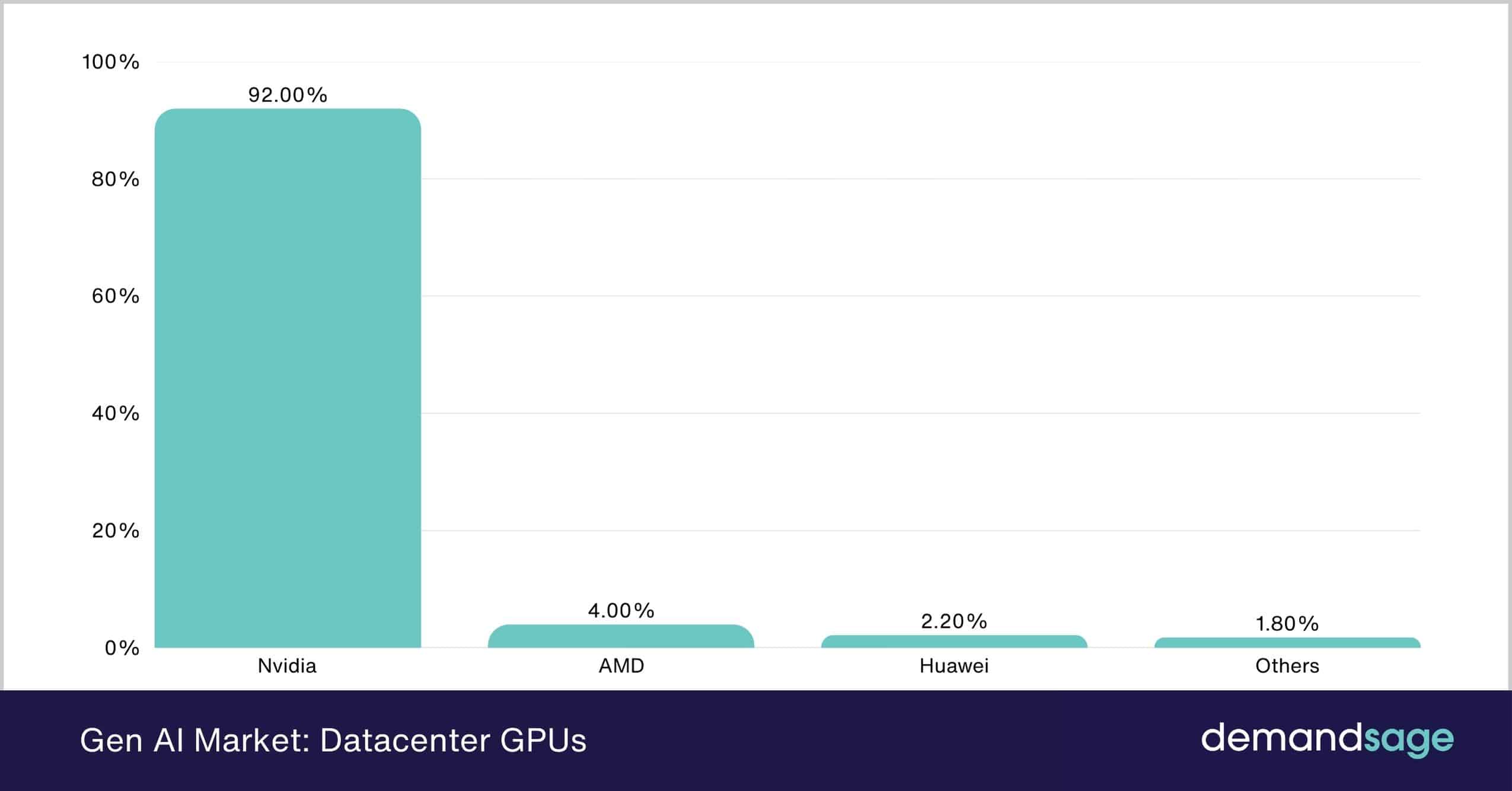
| Sr. No. | Company | Share% |
|---|---|---|
| 1 | Nvidia | 92% |
| 2 | AMD | 4% |
| 3 | Huawei | 2.2% |
| 4 | Others | 1.8% |
The foundation models market reflects a different competitive structure.
- Microsoft and AWS lead the rapidly expanding foundation models and model management platforms market, with a 39% & 19% market share.
- OpenAI holds a 9% share of this market, which excludes direct ChatGPT application revenue.
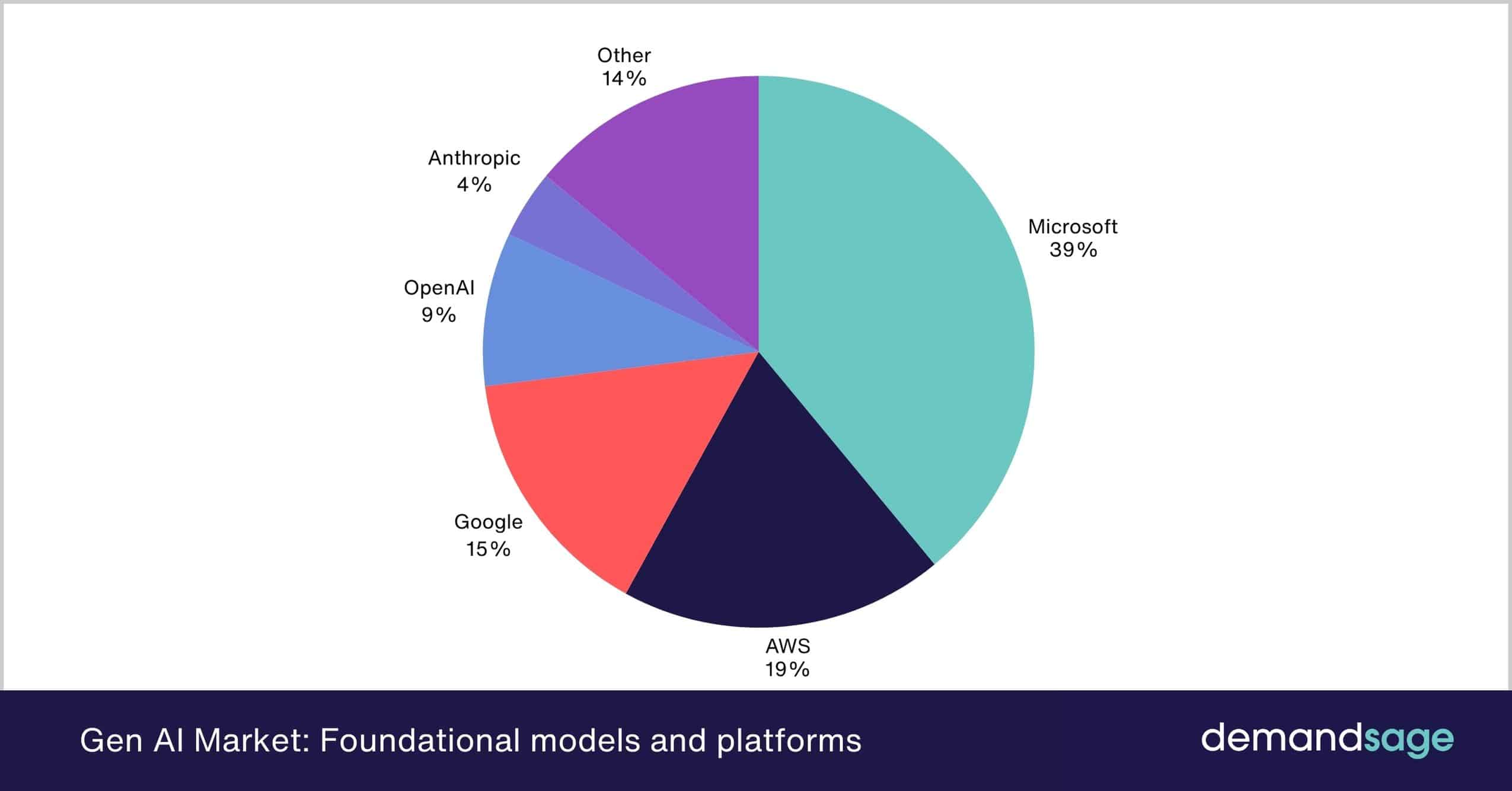
| Sr. No. | Company | Share% |
|---|---|---|
| 1 | Microsoft | 39% |
| 2 | AWS | 19% |
| 3 | 15% | |
| 4 | OpenAI | 9% |
| 5 | Anthropic | 4% |
| 6 | Other | 14%% |
The generative AI services market is much more fragmented.
- Accenture leads with a 7% market share, backed by a $3 billion AI investment and a 390% increase in generative AI services revenue by the end of 2024.
- Deloitte follows with a 3% market share, supported by a $4 billion pledged investment through FY2030 and over 700 generative AI projects delivered by June 2024.
- IBM holds a 2% share in generative AI services, focusing on its watsonx platform and enterprise automation.

| Sr. No. | Company | Share% |
|---|---|---|
| 1 | Accenture | 7.2% |
| 2 | Deloitte | 3.4% |
| 3 | IBM | 2.2% |
| 4 | McKinsey & Company | 2.2% |
| 5 | BCG | 1.9% |
| 6 | Bain & Company | 1.0% |
| 7 | Infosys | 0.8% |
| 8 | Others | 81.3% |
Source: IOT
Do you know: 40% of companies worldwide use AI in their operations? Find detailed statistics on companies using AI with our report.
AI Market Demographics
- Among adults aged 65 and older, men show more interest in AI (35.4%) than women (22%), which is the most significant gender gap across all age groups.
- The gender difference in excitement for AI is minimal among 35-44-year-olds, with male interest (52.3%) being only 5.4 points higher than female interest (46.9%). Source: Datareportal (105)
- Less than a quarter of the Asia-Pacific region (23.93%) has adopted AI, which shows room for improvement & progress. (Source: AIPRM)
AI Adoption By Age
- 84% of 18-34-year-olds use AI sometimes. In contrast, 44% of those aged 55 and older use AI, representing a 40 percentage point difference.
- Formal AI training follows a similar age pattern. Over half (56%) of younger adults received some AI training. Only 20% of those 55-plus did so, a difference more than twice as large.
- The middle-aged group (35-54) falls between the two extremes. Sixty-nine percent use AI, and 41% have training. This shows AI use and training fall with age.
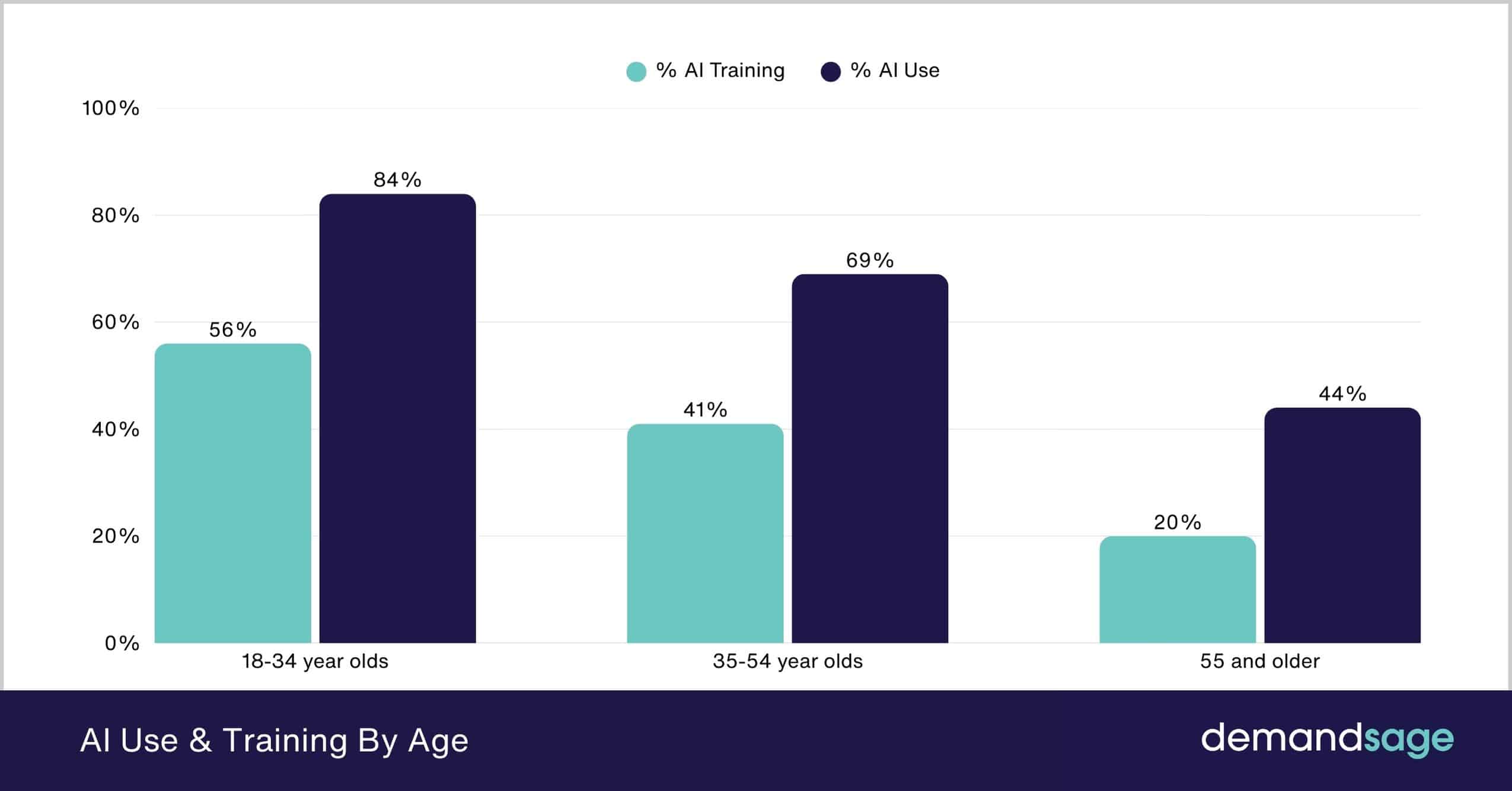
| Sr. No. | Age Group | % AI Use | % AI Training |
|---|---|---|---|
| 1 | 18-34 year olds | 84.00% | 56% |
| 2 | 35-54 year olds | 69% | 41% |
| 3 | 55 and older | 44% | 20% |
Source: KPMG
AI Market Distribution By Gender
- According to Datareportal, men across all age groups are more enthusiastic about AI than women.
- More than half the males (57.3%) between the ages of 16 & 24 are excited about AI, which is the group with the highest interest.
- In contrast, females aged over 65 have just a 22% interest rate, clearly showing how interest in newer technologies fades with increasing age.
- Interest in AI sharply drops in both genders above age 65, falling to just 22.0% for females and 35.4% for males, the lowest across all age groups.
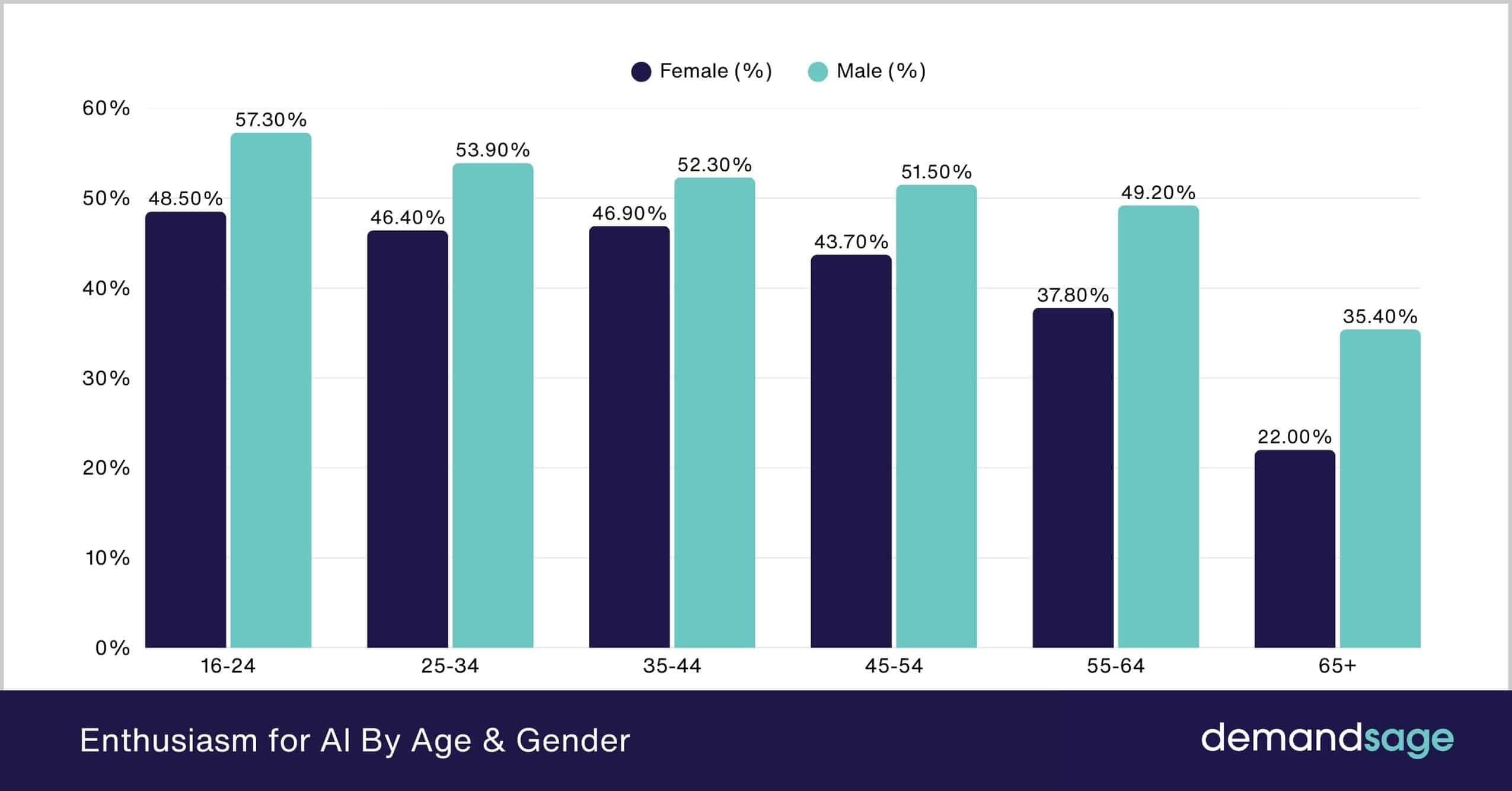
| Sr. No. | Age Group | Female (%) | Male (%) |
|---|---|---|---|
| 1 | 16-24 | 48.5% | 57.3% |
| 2 | 25-34 | 46.4% | 53.9% |
| 3 | 35-44 | 46.9% | 52.3% |
| 4 | 45-54 | 43.7% | 51.5% |
| 5 | 55-64 | 37.8% | 49.2% |
| 6 | 65+ | 22% | 35.4% |
Source: Datareportal (105)
- According to a 2024 BIS Bulletin, men were more likely to have used gen AI than women (50% vs 37%). (Source: BIS)
AI Industry Breakdown By Geography
- North America leads global AI use, accounting for 36.84% of the total share, making it the dominant region.
- Europe and the Asia-Pacific together contribute almost half (48.9%) of global AI use. This indicates good movement outside North America.
- LAMEA (Latin America, the Middle East, and Africa) has the lowest share at 14.26 %, less than half of North America’s share. A significant gap in use sits between developed and emerging regions.
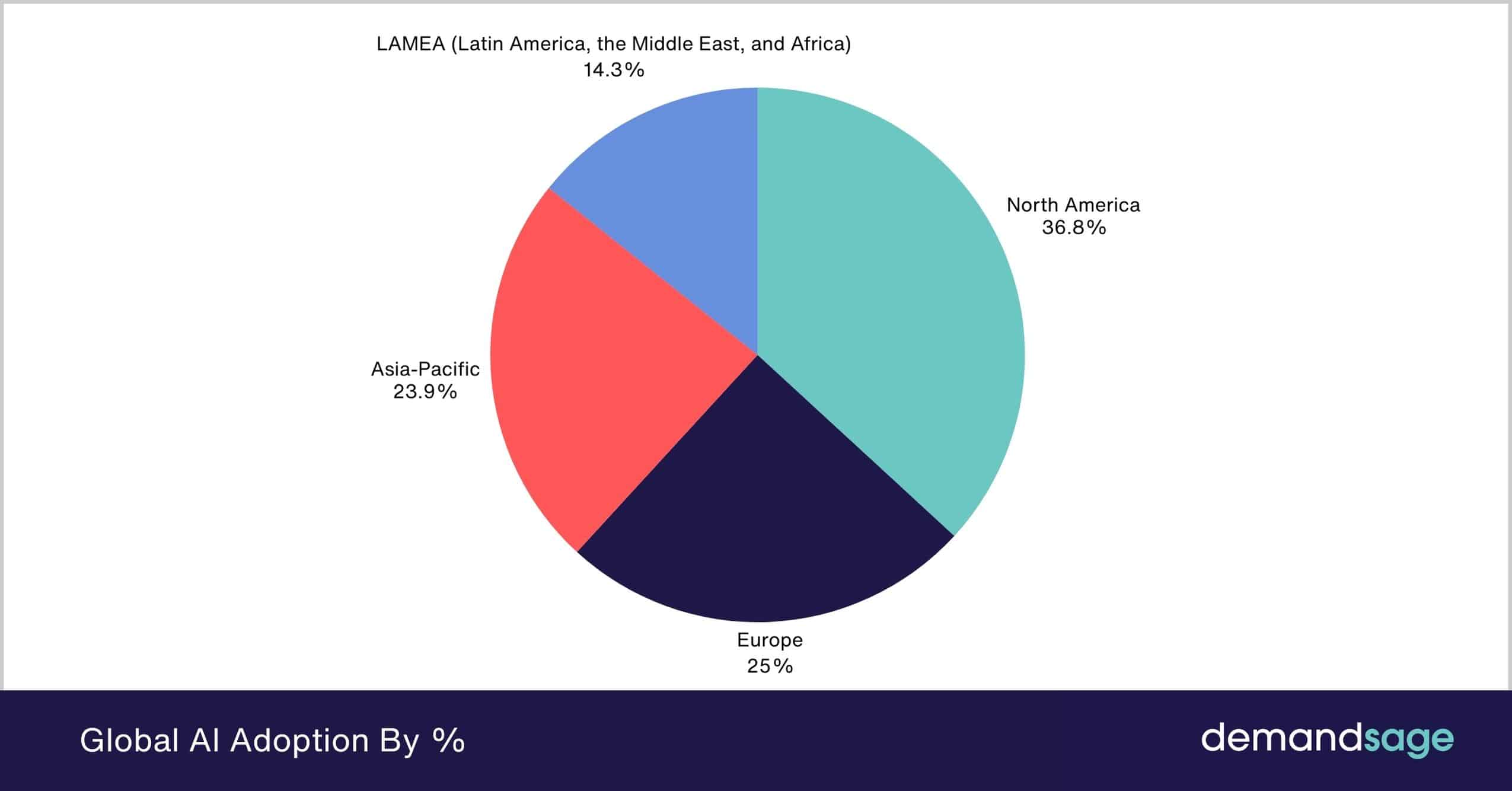
| Sr. No. | Country | % Share |
|---|---|---|
| 1 | North America | 36.84% |
| 2 | Europe | 24.97% |
| 3 | Asia-Pacific | 23.93% |
| 4 | LAMEA (Latin America, the Middle East, and Africa) | 14.26% |
Source: AIPRM
AI Jobs Statistics
- As of Q1 2025, there were 35,445 AI-related positions across the U.S., representing a 25.2% increase from Q1 2024.
- This growth trajectory reflects the median annual salary for AI roles rising to $156,998 in Q1 2025, demonstrating the high value placed on AI expertise. (Source: Veritone)
- The U.S. AI market is valued at $73.98 billion as of 2025, with a predicted compound annual growth rate (CAGR) of 26.95% between 2025 and 2031. (Source: ExplodingTopics)
- Mentions of AI in U.S. job listings increased by 114.8% in 2023, by 120.6% in 2024, and by 56.1% in 2025 through the first quarter.
- Nearly 3 million job listings were analyzed across the report’s timeframe.
- The 2024 cycle included 1.289 million job postings, while the 2025 cycle captured 1.488 million postings.
- AI Engineer roles grew by 143.2%, making them the fastest-growing.
- AI Content Creator roles increased by 134.5% year over year.

| Sr. No. | AI Job Role | Growth (%) |
|---|---|---|
| 1 | AI Engineer | 143.2% |
| 2 | AI Content Creator | 134.5% |
| 3 | AI Solutions Architect | 109.3% |
| 4 | Prompt Engineer | 95.5% |
| 5 | AI Systems Designer | 92.6% |
| 6 | AI Product Manager | 89.7% |
| 7 | AI Coach | 57.7% |
| 8 | AI Compliance Manager | 46.0% |
| 9 | Machine Learning Engineer | 35.3% |
| 10 | AI Strategist | 34.8% |
- Asia recorded a 94.2% increase in AI job listings year-over-year, the highest globally.
- North America ranks second with 88.9% growth in AI job listings.
- South America showed slower growth at 63.4%. (Source: Autodesk)
Artificial Intelligence In Business Statistics
- A report by McKinsey & Company states that 78% of companies use AI in at least one business function, representing an increase from 50% in 2022.
- The survey found that 71 % of companies regularly use generative AI in at least one business function. This demonstrates the quick adoption of newer AI technologies.

| Sr. No. | Year | Use Of AI | Use of Gen AI |
|---|---|---|---|
| 1 | 2025 | 78% | 71% |
| 2 | 2024 | 72% | 65% |
| 3 | 2023 | 55% | 33% |
| 4 | 2022 | 50% | – |
| 5 | 2021 | 56% | – |
| 6 | 2020 | 50% | – |
| 7 | 2019 | 58% | – |
| 8 | 2018 | 47% | – |
| 9 | 2017 | 20% | – |
Source: McKinsey
- Business and professional services report the highest measurable results, with 48.4% of companies experiencing quantifiable benefits from AI implementation. (Source: Edgedelta)
- Manufacturing, information services, and healthcare companies report adoption rates of approximately 12%, while construction and retail sectors lag with lower implementation rates. (Source: Ventionteams)
Economic Impact By Sector And Region
- In healthcare, AI was valued at $15.4 billion and is expected to grow at a 37.5% CAGR from 2023 to 2030. (Source: Edgedelta)
- The manufacturing industry stands to gain $3.78 trillion from AI by 2035. Financial services could see an additional $1.15 trillion contribution, while professional services may earn $1.85 trillion.
- Wholesale and retail sectors could benefit from $2.23 trillion in additional economic output. (Source: ExplodingTopics)
- China and North America are projected to see the most significant economic gains, with potential GDP boosts of up to 26% and 14% respectively, by 2030. (Source: LinkedIn)
Implementation Challenges And Barriers
- Generative AI tools are now deployed by 90% of organizations, with 44% transitioning from early testing to production. (Source: AWS Cloud)
- The most significant barrier to AI implementation is data accessibility, with 34% of companies citing limited AI skills, expertise, or knowledge as their primary challenge.
- Cost concerns affect 29% of organizations, while 25% struggle with insufficient tools or platforms to develop models. (Source: Edgedelta)
Read other AI-related statistics and how it’s impacting different industries:
Skills Development And Workforce Impact
- Wage premiums for AI skills are substantial and growing, with workers possessing AI capabilities earning 25% more than those without such skills, up from previous years.
- AI-exposed jobs now experience 66% faster skill change compared to 25% last year. (Source: PWC)
- AI might eliminate 92 million jobs but create 170 million new ones, resulting in a net gain of 78 million jobs. (Source: Coursera)
