
In the United States, 50% of queries now trigger Google AI Overviews responses, and it’s likely going to go up in the upcoming years.
In addition, 61% of organic CTR dropped due to AIO answers.
However, the battle for clicks is not just with Google AI overviews. With platforms like ChatGPT and Perplexity outperforming Google in query coverage and diversity of sources, the future of search is no longer just about Google results anymore.
Our detailed statistical research will highlight how AI dominance, zero-click trends, and user trust in machine-generated content are changing in 2026.
Top Picks: Google AI Overviews Statistics 2026
- 50% queries now trigger Google AI Overviews responses in the United States.
- Around 61% organic CTR drops because of AI Overviews’ answers.
- Google’s global search share has dipped below 90% for most of 2025.
- Users are nearly 47% less likely to click a traditional search result, with only 8% of visits resulting in a click when an AIO is shown.
- Google’s AI Overviews cite Reddit (21%) and YouTube (18.8%) most often, showing a strong preference for user-generated content.
- Google repeats websites more often (58.49%) than Perplexity (25.11%), making Perplexity’s results more diverse and less biased.
How Much Is AI Overviews Traffic Share? (Worldwide Data)
- Approximately 50% of all Google searches include an AI Overviews in the US.
- 58% of U.S. adults reported encountering at least one Google search with an AI summary.
- Only 8% of visits with a Google AI summary resulted in clicks on traditional links, compared to 15% without a summary.

Here is a table showing how Google users are less likely to click on a link when they encounter search pages with summary AI:
| User Action | Pages with AI summary (%) | Pages without AI summary (%) |
|---|---|---|
| Clicking on a link in the AI summary | 1 | N/A |
| Clicking on a link from the search results | 8 | 15 |
| Ending their Browse session | 26 | 16 |
| Continuing to search Google | 32 | 35 |
| Leaving Google to browse a different site | 34 | 33 |
- Early in Q1 2025, only 1% of visits to pages with an AI summary resulted in clicks on links within the summary.
- Users are more likely to end their search session after seeing an AI Overviews, with the session ending 26% of the time, compared to only 16% for standard results pages without an AI summary.
- When it comes to searches without any clicks* on Google, around 60% of all searches (with or without AI summaries) usually lead users to either browse elsewhere on Google or leave without clicking any result.
- Searches without any clicks refer to when Google provides the answer directly on the search page, like in a featured snippet or AI overview, so the user doesn’t need to click on a website.
Zero-click searches or searches without any clicks refer to when Google provides the answer directly on the search page, like in a featured snippet or AI overview, so the user doesn’t need to click on a website.
Source- Pew Research Center, Bain.com
Google AI Overviews Statistics USA
- Approximately 30% of all search queries trigger AI Overviews across the US, with the percentage ranging from 27.75% to 28.66% by state.
Note: this can vary based on the specific study and time of analysis.
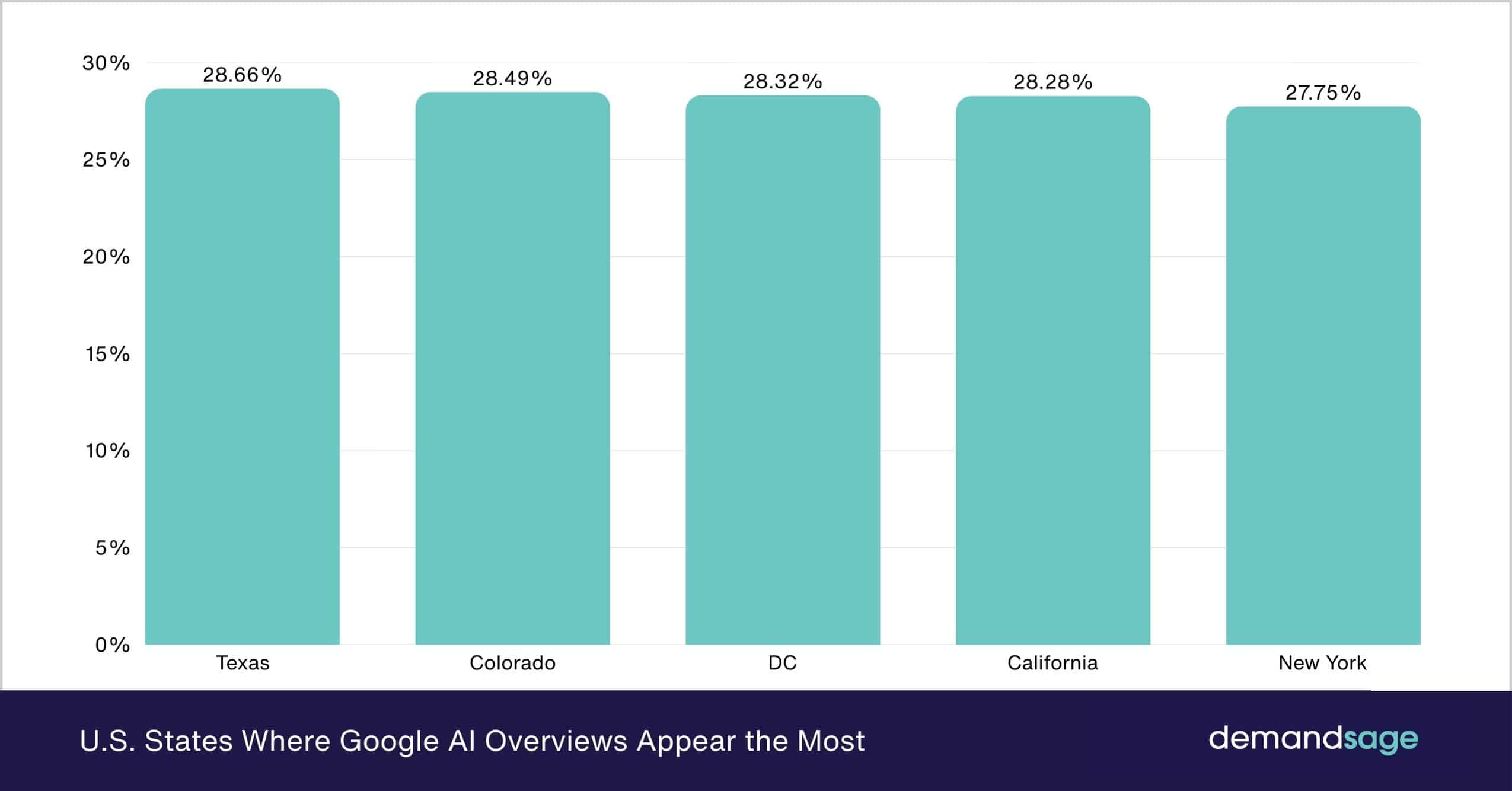
Let’s look at the USA state-wise AI Overviews appearance rates by location:
| Location | Percentage of Queries Triggering AI Overviews (%) |
|---|---|
| Texas | 28.66 |
| Colorado | 28.49 |
| DC | 28.32 |
| California | 28.28 |
| New York | 27.75 |
Source- SE Ranking
Google AI Search Ranking Stats
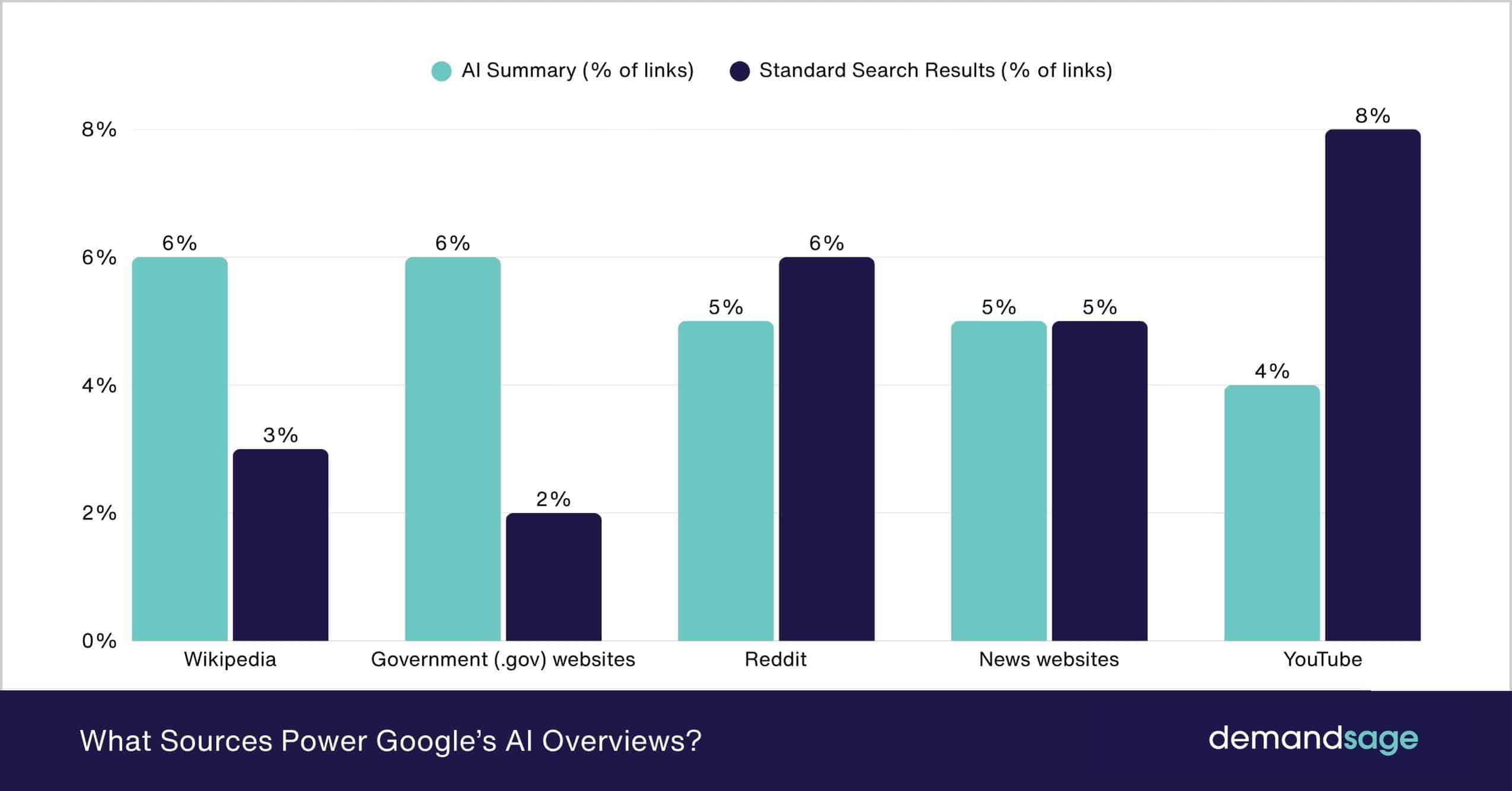
- The most frequently cited sources in AI summaries are user-generated content platforms like Reddit and YouTube, with Reddit alone accounting for 21% of citations.
- The Google AI Search experience now includes concise summaries powered by research AI, significantly altering user expectations.
Let us look at this breakdown:
| No. | Source | AI Summary (% of links) | Standard Search Results (% of links) |
|---|---|---|---|
| 1 | Wikipedia | 6 | 3 |
| 2 | Government (.gov) websites | 6 | 2 |
| 3 | 5 | 6 | |
| 4 | News websites | 5 | 5 |
| 5 | YouTube | 4 | 8 |
AI Overviews tend to refer to platforms like Reddit and YouTube because these summaries aim to deliver concise, experience-driven answers. Much of the practical, firsthand knowledge required for these synthesized responses comes from user-generated discussions and tutorials.
Reddit tends to surface in situations where people are seeking personal experiences, troubleshooting tips, niche recommendations, or community insights. YouTube frequently appears for queries involving step-by-step instructions, since AI systems can draw on video transcripts to outline processes.
By placing a ready-made explanation at the top of the results page, AI Overviews reshape what users expect from search. This is shifting it from browsing through lists of links to receiving something closer to an on-demand conversation or an encyclopedic summary.
- It’s interesting to see that 88% of AI summaries include three or more sources, showing thorough research.
- Meanwhile, only a tiny 1% of summaries mention just a single source, indicating that most summaries tend to be quite well-supported.
- The typical length of AI summaries was a median of 67 words, with the shortest being 7 words and the longest reaching 369 words.
- Search queries starting with question words like “who,” “what,” “when,” or “why”, which make up 60% of questions, usually lead to an AI summary. This highlights that long-tail keywords and queries are likely to get picked by the AI overviews.
- Additionally, 36% of searches employing complete sentences, which include both a noun and a verb, also yielded an AI summary.
Source- Pew Research Center
- 43.42% of AI Overviews replies contain links to Google’s search results, usually including 4-6 internal links.
- The term “internal links” here means the links in an AI Overviews that take you to another Google search page, not to an outside website.
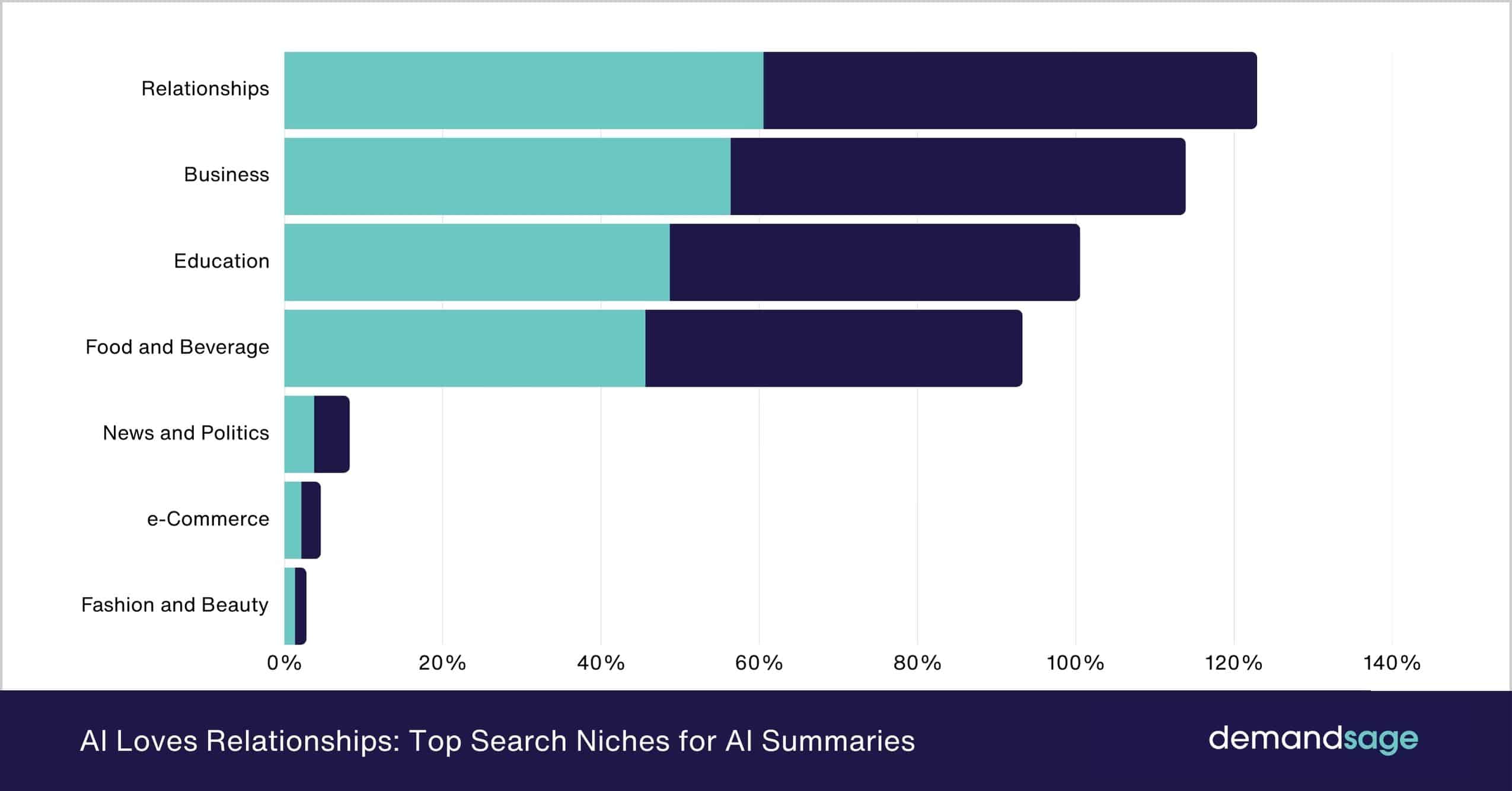
- Relationship queries most frequently trigger AI overviews at a rate of 60-62%. Below is an AI overviews of appearance rates by niche:
| Niche | AI Overviews Trigger Rate (%) |
|---|---|
| Relationships | 60.54 to 62.38 |
| Business | 56.38 to 57.52 |
| Education | 48.70 to 51.86 |
| Food and Beverage | 45.62 to 47.66 |
| News and Politics | 3.76 to 4.50 |
| e-Commerce | 2.14 to 2.48 |
| Fashion and Beauty | 1.34 to 1.46 |
Source- SE Rankings, Search Engine Land
In conclusion to this section, we would like to point out that Marketers must now optimize not just for Google position rank but also for how their content appears in AI Overviews.
AI Overviews Source Citations
- Search Engine Land study reveals that 43% of AI overview answers point back to Google’s search results.
- AI overviews cite an average of 13.34 sources per response.
- The maximum number of sources cited in a single response has reached 95 links. This represents a nearly twofold increase from 2024, when the average was approximately 6.82 links.
- The majority of AI overview responses contain between 6 and 14 links, which is the most common range.
- Usually, keywords with 0-100 monthly searches trigger AI Overviews 30-32% of the time.
Source- SE Rankings, Search Engine Land
SERP CTR & AI Overviews
- A Google CTR study shows AI Overviews cut organic traffic. Individual sites’ CTR dropped 34.5% when an AI Overviews appeared compared to similar keywords without an AI Overviews.
- In March 2024, the CTR of SERP position one was 7.3% for keywords that later started coming in AI Overviews by March 2025, which fell to 2.6%.
Note: The study compares the CTR of the #1 position on a SERP without an AI Overviews to the CTR of the #1 position on a SERP with an AI Overviews.
- The most interesting fact in this research is that 99.2% of the 300,000 keywords researched triggering AI Overviews had informational intent.
- To put this in layperson’s terms, when people see an AI overviews, they are mainly looking for information to learn about a specific topic, rather than to find a particular website or visit a local business.
- These findings suggest that Google + AI features like Overviews are accelerating the trend toward zero-click searches.
Source- Ahrefs
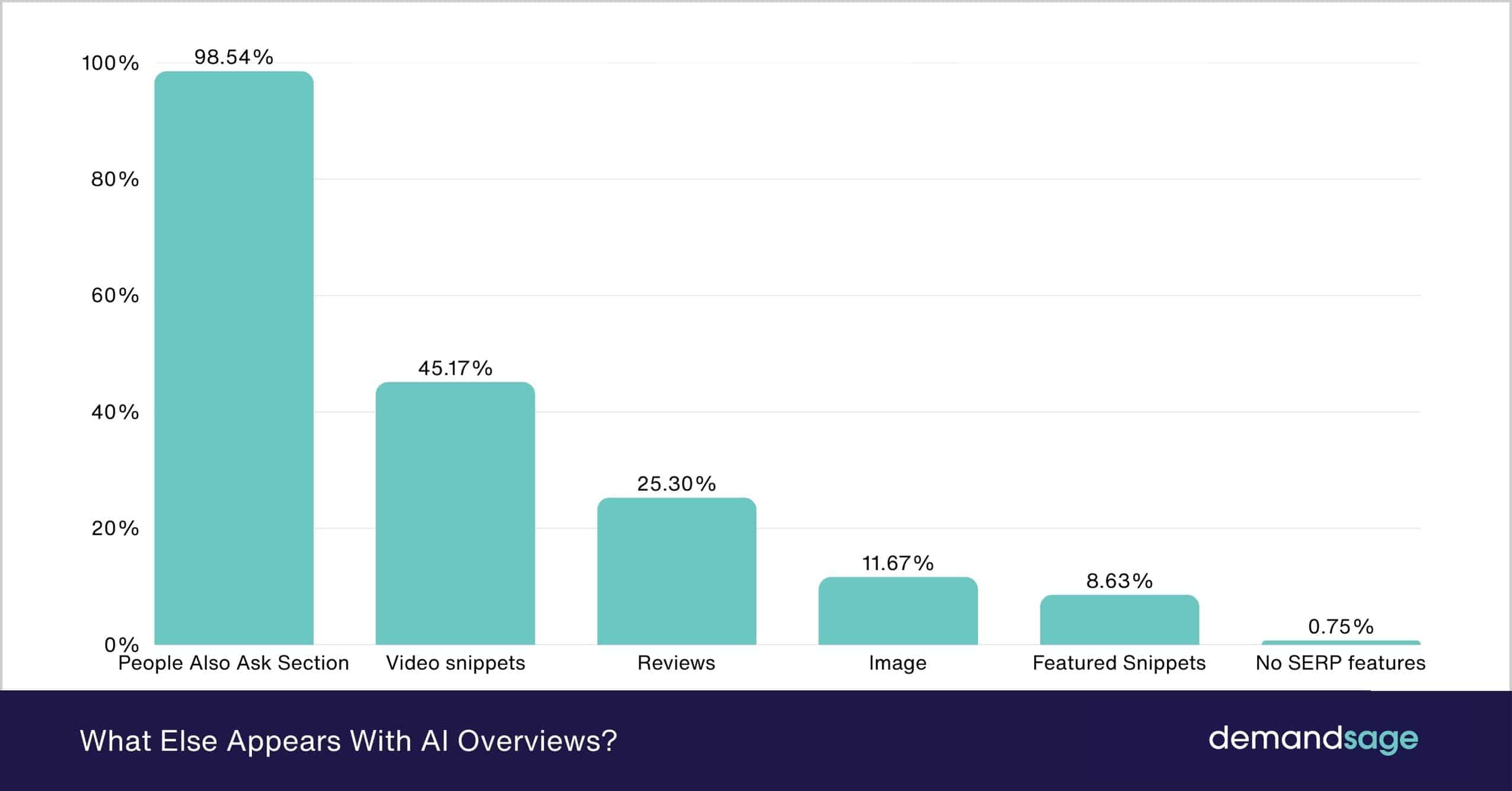
- 99.25% of all AI overviews appear with at least one of the 5 other search features. SERP features appearing with AI overviews are as follows:
| SERP Feature | Appearance Rate with AI Overviews (%) |
|---|---|
| People Also Ask Section | 98.54 |
| Video snippets | 45.17 |
| Reviews | 25.30 |
| Image | 11.67 |
| Featured Snippets | 8.63 |
| No SERP features | 0.75 |
Source- SE Rankings
AI Search Distribution: Google AI Overviews X ChatGPT
- Google AI overviews now come up in 60% of total queries in the US.
- Google intentionally doesn’t show up in 100% queries, stating it triggers only when it’s genuinely helpful.
- ChatGPT is designed to generate a response for virtually every prompt, hence its near 100% success rate.
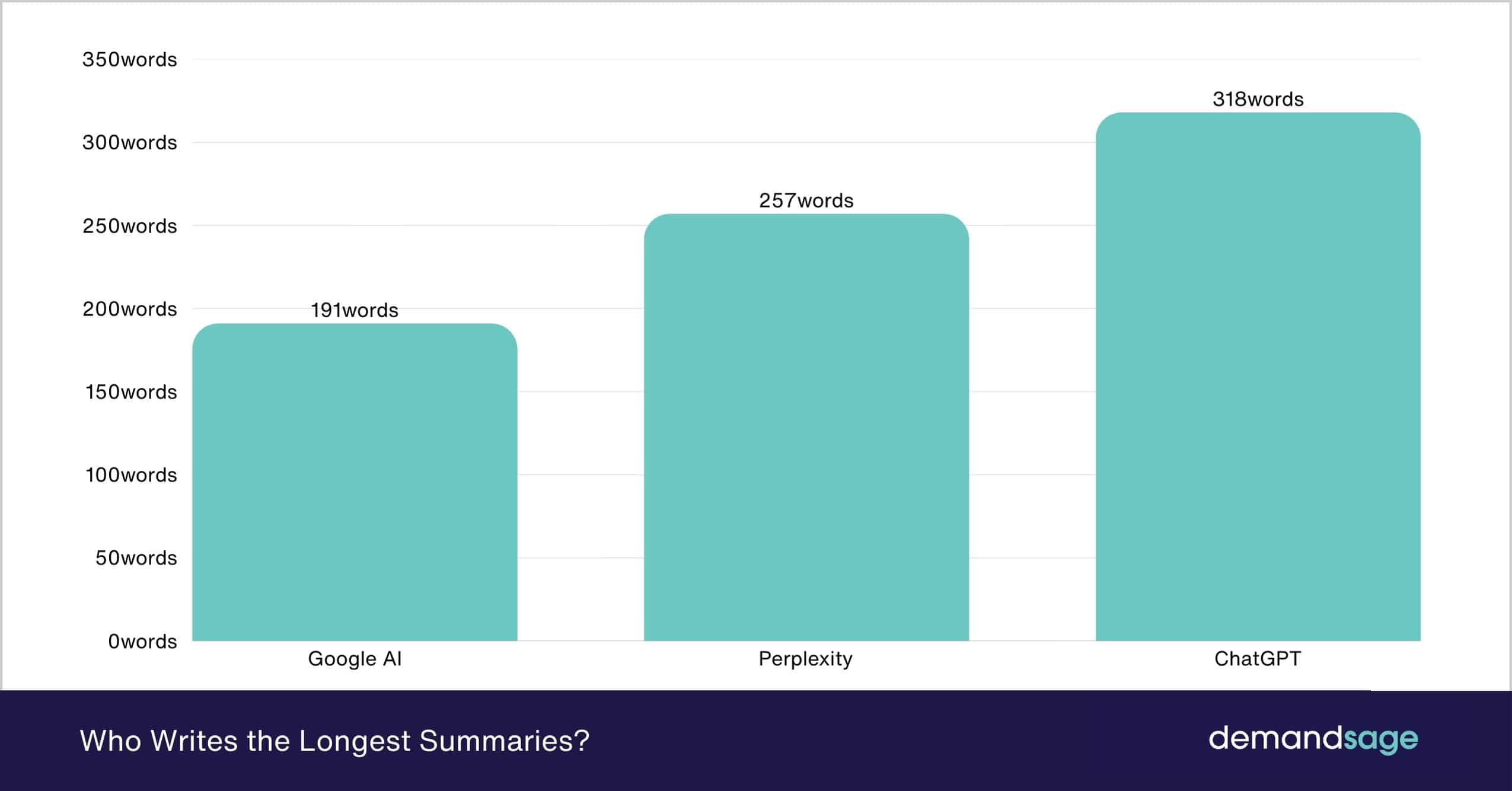
- CTR SERP Google behavior shifts with AI Overviews offering concise, 191-word summaries, compared to ChatGPT’s 318-word conversational responses.
- ChatGPT cited 10.42 links per reply, more than Google AI Overviews (9.26), signaling higher link density and engagement potential.
- ChatGPT content has a higher objectivity score (lower subjectivity score of 0.44) than Google AI Overviews (0.48), meaning its language is technically more neutral and factual on average.
- Google AI Overviews content is marginally easier to read on the Coleman-Liau index (12.75) compared to ChatGPT (12.85).
- ChatGPT has a higher domain duplication rate of 71.03% compared to Google AI overviews (58.49%).
Source- SE Rankings , Google Search Central, Xponent 21
- The Google SERP CTR may be influenced by citation patterns, indicating that Google depends on YouTube (18.8%), whereas ChatGPT extensively utilizes Wikipedia (47.9%).
Here is its breakdown by citation patterns for Google AI Overviews vs ChatGPT:
| Google AI Overviews | ChatGPT |
|---|---|
| Reddit: 21% | Wikipedia: 47.9% |
| YouTube: 18.8% | Reddit: 11.3% |
| Quora: 14.3% | YouTube: 11.30% |
| LinkedIn: 13% | TikTok: <1% |
| Gartner: 7.1% | Other Sources Like Forbes, G2, TechRadar |
Source- Try Profound and SE Rankings 2
More AI-related data and statistics:
Google AI Overviews X Perplexity: Comparative Study
- Google’s AI Overview CTR patterns differ from Perplexity, which had a 99.95% query response rate, vastly outperforming Google’s 58.15% on query completion.
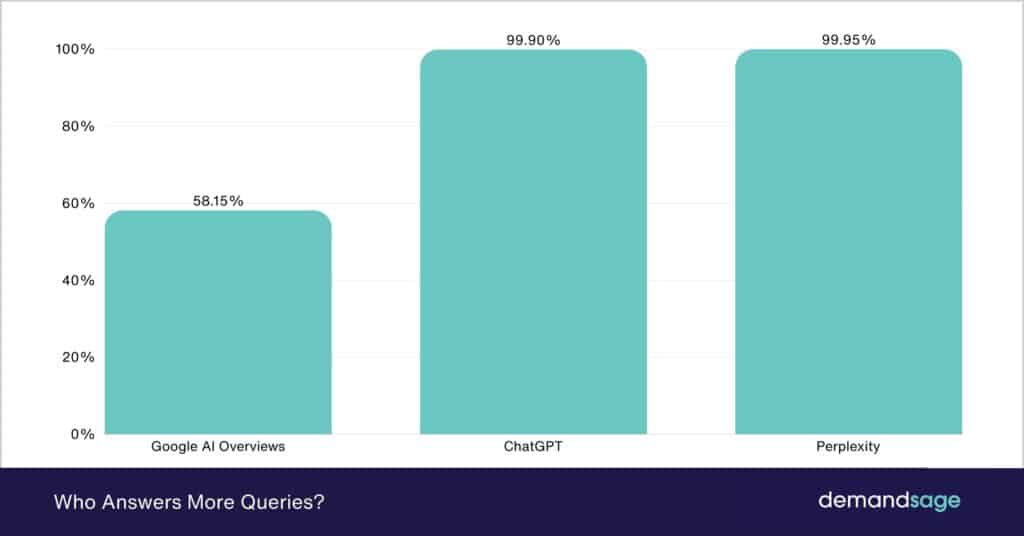
- When it comes to search answers, Perplexity gives responses that are shorter than ChatGPT’s (257 words for Perplexity) but longer than what Google typically provides (191 words).
- This means Perplexity aims for a good balance, giving you enough detail without being as lengthy as ChatGPT
- Perplexity, on the other hand, shows links from many more different websites (only 25.11% duplication), which can make users trust its information more because it seems less biased and more varied.
- Google favors older domains (49.21%), while Perplexity leans into mid-aged domains (10–15 years) at 26.16%
- Semantic similarity to Google AI Overviews was -0.48 for Perplexity, indicating notably different structuring and language choices in answers.
- In simple terms, the negative score of -0.48 means that Perplexity doesn’t just rephrase what Google’s AI Overviews say; it tends to present information in its own unique way, with different sentence structures and vocabulary.
- When analyzing Google SERP CTR trends, the distinct .ai domain citation rate (2.93%) for Perplexity may reflect a stronger focus on AI-native content.
- This translates to a “distinct .ai domain citation rate” of 2.93% for Perplexity, which means that nearly 3% of the websites it cites as sources are AI-specific domains. (ending in .ai)
Source- SE Rankings
- Google + AI referenced Reddit (21%) and YouTube (18.8%), whereas Perplexity depended more heavily on Reddit (46.7%).
Here is the full breakdown of the same:
| Google AI. Overviews | Perplexity |
|---|---|
| Reddit: 21% | Reddit: 46.7% |
| YouTube: 18.8% | YouTube: 13.9% |
| Quora: 14.3% | Gartner: 7% |
| LinkedIn: 13% | Yelp: 5.8% |
| Gartner: 7.1% | Moodle: 4.08% |
Source- SE Rankings
Data Accuracy of AI Overviews
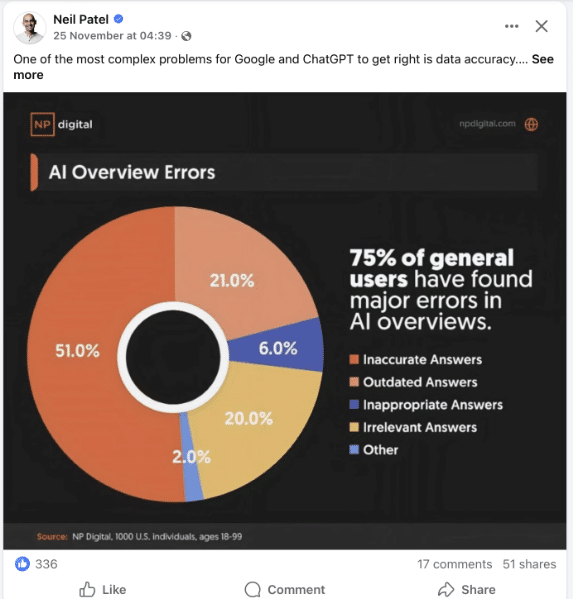
Neil Patel recently shared data on how Google and ChatGPT encounter multiple errors for answers, highlighting it as “one of the most complex problems.”
A quantitative survey by NP Digital, sampling 1,000 U.S. individuals aged 18 to 99, found that 75% of users identified at least one major error in AI Overview outputs.
Reported error categories included:
| Inaccurate answers | 51.0% |
| Outdated responses | 21% |
| Inappropriate answers | 6% |
| Irrelevant answers | 20% |
| Others | 2% |
This distribution suggests that the predominant challenge lies in factual reliability.
How Do I Track AI Overviews’ Rankings Over Time?
There are various platforms to monitor AI overview sources. At Demandsage, we use Semrush One to track AI visibility, prompts that our content is showing up for, competitor analysis, and more.
Semrush One plan gives you the classic plan + AI visibility toolkit in one. You can also use it to check which prompts your competitors are showing up for and come up with a better content plan and strategies.
You don’t need to pay for the tool without trying to see if it’s worth it for you. Instead, you can use our exclusive 14 day Semrush free trial that gives you access to the Semrush One plan without paying a single dollar!
