
Imagine getting answers to your query in a summarized format, saving hours of your time. Well, you don’t have to imagine anymore, as AI search engines make that possible now!
The way tech in 2026 is evolving has made and broken many businesses that were built around traditional search engines. With the updates and features evolving rapidly, the title of the best AI search engine keeps changing with every new keynote.
To compare, test, and decide on a single solution, I have listed top 7 AI search engines with a common question and evaluated their response and variations. Read on to know more!
7 Top AI Search Engines For 2026 (Tested)
The top 7 listed AI search engines in this list include free AI search engines, AI search engines with additional chat assistant support, and ones with enterprise API solutions, too.
Check what they are best for and how much their subscriptions cost.
| AI Search Engine | Best For | Subscription Price |
|---|---|---|
| Perplexity AI | Real-time answers & follow-up | Starts from $20/month |
| ChatGPT Search (SearchGPT) | Conversational AI search engine with advanced capabilities | Starts from $20/month |
| Microsoft Bing | Combination of a traditional search engine and an AI chatbot | Starts at $20 per month per user |
| Google AI Mode | A combination of traditional and an AI search engine | Free |
| Brave Search | Search engine with AI assistant Leo | Free |
| You. com | Enterprise API solutions | Starts from $15/mo |
| Komo | Quick and affordable AI search engine | Starts from $15/mo |
Please note that the order of this AI search engine list does not directly relate to their proficiency. They are listed in order of popularity and my experience and comfort level of using them.
Traditional Search Engines vs AI Search Engines
The main difference between traditional search engines and AI search engines is that an AI search engine delivers the answer you are looking for in a summarized format, while also providing you with supporting information readily available.
You will notice that an AI search engine will analyze the context, your search intent, and related queries to deliver personalized and highly relevant results that include more than just text. Here’s more to it:
Traditional Search Engine
A traditional search engine works on keyword-based indexing and is not as interactive as an AI search engine can be. To compare, try searching for anything on both a traditional search engine and an AI search engine simultaneously.
Some of the top traditional search engines are:
- Bing
- Yahoo
- Yandex
- DuckDuckGo
- Ecosia
- Baidu
While the majority of all these platforms focus on traditional search, some of them, like Google, are transitioning to a combination of a traditional search offering and AI capabilities.
AI Search Engine
If an AI search engine is a relatively new term for someone who has not been following the tech news and trends for the past 3 years, you need to jump on the bandwagon now!
It can surf the internet, browse hundreds of pages, do step-by-step research of your query, and reach a conclusion that is verified, summarized, and close to the accurate results you want.
The reason I say “close to accurate” is that no AI search engine in 2026 can guarantee 100% accurate results as their disclaimers suggest.

Given the complexity of verifying information, every AI search engine accepts that it can provide the best results but cannot ever guarantee 100% accuracy, and asks for users’ consideration here.
Some of the top emerging AI search engines of 2026 are:
- Perplexity AI
- ChatGPT Search
- Google AI Mode
- Microsoft Bing
- Brave
- You.com
- Komo
Comparing a traditional search engine directly to an AI search engine brings out two things: the price to use, and the user experience.
These two things separate them and help a user choose the one they are most comfortable with. Usually, people are willing to pay for using an AI search engine, given the additional AI chat assistance it provides.
How We Tested The Top AI Search Engines of 2026
The next part of this post covers the top search engines compared for a common prompt, evaluating their key features, what makes them unique, and the user experience they offer.
A common prompt we will be running to test the effectiveness of using an AI search engine is:
Prompt: “Explain how photosynthesis works in simple terms.”
1. Perplexity AI
Starting with Perplexity AI, which is one of the very first AI search engines in the market, it has always been the one to combine both AI assistance with a traditional search experience.
As soon as you use Perplextiy AI, you get to see how different it is from your standard Google search answer. The best part of using the Perplexity AI search engine is that it provides multimedia solutions for every query asked.
Perplexity is also capable of showing live sports scores and stock market charts.
For our test, we simplified the answer into four sections: answer, images, sources, and steps.
Answer: This includes the main body of the answer while giving a direct answer to the asked question using pointers

Images: This section on Perplexity AI lists down all the images related to your prompt from all the credible sources.

Sources: This section provides all the sources that Perplexity AI used to arrive at the answer to your question. From here, you can check the source names and explore each listed source further to know more about the topic.

Steps:
This part gives you the flow that the AI search engine followed to arrive at the answer. This helps the user to know what direction and depth the query has been researched.

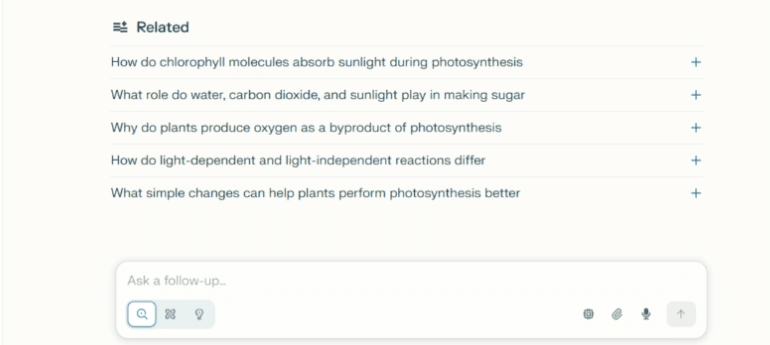
To continue your search on Perplexity AI, you can either ask follow-up questions directly or use this related section below to find common questions related to your query that other people ask.
Perplexity AI Pros
- Accuracy
- Relies on credible sources to share responses
- Personalization of answers
- Multimedia results
- Offers premium features for free
Perplexity AI Cons
- Not as conversational as other AI search engines
- It is not the best option for creative tasks or content generation
Why Use Perplexity AI?
Perplexity AI is one of the most fun AI search engines to use, which frequently brings about changes and improvements to its user experience.
2. ChatGPT Search (SearchGPT)
Lining up next, ChatGPT search, which originally launched as “SearchGPT,” has taken Perplexity as a competitor seriously. As evident from our Perplexity AI vs ChatGPT comparison, it was pretty evident that Perplexity AI brought its ‘A game’ and is a better tool, until ‘ChatGPT Search’ was launched.
From the demo that can be seen from the ChatGPT Search launch, it promises to do everything that Perplexity AI can and push to be better. While this ChatGPT feature is available for all, even for someone not signed up on ChatGPT, it feels like it misses something.
When asked for a stock price update or weather, it gives a less interactive result, which it can improve on. But, based on the demo shared by OpenAI during the launch of this feature, it is evident that this will soon get better!
Running our test prompt and looking at the response received, I was underwhelmed, to be honest. ChatGPT and its web search feature gave me a satisfactory resolution of my query, but it still feels like a search assistant responding.
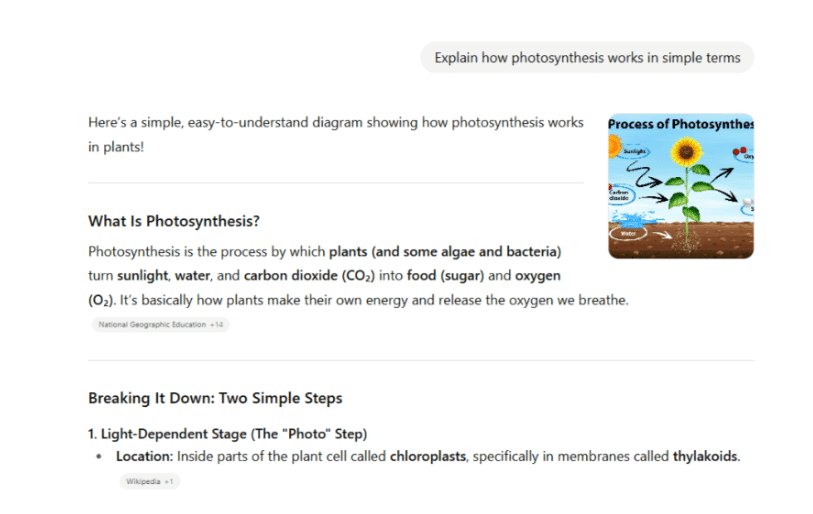
From an AI search engine, I expect better results, and want to get all of the things that I may need, like images, videos, charts, etc, which are related to my query. What I found during my tests is that I had to prompt and make an effort to get additional answers from ChatGPT.
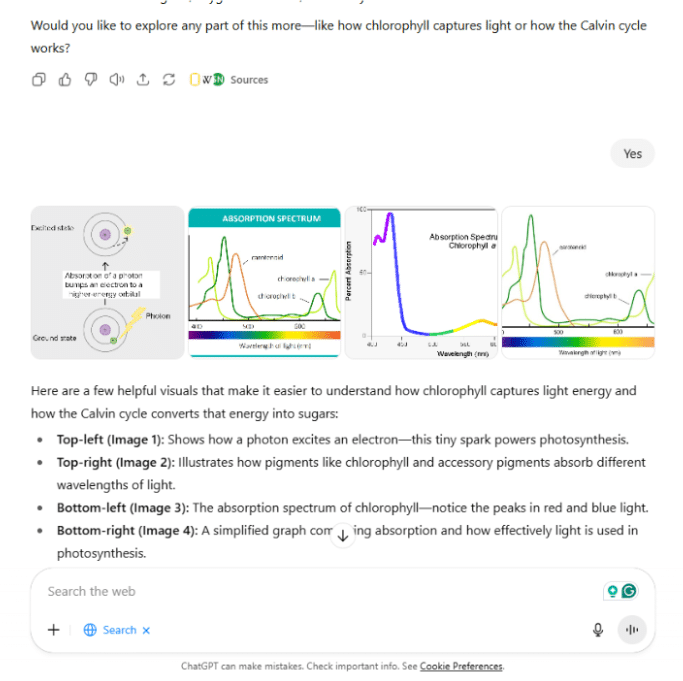
Whereas all this was already suggested when I used some of the other AI search engines.
However, the best part about ChatGPT web search is that you can instantly convert your standard search into a personalized conversation. ChatGPT already gets over a billion queries per day, and with more people using their AI search engine for free, this number is expected to rise.
ChatGPT Search Pros
- Operates on the most advanced OpenAI AI language model
- Best at conversational responses
- Shares live location-based results precisely
- It is available to use without signing up
ChatGPT Search Cons
- Inconsistency in sharing multimedia responses
- Needs active prompting to get more information
3. Microsoft Bing
Moving on to the next set of AI search engines, Microsoft Bing, powered by its Copilot, combines what we know as a traditional search engine with an AI search engine.
If you have been a Microsoft Bing user, you are one of the niche users who search only 900 million searches daily on Bing.
Only a few appreciate Bing, and those who use it know how underrated Microsoft Bing and the way it provides search results are.
To better understand how Microsoft Bing works as an AI search engine, imagine merging Perplexity AI, its unique way of generating results, with a standard search engine like the results that we are used to seeing.

Evaluating Microsoft Bing even without using any AI feature, it provides an answer to our test prompt in a much diverse way than any of the AI search engines on our list has.
To further make it better, you can power your search with Copilot if you want to move to a conversational style and have to ask specific questions.
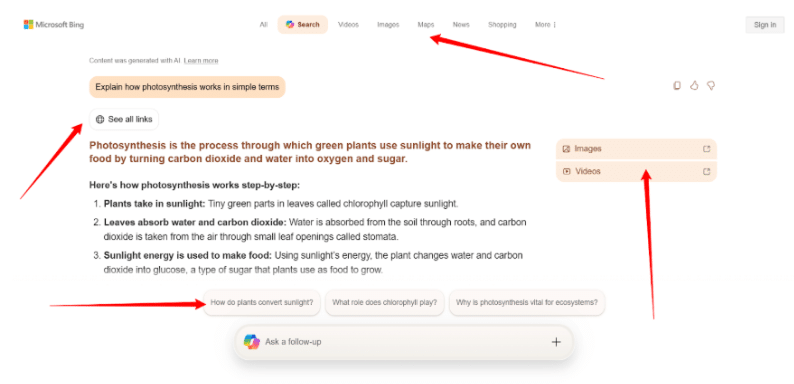
As soon as we switch to Copilot Search, you can continue with this search query as a conversation and get personalized answers to your questions.
Just like Perplexity AI, you can switch between videos, images, maps, shopping, and more. It also allows you to ask the next questions related to your original one, ready to be used based on what can be asked.
Microsoft Bing Pros
- Free to use on Microsoft Bing
- Offers GPT-5 the latest language model, for free
- Combines traditional search with AI chat assistant features
- Multimodal answers to questions
Microsoft Bing Cons
- Lacks interactive features
- Does not have much integration or deep research features
4. Google AI Mode
The new way to ‘Google’ is now available with the new Google AI mode that takes search to the next level. With a lot of new features and updates announced at the Google 2025 I/O, the Google AI mode is one of the first to be released.
The new Google AI mode introduces a new mode to search simultaneously normally on the Google search engine, and a new option where you are seeking more detailed answers.
Using Google AI Mode is free and very easy. You can easily activate the Google AI Mode from your main Google dashboard and search as you normally would.
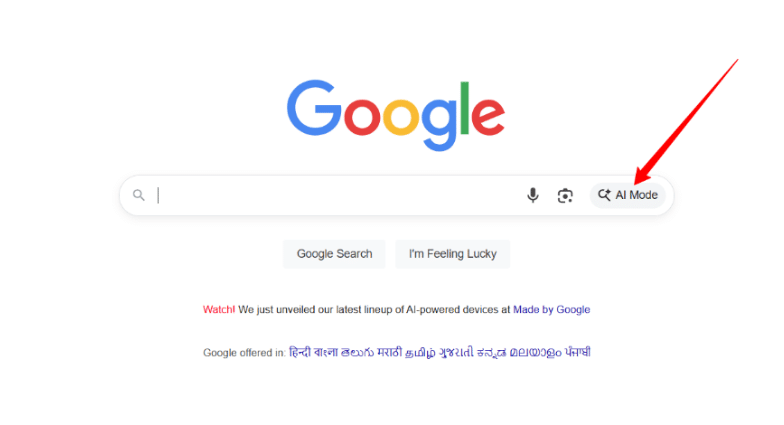
Testing the Google AI search engine with the test prompt gave me the exact answer to my question while also breaking down the complexity.
The response I received from Google AI mode was much simpler to understand, with the example it shared, and it explained the whole process.
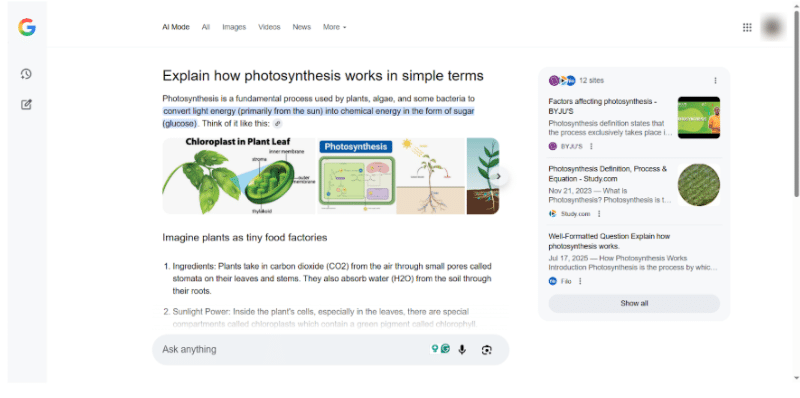
Similar to other AI search engine responses, Google AI mode, too, shared the sources it referred to and also linked them clearly on the side, making it easier to explore, and it can be a great AI search engine for research.
The best part of using the Google AI search engine mode is the availability of using Google Lens. No other listed AI search engine here has this, which gives it a slight edge.
Based on the announcements and improvements shared in the recent I/O event, Google sits in a comfortable position of leading the AI search engine race.
Google AI Mode Pros
- Free to use AI search engine mode
- Google lens and other Google feature integration
- Simplified responses
- Clear mention of sources with quick reference check available
Google AI Mode Cons
- Reported issues with bias
- Does not offer a deep research feature yet
5. Brave Search
Brave is another search engine turning towards an AI search engine offering a privacy-focused, ad-free browsing experience. This AI search engine continues to serve what has always been the motto of Brave in terms of privacy and security of the users online.
It uses its Leo AI assistant, which is based on Qwen, Meta, Claude, and DeepSeek large language models. The Brave AI search engine can summarize any page, generate content for you, and offer seamless integration within the browser itself.
While looking at the test prompt results from the Brave AI search engine, it did not feel quite reader-friendly.
Even though the answer explained everything about my question in summary, it wasn’t easy to read. In visual aspects, too, the response fell short of the other AI search engines.

Brave AI Pros
- Secure, privacy-focused AI search engine
- Does not store chat history on servers
- IP address stays safe
- Free to use
Brave AI Cons
- Free users have rate limits
- Cannot be used outside the Brave browser
6. You. com
Using You. com feels a little different as it looks to benefit businesses the most. This AI search engine is built with providing enterprise solutions in mind.
Apart from being a free chat agent, you. com helps build a Web Search API for LLMs and combine powerful AI technology with hands-on support
By building on foundational models in mind, they help bridge the gap between the two. Hence, this AI search engine does not fit quite well in this comparison, given its focus of operations.
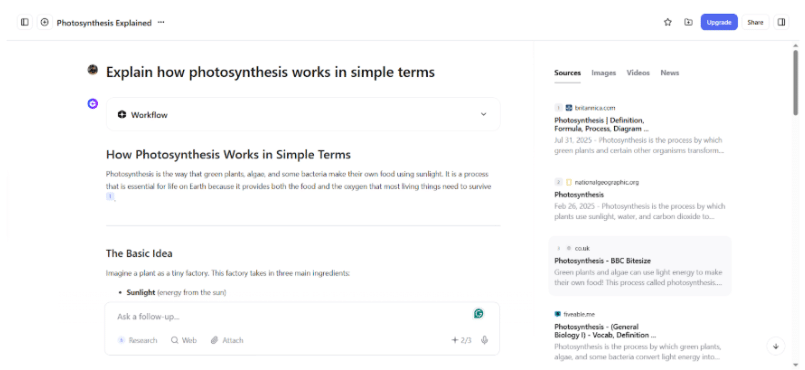
Testing this AI search engine with our test prompt, I was underwhelmed with the results received. The main issue with using this AI search engine is that the responses received from it took a long time to generate.
Additionally, the answers and their tone were oversimplified and lacked interactivity compared to other AI search engines.
You. com Pros
- Good for creating a custom enterprise-based solution
- Provides quality web search APIs for LLMs
- Helps LLMs reach greater context depth
- Supports world’s most trusted Fortune 500 companies
You. com Cons
- Result generation takes time
- Not a general user search engine
7. Komo
Komo AI search engine is an ad-free platform and is powered by its own Sunshine AI. Like ChatGPT, Komo also offers a no-signup experience, where you can test the features and limitations.
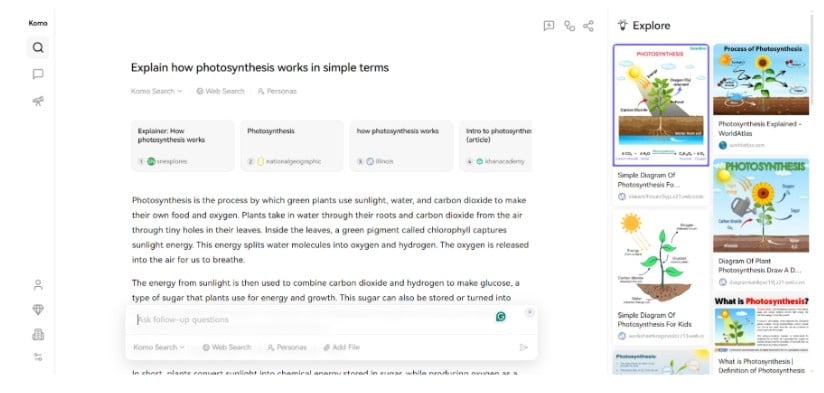
The results on the test prompt we ran provided impressive results with speed and, more importantly, with much visual context. Still, with the provided results, it does not outperform the top AI search engines like Bing and Perplexity.
The free Komo version offers all the necessary support, and the paid subscription provides greater access to AI search and unlocks more AI models from ChatGPT, Claude, and Gemini.
A unique part of the Komo interface is the “Discover” section that covers the most recent coverage on popular topics, including Technology, News, Science, Business, Politics, Entertainment, Travel, and Sports. Finance etc.
Komo Pros
- Ad-free and privacy-focused AI search engine
- Provides visual responses
- Offers access to multiple powerful AI models at once
- Most affordable premium plan
Komo Cons
- Answers lack simplicity and depth
- Frequent accuracy issues as reported
What Is The Difference Between An AI Search Engine And An AI Chatbot?
The primary difference between an AI search engine and an AI chatbot is that an AI search engine shares more with its results than a traditional chatbot does.
A chatbot is only a conversational chat that you can continue, while an AI search engine is more diverse with its responses; it provides images, videos, and resources that might add up to what you are looking for in your result.
| Features | AI Search Engine | AI Chatbot |
|---|---|---|
| Purpose | Summarize real-time content from web results | Conversation, planning, and understanding of concepts |
| Data Source | Live posts from the internet | Trained existing data |
| Results | Summaries and overviews | Conversation style answers in a chat |
| Accuracy | Not 100% accurate | Not 100% accurate |
| Recency | Provides most fresh information | Information provided might be outdated |
These differences also shed further light on the fact that an AI chatbot, as we know, is slowly evolving into an AI Search engine where it can play both roles, and serve the user as per their requirements.
How Do AI Search Engines Work?
The way AI search engines work is that they use artificial intelligence techniques like Natural Language Processing (NLP) and Machine Learning (ML) to understand user intent and deliver relevant results that a traditional search engine may not be able to.
This was the technical part of how an AI search engine works, and to put it simply, an AI search engine goes to the internet and finds the most relevant information related to your query and presents you with everything you need to know.
Instead of putting resources on a page for you to research, it does the job for you and tells you where exactly it took the reference from.
While this tech looks simple on the page, there is a lot that goes beyond, like:
- User query NLP layering
- Crawling
- Ranking of sources as per credibility
- Contextual compression (RAG)
- Answer generation
- Giving citations
- Getting visual elements ready and follow-ups
Flow Steps (Boxes or Circles in Sequence)

- User Query
- Icon: person typing/search bar.
- Text: “User enters a question in natural language.”
- Query Understanding (NLP)
- Icon: brain/AI chip.
- Text: “AI interprets intent & keywords using natural language processing.”
- Document Retrieval
- Icon: magnifying glass over stacked documents.
- Text: “System searches indexed web pages & databases.
- Ranking & Filtering
- Icon: stacked bars or filter funnel.
- Text: “Relevant results are ranked by relevance, freshness & authority.”
- Retrieval-Augmented Generation (RAG)
- Icon: AI + book/documents.
- Text: “AI combines search results with its knowledge to prepare an answer.”
- Answer Generation (LLM)
- Icon: chat bubble with sparkles.
- Text: “Large Language Model rewrites results into clear, natural language.”
- Citations & Sources
- Icon: link chain or book with citation mark.
- Text: “Answer includes references for transparency.”
- Response Delivered
- Icon: computer screen with a neat summary.
- Text: “User gets a clear, up-to-date, and trustworthy answer.”
How & Why Are AI Search Engines Important
An AI search engine is becoming important than a traditional search engine as users are more inclined to get summarized and concise information as part of their answers and don’t want to spend much time searching.
What usually takes 20 minutes for someone researching a topic, an AI-powered search engine does that in a matter of seconds. This leaves the user with more time on hand and also helps with more resources as a result that they might not have been able to get by checking manually.
As users turn towards AI search engines, brands and marketers are focusing on AI search engines too. With the changing trend and requirements, AI SEO tools are emerging that marketers can use to understand how their audience is interacting on these AI search engines.
Thus, AI search engines have become important as they offer quicker resolution to a reader and are equipped with richer knowledge.
Challenges and Limitations of AI Search Engines
The most critical challenge that an AI search engine faces is result accuracy, and the ongoing data scraping conflict between publishers and AI services.
In ethical terms, a website that publishes any piece of information owns that data as they spend resources creating content in forms of blogs, videos, etc.
When AI search engines scrape these websites and only summarize the results, it keeps the reader away from their website, resulting in a loss of traffic and monetary transaction opportunities.
Another challenge is the constant hallucination of information that AI provides it generates out of thin air, leading to the reader facing damage. This can be understood from this incident, where a New York attorney relied on ChatGPT for his legal research, resulting in the generation of false court decisions.
Read more about this case here.
Which AI Search Engine Should You Use?
Since AI search engines are constantly evolving and improving, there is no common ground to compare and decide which AI search engine is the best.
However, you can consider a few factors that can help you find the best AI search engine.
- Price – look for the difference between their free vs paid subscriptions.
- Features – evaluate the modes (chat, research, explore), integrations, citations, summarization, and result visualization features
- Speed – find AI search engines that are quick in providing a summarized result
- Integration – check if they provide integration features in terms of browser extensions or mobile apps.
As we look ahead, events like the Google 2025 I/O and the launch of ChatGPT hint towards a more agentic direction that these AI search engines would take.
What we see as an AI search engine now can soon evolve into a function that can execute multiple tasks for you from a single prompt, for example, “book my movie tickets.”
Conclusion: AI Search Engines Changes The User Experience
AI search engines have revolutionized the search experience as we know it. What seemed foreign to us a few years ago looks and feels real.
With quicker answers to results and much more context than traditional search, AI search engines provide a solution for users to get an elaborate reply to their query backed up with citations and references.
Among the live and popular ones, Perplexity AI provides the best AI search engine experience and has been the first AI tool to introduce a new way to search.
FAQs
The best free AI search engine is Perplexity AI. Even without the $20/mo subscription, it offers the best search experience that feels unique.
There is no AI search engine that can be declared as the most accurate AI search engine, as each one of them accepts the room for error and advises user verification.
ChatGPT’s deep search feature is the best, given its usage of the latest GPT-5 model. It breaks down complex elements into a query and thinks from the user’s perspective brilliantly.
