
Customer Relationship Management (CRM) systems have become essential for businesses aiming to improve customer interactions, streamline operations, and boost revenue.
The CRM market is expected to grow to $126.17 billion in 2026, with 91% of companies already using these tools to manage their sales and customer data. AI is also playing a bigger role, with 83% of companies already using AI features for smarter automation and personalized customer interactions.
This article covers the latest CRM statistics, including the facts and figures about its current state, adoption, latest trends, and more.
CRM Statistics 2026: Top Picks
- The CRM market is expected to reach $126.17 billion in 2026.
- Businesses using CRM software experience a 300% increase in conversion rates, leading to more closed deals.
- Around 87% of companies use cloud-based CRM platforms for better accessibility and flexibility.
- Over 82% of organizations rely on CRM for sales reporting and automation, improving efficiency and tracking.
- Nearly 81% of CRM users access their system from multiple devices, ensuring convenience and seamless workflow.
- Companies that invest in CRM see an average return of $3 to $5 for every $1 spent.
- Over 47% of businesses report higher customer retention rates after adopting CRM software.
- CRM users see a 17% increase in lead conversions, a 16% boost in customer retention, and a 21% rise in agent productivity.
Current State of the CRM Market
- A staggering 94% of tech companies and 71% of small businesses rely on CRM systems to streamline customer interactions, track sales, and enhance overall efficiency.
This widespread adoption highlights how essential CRM tools have become for large enterprises and small businesses looking to scale and build lasting customer relationships.
Source: Fresh Works
- Around 83% of companies are already using AI in their CRM workflows.
One major reason is that AI helps businesses respond faster, with companies seeing a 30-50% improvement in response times. It also enhances customer interactions, with 65% of businesses reporting better engagement thanks to AI-powered virtual sales assistants.
Plus, AI isn’t just about speed; it also helps save money. By automating routine tasks and improving efficiency, 41% of companies have already cut costs with AI-driven CRM systems.
Source: Market.us, Salesforce
CRM Market Size
The CRM market has grown exponentially over the past few years. It has grown by $22 billion in the last three years and is predicted to grow by nearly $30 million in the next three years.
The Revenue Of The CRM Market Is Projected To Reach $112.91 Billion
- The revenue is anticipated to grow at a CAGR of 12.40% between 2025 and 2034, resulting in a market volume of $320.99 billion by 2034.
- In a global comparison, the United States will generate most of the revenue in the CRM market. North America currently leads the market with 31.70% CRM market share.
Some of the major driving forces of the CRM market are a rising focus on consumer engagement, emerging small businesses and social media usage, and the sharing of ideas on a real-time basis.
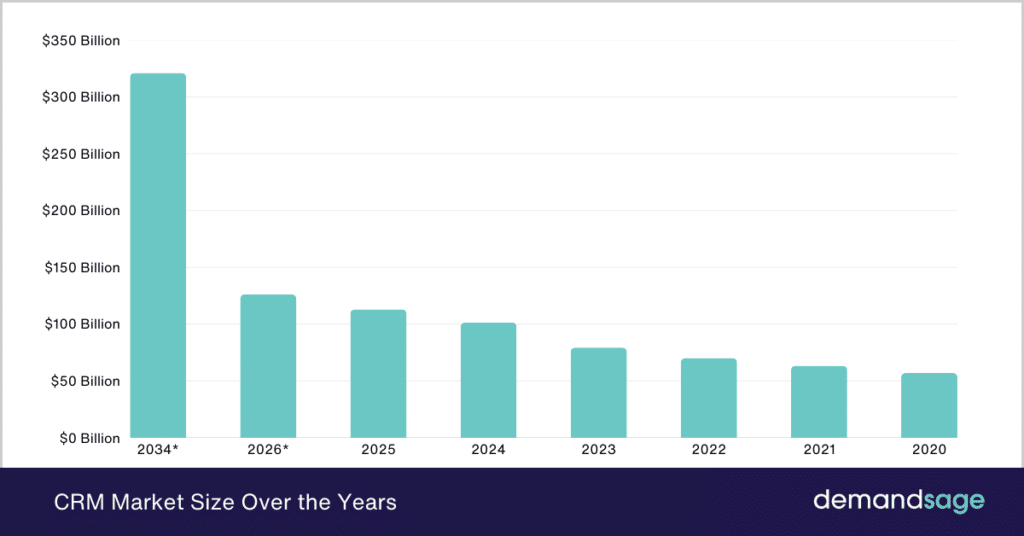
The following table displays further information about the Market volume of CRM recorded over the years.
| Year | CRM Market volume | Revenue Change |
|---|---|---|
| 2034* | $320.99 billion | 12.40% |
| 2026* | $126.17 billion | 12.8% |
| 2025 | $112.91 billion | 12.8% |
| 2024 | $101.41 billion | 11.08% |
| 2023 | $79.40 billion | 13.19% |
| 2022 | $70.14 billion | 10.65% |
| 2021 | $63.39 billion | 11.15% |
| 2020 | $57.03 billion | 5.37% |
Source: Fortune Business Insights
CRM Usage Statistics
- Over 9 in 10 big enterprises worldwide have adopted CRM software. The major reasons for these high usage rates are benefits like increased sales, consumer satisfaction, and better customer interactions.
91% Of Companies With More Than 11 Employees Use A CRM System

- Comparatively, only 50% of the companies with 10 or fewer employees do not use a CRM system.
CRM usage helps improve consumer data access, boost conversion rates, and increase productivity. Businesses reported that CRM software helps them increase productivity by almost 50%.
Source: LinkedIn.
Around 82% Of Businesses Use CRM For Sales Reporting
- According to a Grand View Research study, over 8 in 10 businesses use CRM systems for sales reporting and process automation.
Additionally, the business leaders report that they rely on CRM solutions for handling consumer data.
Source: focus on force.
54% Of Sales Professionals Use CRM to Build Stronger Relationships With Buyers

It helps the sales team make the communication more flawless and understand the buyers’ needs. Further, it helps in having more effective interactions with the consumers.
CRM software also helps in improving consumer relationship management by
- Creating a 360-degree view of the consumer.
- Capturing the interactions
- Surfacing the information that will help in achieving better communication with the readers.
Source: Highspot, Salesforce.
CRM Software Has Helped 74% Of Businesses Improve Access To Customer Data
- A recent survey by Resco.net found that 74% of companies said that CRM technology helped them get better access to consumer data.
CRM software manages every consumer interaction and consistently tracks the conversation, helping companies make data-driven decisions that help them boost sales.
Source: Resco.
37% Of Small Businesses Are Very Satisfied With Their CRM Systems
33% of small businesses said they were somewhat satisfied. The same satisfaction results were recorded among the large enterprises.
Source: Resco.
61% Of Businesses Use CRM Software For Lead Generation
- A study by INVESP, which surveyed marketing specialists, concluded that nearly 6 in 10 businesses useCRM for lead generation and nurturing.
At the same time, 3 in 10 businesses said their main objective for using CRM software is increasing marketing productivity.

The following table displays the top objectives of the businesses using CRM.
| Objective for using CRM | Percentage of CRM users |
|---|---|
| Lead Generation | 61% |
| lead nurturing | 57% |
| sales revenue | 47% |
| increasing customer engagement rates | 36% |
| increase marketing productivity | 29% |
| improving campaign CRM statistics | 28% |
Source: STROE.
81% Of Users Access Their CRM Software From Multiple Devices
- 48% of the people access CRM using mobiles, while 45% use a tablet.
Meanwhile, 50% of the teams improved their productivity by using a mobile CRM.
- Another Nucleus research report highlights that 65% of companies using a mobile CRM are achieving their sales quotas. Comparatively, only 22% of businesses using non-mobile CRM have reached the same targets.
- 87% of companies have already moved to the cloud, leveraging mobile CRM and its capabilities.
Source: Forester, Nucleus Research, Lead Suared.
87% Of Businesses Today Use Cloud-Based CRM
- In 2008, only 12% of the businesses used cloud-based CRM. This figure has increased to 87%.
That means nearly 9 in 10 businesses using CRM prefer a cloud-based CRM.
The major reason businesses prefer cloud-based CRM is the need to access the software from multiple devices and locations.
SuperOffice backed this stat with their data. Their report added that they had just 15% of the new consumers subscribed to SuperOffice’s cloud CRM in 2010. However, they sold cloud CRM to 97% of their customers.
Source: SuperOffice.
43% Of CRM Customers Use Fewer Than Half the Features They Have on Their CRM
Implementing CRM has various benefits, yet some companies fail to implement the software to its full potential.
- Study shows that over 4 in 10 CRM users use only half or fewer features and functions of the tool.
On the other hand, 22% of sales professionals are still unsure what CRM is and how to use it to its full potential.
Source: Kylas.
CRM Adoption Rate
- With the increased usage of CRM software, their adoption rates have also increased rapidly. Today, 9 in 10 Fortune 500 companies have adopted CRM software.
Not only that, but the majority of businesses worldwide have adopted CRM usage to some extent.
40% Of Businesses Claim A 90% CRM Adoption Rate
CRM ensures that salespeople effectively manage consumer interactions, sales processes, and other campaigns.
- However, only 4 in 10 businesses can use CRM software to almost their full potential, and most businesses struggle to adopt CRM to its full potential.
Source: G2.
90% Of Fortune 500 Companies Use Salesforce to Manage Their Business Relationships
Back in 2017, only 83% of the Fortune 500 companies used Salesforce.
Spotify, Amazon Web Services, Toyota, Walmart Inc., etc., are some of the top Fortune 500 companies that use Salesforce. Salesforce itself ranked 133 in the Fortune 500 list.
Source: Ascendix.
On Average, 65% Of Companies Adopt CRM within 5 Years Of Launching
- 18% of businesses adopt CRM within one year, while 1 in 5 companies adopt CRM between one and two years.
Here are further details about the adoption of CRM by companies after their establishment.
- Three to five years: 23%
- One to two years: 20%
- Less than one year: 18%
- Company founded before CRM: 13%
- Six to ten years: 10%
- More than ten years: 10%
- Not sure: 8%
Source: Zippia.
The Retail Industry Has The Highest CRM Usage, With 18% Of Companies Using It
- Almost 1 in 5 retail businesses use CRM software, while 1 in 10 Business services companies use CRM software.
CRM services help retail businesses keep track of their consumers and consumer interactions, making it more convenient to fulfill all the customers’ requirements.

The following table displays the industries with the highest CRM user share.
| Industry | Percentage of companies that use CRM |
|---|---|
| Retail | 18% |
| Business Services | 10% |
| Technology | 8% |
| Banking/Insurance/Finance | 7% |
| Manufacturing | 6% |
| Others | 51% |
Source: Zippia.
B2C Companies Make Up More Than 60% Of The CRM Consumers
B2C companies make up the largest share of the CRM users.
- They are followed by the B2B companies, which comprise 55% of the CRM users.
- On the other hand, business-to-government and non-profit organizations make up just 10% of the CRM users.
Source: Zippia.
Benefits of CRM
This section highlights the benefits of CRM software adoption and how users benefit in terms of revenue, sales, leads, and more.
CRM Can Boost The Conversion Rates By 300%

- CRM acts as a catalyst for improving sales performance. 75% of the sales managers who used CRM reported that CRM helped them increase sales.
Additionally, it was found that these managers were able to improve their sales conversion rates by three times after adopting CRM.
These stats prove that CRM is a critical tool to improve your sales success.
Source: Five CRM.
CRM Software Can Boost Sales By 29%
- Most businesses that adopted CRM to its full potential witnessed 87% improvement in sales.
- At the same time, they also witnessed a 74% increase in customer satisfaction and a 73% improvement in business efficiency.
Source: Tech.
Businesses That Use CRM Saw An Increase Of 41% In Sales Revenue
- They also saw a 32% reduction in marketing costs. Additionally, businesses that adopted CRM strategy reported a 50% increase in consumer retention rates.
Source: LinkedIn.
The Average ROI for CRM for Every Dollar Spent Is $3 to $5 in 2026
According to a Nucleus Research study in 2014, CRM was getting $8.71 on every $1 spend. The ROI declined over the years as the market matured and implementation costs rose.
- The ROI of CRM software can increase by 245% when properly implemented.
However, the average ROI varies depending on company size, CRM maturity, user adoption, and CRM application.
Source: CRM search. Prospeo
37.8% Of Businesses Experience an Improvement in Sales Productivity After Implementing CRM Sales Tools
A recent study by Newswire reveals that over one-third of CRM users experienced an increase in sales productivity.
- The study further highlighted that over 79% of CRM users recognized the importance of artificial intelligence in CRM sales tools.
These AI functions proved to be game changers in the field of customer relationship management, enabling businesses to personalize interactions, streamline processes, and drive sales growth.
Source: Newswire.
Challenges In CRM
Despite the number of benefits of CRM adoption, businesses face challenges that make it difficult for companies to adopt CRM software for its potential use.
This section highlights the companies’ struggles with using CRM software and their views on it.
32% Of CRM Users Feel A Lack of Technical Expertise Is the Biggest Roadblock

Small businesses face various difficulties while implementing CRM software. One of the most common issues faced by almost one-third of small business owners is a lack of technical expertise.
Here are other challenges small businesses face in adopting CRM software.
- Cost of a CRM: 31%
- Data migration issues: 30%
- User adoption: 27%
- Lack of app integrations: 23%
Source: fit small business.
70% Of CRM Projects Fail
- 20 to 70% of the CRM projects fail. Poor usage adoption is the leading cause of CRM implementation failure.
Ineffective CRM adoption can mismanage customer relationships, fail to capture important data and insights and lead to a loss of potential customers, leaving your business with unfavorable consequences.
Source: Skuid.
17% Of Businesses Say Manual Data Entry Is Their Biggest CRM Challenge
- Another 17% of companies say that lack of integration with other tools is a major CRM challenge.
Moreover, 7% of the businesses said it is complicated to use, and 1 in 10 companies find it difficult to track sales funnels when using a CRM.
The following table displays the challenges companies face while using a CRM.
| Biggest challenges faced by companies that use CRM | Percentage of comapnies |
|---|---|
| Manual data entry | 17% |
| Lack of integration with other tools | 17% |
| Difficult to track my sales funnel | 12% |
| Invalid of incorrect data | 8% |
| It’s too complicated to use | 7% |
| Managers don’t use it | 5% |
| My sales team doesn’t use it | 16% |
| Don’t know/not applicable | 14% |
| Other | 5% |
Source: Zippia.
CRM Software Statistics
- Salesforce owns 20.7% of the CRM market share, being the #1 for the 12th consecutive year. Around 2 in 10 businesses using CRM software prefer Salesforce.
Other most preferred CRM software are Microsoft Dynamics, Oracle, Adobe, SAP, and more.
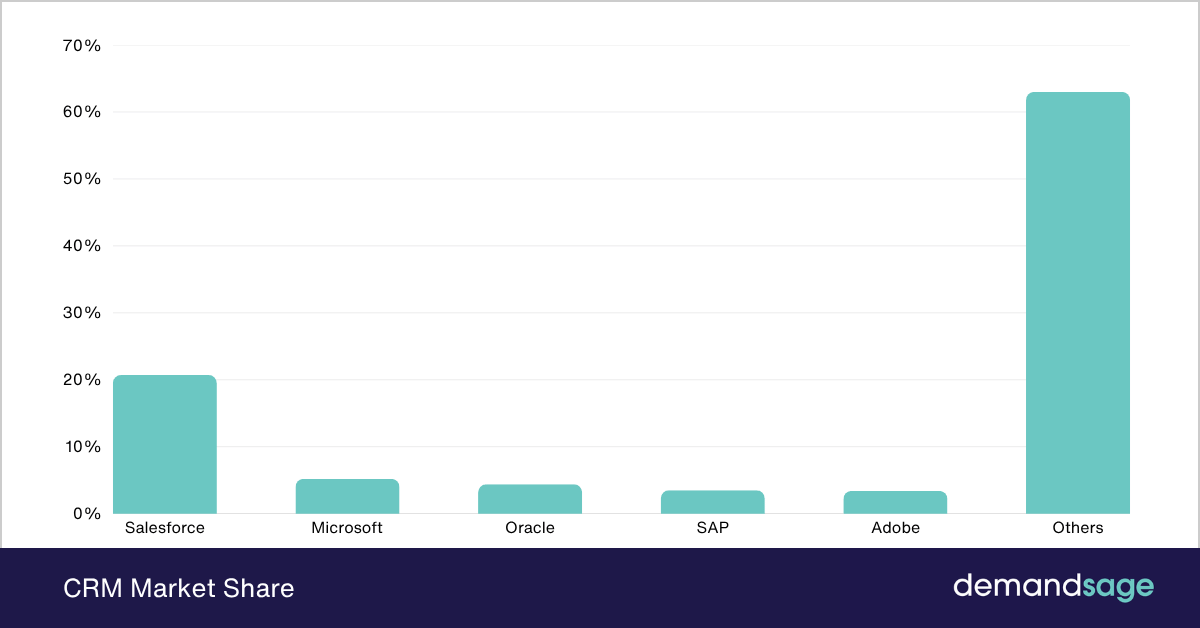
Here are further details about the CRM market share.
| CRM software | Market share |
|---|---|
| Salesforce | 20.7% |
| Microsoft Dynamics | 5.2% |
| Oracle | 4.4% |
| SAP | 3.5% |
| Adobe | 3.4% |
| Other | 62.8% |
Source: Technology Checker
Let us explore detailed facts and figures about the most popular CRM software worldwide.
Salesforce CRM Statistics
- On average, Salesforce CRM users witness 38% faster decision-making, a 35% increase in customer satisfaction, and an 18.4% jump in revenue.
- Salesforce boasts more than 150,000 customers worldwide.
- Salesforce is valued at $247.43billion.
- 61.8% of Salesforce CRM users are from the United States. The United States has the highest number of Salesforce users, followed by the United Kingdom.

Here are further details about the businesses that use Salesforce CRM in different countries worldwide.
| Country | Percentage of Salesforce consumers in the country |
|---|---|
| United States | 61.8% |
| Germany | 2.7% |
| Australia | 1.8% |
| United Kingdom | 4.9% |
| Netherlands | 3.2% |
| France | 13.6% |
Source: Vention Teams, Macroaxis
Hubspot CRM Statistics
- HubSpot has 279,000 customers located across 135+ countries. HubSpot is valued at $20.29 billion and has over 100K paying customers.
- HubSpot annual revenue for 2024 was $2.628 billion, a 21.07% increase from 2023.
Source: Hubspot, Backlinko, Macroaxis.
Zendesk CRM Statistics
- Zendesk has a market valuation of $10.2 billion. 178,168 companies have started using Zendesk. 73,033 Zendesk customers are in the United States.
- The customer experience management market is estimated to grow at a compound annual growth rate (CAGR) of 15.4% from 2023 to 2030. Zendesk generated a revenue of $1.58 billion in 2022, an approximate increase of $25 million compared to 2021.
The following table displays the revenue generated by Zendesk over the past year.
| Year | Revenue | Change |
|---|---|---|
| 2022 | $1.58 billion | 18.61% |
| 2021 | $1.33 billion | 30.02% |
| 2020 | $1.02 billion | 26.11% |
| 2019 | $0.81 billion | 36.35% |
| 2018 | $0.59 billion | 39.08% |
Source: Companies market cap, Zendesk, Tech. co.
CRM Trends for 2026
- Companies are no longer waiting for IT to build CRM workflows. By the end of 2026, 70% of new enterprise applications (including CRM customizations) will be built using low-code or no-code technologies.
- Despite AI’s rise, the human element is struggling. 76% of customer service agents report high levels of burnout due to the increased complexity of tier-2 issues that AI cannot yet solve.
- While the general CRM market is huge, the Healthcare sector has become the fastest-growing niche. The global Healthcare CRM market is projected to hit $20.60 billion by 2026.
- CRMs are being repurposed for Green reporting. New EU regulations coming into full effect in 2026 mandate that 90% of listed companies must provide verifiable ESG (Environmental, Social, and Governance) data, leading to a surge in Sustainability CRM modules.
- Technological failure is rare, but human failure is constant. Roughly 70% of CRM projects fail to meet their goals, not because of the software, but due to cross-functional misalignment between sales and marketing departments.
Source: Integrate.io, Salesmate, Precedence Research, Digitalfynd, Walkme
Conclusion: CRM Generates $3 to $5 for Every $1 Spent
The global CRM market is projected to reach $126.17 billion, with 91% of businesses using CRM tools to manage customer interactions. AI-driven CRM adoption is rising, with 83% of companies using AI for automation and personalization.
Companies investing in CRM see a 300% increase in conversion rates and earn $3 to $5 for every $1 spent. As CRM technology evolves, businesses that leverage its capabilities will continue to see improved customer retention, higher efficiency, and greater revenue growth.
