
Google remains the world’s most popular search engine, processing an estimated 16.4 billion searches per day. With over 5.01 billion users globally, Google dominates the search engine market with a 90.02% share, making it the go-to platform for finding information online.
Back in 1999, it processed just 1 billion searches per year. By 2016, that number had surged past 2 trillion annually. Now, Google handles around 5.9 trillion searches per year, reflecting its deep integration into everyday life.
This article covers the latest facts and figures about the number of Google searches per day, the number of searches per person, and more
Google Search Statistics 2026 (Top Picks)
- Nearly 16.4 billion searches take place on Google every day.
- Google processes around 189,800 searches per second.
- Annually, Google handles over 5.9 trillion searches worldwide.
- Roughly 5.01 billion people use Google globally.
- Google dominates the search engine market with a 90.02% share.
How Many Google Searches Per Day?
Currently, Google processes over 5.9 trillion searches per year, which translates to approximately 16.4 billion searches per day.
However, the exact number remains undisclosed. The last official figure from Google was in 2016, when it confirmed handling at least 2 trillion searches annually, marking a 150% increase in search volume since then.
Google now sees 5+ trillion searches annually, or 416B searches per month (Jan 2025 data) https://t.co/j8xdHLUnOw pic.twitter.com/5Jj5Y1eC9v
— Glenn Gabe (@glenngabe) March 3, 2025
Here are details about the Estimated Number of Google Searches according to the last data recorded:
- Searches per second: 189,815
- Searches per minute: 11.4 million
- Searches per hour: 684 million
- Searches per day: 16.4 billion.
- Searches per month: 492 billion
- Searches per year: 5.9 trillion.

The following table displays the number of estimated Google searches recorded by year:
| Year | Estimated Google Searches By Year |
|---|---|
| 1999 | 1 billion |
| 2000 | 14 billion |
| 2001–2003 | 55 billion |
| 2004–2008 | 73 billion |
| 2009 | 365 billion |
| 2012–2015 | 1.2 trillion |
| 2016–2023 | 2 trillion |
| 2024 | 5 trillion |
| 2025 | 5.9 trillion |
Source: Search Engine Land, Exploding Topics
Google Searches Per Person
Right now, Google processes over 5.9 trillion searches annually, averaging 16.4 billion searches per day. With approximately 6.04 billion internet users globally, this results in an average of 2.71 searches per person per day.
Search behavior can vary across demographics. For instance, in the United States, desktop users conduct an average of 126 unique searches per month or about 4.2 searches per person per day.
Search habits can differ by demographic. For example, in the United States, desktop users conduct an average of 126 unique searches per month or about 4.2 searches per day.
When breaking it down further, 34% of people perform more than 100 searches each month, 36% search between 21 and 100 times, and 30% make just 1 to 20 searches a month. This shows how diverse search behaviors can be across different users.
As for how Americans use Google’s search verticals, most prefer the homepage:
| Google Search Vertical | Usage Percentage |
|---|---|
| Google Homepage (Main Search Page) | 86.94% |
| Images | 10.62% |
| Video | 1.16% |
| Maps | 0.64% (likely an undercount) |
| News | 0.38% |
| Shopping | 0.23% |
| Web | 0.04% |
Source: Search Engine Land
How Many People Use Google?
An estimated 5.01 billion people use Google worldwide.
With a 90.02% share of the global search engine market and approximately 6.04 billion internet users, Google remains the dominant platform for online searches.
Source: Statista, StatCounter
Most Searched Things on Google (Global)
“ChatGPT” takes the top spot as the most searched term, with an impressive 768.3 million searches per month, showcasing its meteoric rise and unmatched popularity in the digital world.
Meanwhile, social media and tech platforms continue to dominate search trends — WhatsApp Web (533.4M), YouTube (390.8M), and Facebook (207.2M) all rank among the top 10, highlighting the ever-growing demand for online connectivity, communication, and entertainment.
Additionally, Amazon (204.1M) secures seventh place, reinforcing its status as the world’s leading online marketplace and a go-to destination for shoppers worldwide.
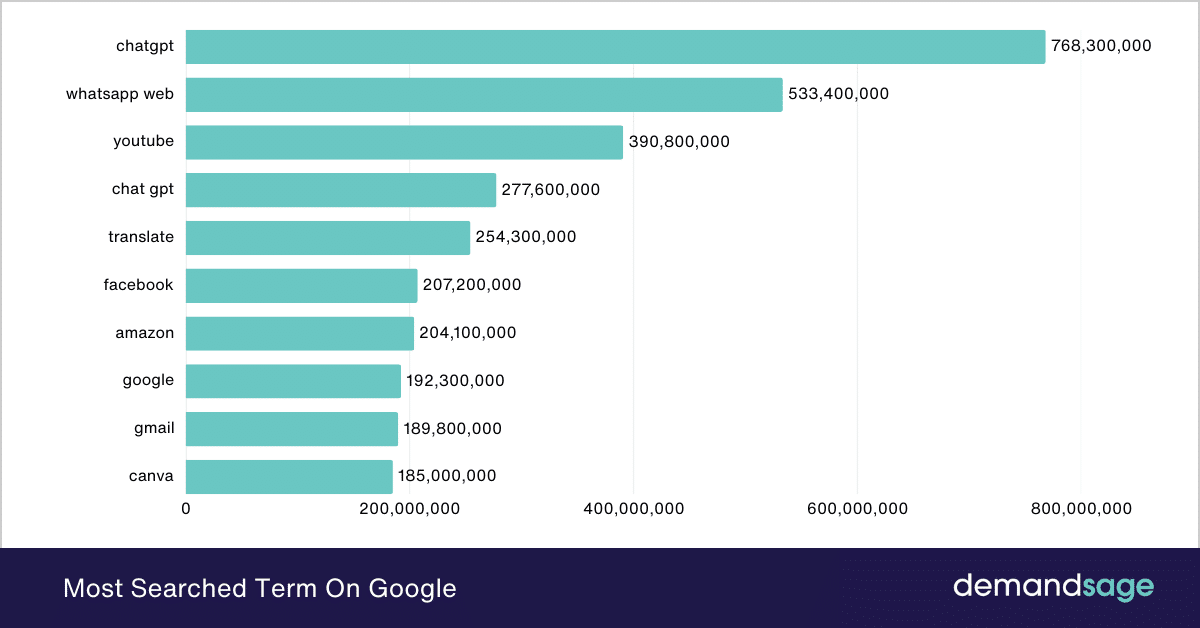
The following table displays the most searched terms on Google:
| Rank | Search Terms | Average Monthly Search Volume |
|---|---|---|
| 1 | chatgpt | 768,300,000 |
| 2 | whatsapp web | 533,400,000 |
| 3 | youtube | 390,800,000 |
| 4 | chat gpt | 277,600,000 |
| 5 | translate | 254,300,000 |
| 6 | 207,200,000 | |
| 7 | amazon | 204,100,000 |
| 8 | 192,300,000 | |
| 9 | gmail | 189,800,000 |
| 10 | canva | 185,000,000 |
Source: Ahrefs
Google Voice Search Stats
Almost 1 in 5 Google searches are voice searches. The number of voice searches on Google has rapidly increased over time as it is more convenient and easier to use.
Google Home is recognized as the top-performing voice search platform, delivering results with an impressive 81% accuracy rate.
More Than 20% Of The Searches In The Google App Are Made Using Voice Search
Voice search is used by approximately 58% of consumers to find a local business. Besides, 41% of the adults in the US use voice search daily.
Hence, with the increased usage of technology and AI, voice search usage on the Google App has grown.
Source: Think with Google.
750 Million People Worldwide Use Google Gemini Every Month
Google Gemini (assistant and app) is now used by over 750 million users every month in 2026. In the last quarter of 2025, the app gained over 100 million users.
It was the most popular voice assistant in the US in 2023. It had 85.4 million users in the country.
Further, Google Assistant is predicted to have reached 88.7 million users in the United States.
Source: Insider Intelligence, Google Blog
Google Lens Search Stats
Google Lens is not far behind when it comes to Google searches. Google Lens is used more than 3,086 times per second.
It helps find similar product images, extract text, and more. Let’s look at further statistics related to Google Lens.
Each Month, Users Turn To Google Lens For Approximately 12 Billion Visual Searches
This highlights the growing popularity of visual search technology.
Google has made it very convenient for users to search for queries. As a result, several users are exploring Google Lens to find similar images or queries.
Google Lens helps users identify objects through their smartphone camera. Hence, with all the latest updates, Google Lens could identify up to a billion different items.
However, Google Lens functions are not just limited to images. It can identify text in the images, translate text, and extract text from the images.
Source: Google
32.5% Of All Google Lens Results Have A Matching Keyword In The Page’s Title Tag
Hence, keyword-optimized title tags will help the pages rank in Google Lens searches.
Source: Backlinko.
Approximately One-Third Of The Google Lens Image Results Appear From The Top 25% Of Web Pages
According to the study conducted by Backlinko, approximately 1/3rd of Google Lens results are pulled from images included in the top web pages.
Source: Backlinko.
7.2% Of All Google Lens Results Come From Pinterest
Meanwhile, 4.1% of the Google Lens results are from Amazon.
Pinterest and Amazon are the two top-performing websites in Google Lens. 11.3% of the Google Lens results are from either of the websites.
Source: Backlinko.
Bonus: Check out Pinterest Statistics to get more insights about the platform.
Mobile Searches On Google
With over 7 billion people using smartphones, mobile searches have skyrocketed over the years. Currently, 3 in 5 people use their mobile devices to conduct Google searches.
Let us take a closer look at the figures related to mobile searches on Google.
60% Of All Google Searches Are From Mobile Devices
People are using their smartphones more than ever to conduct Google searches. The volume of mobile searches on Google has doubled compared to that recorded 5 years ago.
Source: Luisa Zhou.
Google Holds A Dominant 95.52% Share Of The Mobile Search Engine Market
A significant number of internet users prefer using Google for searches on their mobile devices.
Additionally, Yandex holds a 1.06% share of the mobile search engine market, while DuckDuckGo accounts for 0.69%.
The following table displays the distribution of the mobile search engine market.
| Mobile Search Engine | Share Of Mobile Search Engine Market |
|---|---|
| 95.52% | |
| YANDEX | 1.06% |
| DuckDuckGo | 0.69% |
| Bing | 0.68% |
| Baidu | 0.55% |
| Yahoo! | 0.52% |
Source: Statcounter.
63% Of Google’s Organic Search Traffic In The US Comes From Mobile Devices
Mobile searches on Google have skyrocketed over the past few years with the increased adoption of smartphones.
Users on tablets or smartphones are more likely to conduct local searches, looking for answers to a particular query that is more likely to be location-based. Plus, searches carried out on mobile phones are less complex and may include faster facts than learning details.
Besides, the first mobile search result on Google has an average click-through rate of 26.9%.
Source: Advanced Web Rankings, Oberlo.
Google vs LLM Searches
Google’s advertising revenue hit $102.3 billion in Q3 2025, which sounds impressive. But beneath the surface, there are signs of trouble. The company’s Network advertising revenues dropped from $31.3 billion to $30.4 billion in 2024, a 3% decline that signals shifting user behavior.
New AI-powered search platforms are making serious moves. Take Perplexity AI, for example. Since launching in August 2022, the platform has seen its website visits jump nearly five times between 2023 and 2024. Google hasn’t been sitting idle, though.
The following table displays the comparison between Google and LLM-powered search platforms:
| Metric | Google Search | LLM-Powered Search (Bing with ChatGPT) |
|---|---|---|
| Market Share | Below 90% | Growing (15.8% page visit increase) |
| Daily Active Users | 5.01 billion globally | 100+ million (Bing) |
| Traffic Trend (2023-2024) | Declined by nearly 1% | Increased by 15.8% |
| Search Type | Keyword-based | Conversational, AI-generated answers |
| Primary Revenue Model | Advertising (72.5% of revenue) | Advertising + Premium subscriptions |
| Alternative Platform Usage | Gen Z shifting to TikTok (65%) | ChatGPT integration driving growth |
Miscellaneous Google Search Stats
Google is a medium that will help you reach potential consumers worldwide. Nearly half of the Google searches are local searches, and a few of them may end in purchases.
That’s the power of Google.
Here are some interesting facts that will help you understand consumer behavior on Google.
46% Of All Monthly Google Searches Have Local Intent
This means 97 billion local searches per month. It breaks down to 3.2 billion daily local searches and 37,000 local searches per second.

The following table displays the local searches recorded by Google in different time frames.
| Time Frame | Number Of Local Searches On Google |
|---|---|
| Per second | 37,000 |
| Per minute | 2.22 million |
| Per hour | 133.2 million |
| Per day | 3.19 billion |
| Per month | 97 billion |
| Per year | 1.164 trillion |
Source: LinkedIn.
78% Of Local Mobile Searches on Google Result In An Offline Purchase
Users making local searches on their mobiles are even more likely to convert to paying customers. 90% of these purchases take place in the physical store locations.
Hence, offline stores must have a crucial local SEO strategy to attract potential consumers.
Source: Safari Digital.com.
46% Of The Product Searches Begin On Google
Almost half of the product research begins on Google. However, due to the availability of the latest data, Amazon has surpassed Google, with 54% of searches starting on Amazon.
Hence, if you are trying to rank organically or run effective Google ads, you can reach your potential consumers by appearing in relevant Google searches.
Source: Jumpshot.
AI Overviews appear in 20.5% of all Google Searches
AIOs are triggered for 20.5% of keywords. AIO appears 9.5% times for single-word keywords and 46.4% times for 7 or more keywords.
In January 2025, AI Overviews appeared in only 6.49% of search results, which is nearly double in mid-2025.
Only 7.71% of users follow the links provided by AI Overviews. Meanwhile, 8.5% of users trust the information given in the AI Overviews.
Source: Semrush, Search Engine Journal
SEO Statistics (Leverage Google Searches)
As most online experiences start with Google searches, they are a way to drive traffic to your website/blog/business/basically anything.
SEO will help you rank better when people enter a query, thus driving traffic to you.
Let’s explore fascinating facts about Google that will help you understand the importance of SEO.
Only 0.63% Of The People Click On The Second Page Of The Google Search Results
Chances are that the users do not find an answer to their queries. Hence, they visit the 2nd page of Google for further research. However, these chances are very low, and the results on the 2nd page have a CTR of less than 2.4%.
However, the result that makes it to the #1 position on Google’s search results has an average click-through rate of 27.6%.
That’s a huge difference!
The following table displays the CTR rate of the results on Google Search by position.
| Google Search Result’s Position | CTR Rate Recorded By Result |
|---|---|
| #1 | 27.6% |
| #2 | 15.8% |
| #3 | 11.0% |
| #4 | 8.4% |
| #5 | 6.3% |
| #6 | 4.9% |
| #7 | 3.9% |
| #8 | 3.3% |
| #9 | 2.7% |
| #10 | 2.4% |
Source: Backlinko.
75% Of People Don’t Go Past The First Page Of Google Search Results
This means if your website isn’t ranking on the first page, then you are missing a huge consumer base.
Hence, to reach your potential consumers and grab your audience’s attention, you must make sure to rank on the first page of Google’s search results.
Source: LinkedIn.
Around 93% Of Online Experiences Begin With A Search Engine Like Google
Hence, if a business isn’t found on Google, it could miss a lot of traffic and potential consumers.
Source: Search Engine Journal.
Conclusion: Approximately 16.4 Billion Searches Take Place Every Day On Google
Google continues to be the world’s leading search engine, handling over 5.9 trillion searches a year—that’s about 16.4 billion searches every day. With a 89.94% market share, it remains the top choice for finding information online.
Right now, around 5.01 billion people worldwide use Google, and 84% of them search at least three times a day, showing just how essential it has become in daily life.
