
78% of companies worldwide now use AI, and in marketing, the adoption rate is even higher. 66% of marketers use it daily. In the US, that number climbs to 74%.
The global AI marketing market is valued at $25.83 billion in 2025 and is on track to hit $217.33 billion by 2034, an 8x expansion in under a decade.
The question is no longer who uses AI in marketing. It’s how well.
This report compiles the latest AI marketing statistics across adoption, generative AI, content trends, tools, and market growth, sourced from credible third-party sources.
Top AI In Marketing Statistics for 2026
- Marketing is seeing its largest shake-up in 20 years, according to 61% of professionals.
- Almost three-fourths (74%) of American marketers use AI regularly.
- As of 2025, 78% of the total companies worldwide are using AI.
- The global AI in Marketing Market is projected to hit $217.33 billion by 2034.
- A lack of knowledge or training is cited by 23% of respondents as the biggest barrier to adopting AI.
- The primary reason marketers use AI is to save time on data-heavy and repetitive tasks, according to 82% of respondents.
- Generative AI is now used by 55% of marketers for writing tasks such as books, product descriptions, and social media content.
- 71.7% of the web pages in AI overviews are a mix of AI and human content.
Growth Of AI In Marketing: How Marketers Are Using AI
“The real competitive advantage in any business is one word only, which is AI.”
— Mike Lynch (British technology entrepreneur and co-founder of Autonomy Corporation, Invoke Capital, and Darktrace)
- 61% marketers believe marketing is experiencing its biggest disruption in 20 years.
- On the other hand, almost three-fourths (74%) of American marketers use AI regularly.
- AI adoption is primarily driven by built-in features, such as Google Gemini & Zoom AI Companion, with 89% of users reporting that these have increased their overall AI usage.
- Moreover, chatbots, such as ChatGPT, and image generators are equally the most commonly used AI tools by marketers, with 40% each.
- In fact, ChatGPT remains the most widely used chatbot worldwide, with 81.85% market share, as reported in our Chatbots statistics.
- AI-powered productivity tools (21%) and non-voice audio generators (19%) are the least-used AI tools among marketers over the past 12 months.
- According to the Marketing AI Institute, 14% of the 1,865 surveyed companies are pursuing wide-scale AI adoption, while 40% are in the pilot phase.
- Among the surveyed companies, 46% are still in the exploration & experimentation phase.
- The main purpose of using AI in marketing is to reduce time on data-heavy tasks, cited by 82% respondents.
- Similarly, getting actionable, clear insights from marketing data is another reason for AI adoption, favoured by 65% ofrespondents.
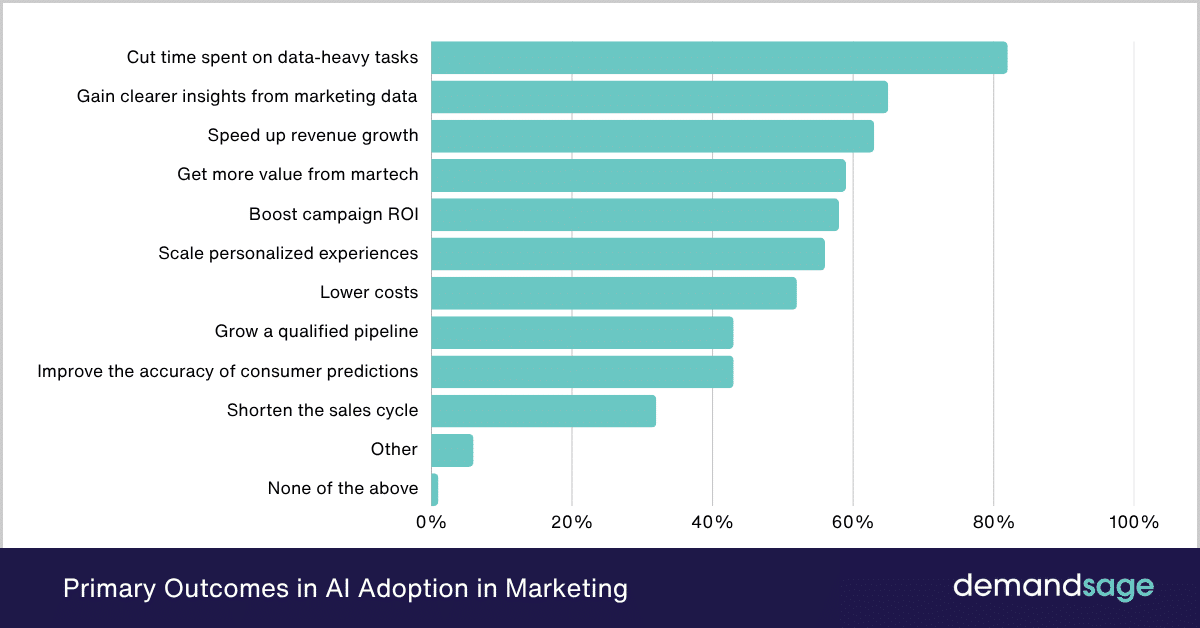
The table below shows the primary expected outcomes in the adoption of AI in marketing:
| Primary Outcome | Percentage of Respondents |
|---|---|
| Cut time spent on data-heavy tasks | 82% |
| Gain clearer insights from marketing data | 65% |
| Speed up revenue growth | 63% |
| Get more value from martech | 59% |
| Boost campaign ROI | 58% |
| Scale personalized experiences | 56% |
| Lower costs | 52% |
| Grow a qualified pipeline | 43% |
| Improve the accuracy of consumer predictions | 43% |
| Shorten the sales cycle | 32% |
| Other | 6% |
| None of the above | 1% |
Source: Marketing AI Institute, HubSpot
Generative AI For Marketing (AI Adoption In Marketing)
- Generative AI is now a key tool in marketing, with 55% of users utilizing it for writing tasks, including books, product descriptions, blogs, and social media posts.
- Internal communication and stakeholders’ documentation have the lowest user percentages of just 14%.
- The generative AI market size is currently worth about $37.9 billion and is expected to double to ~$69.9 billion as adoption accelerates.
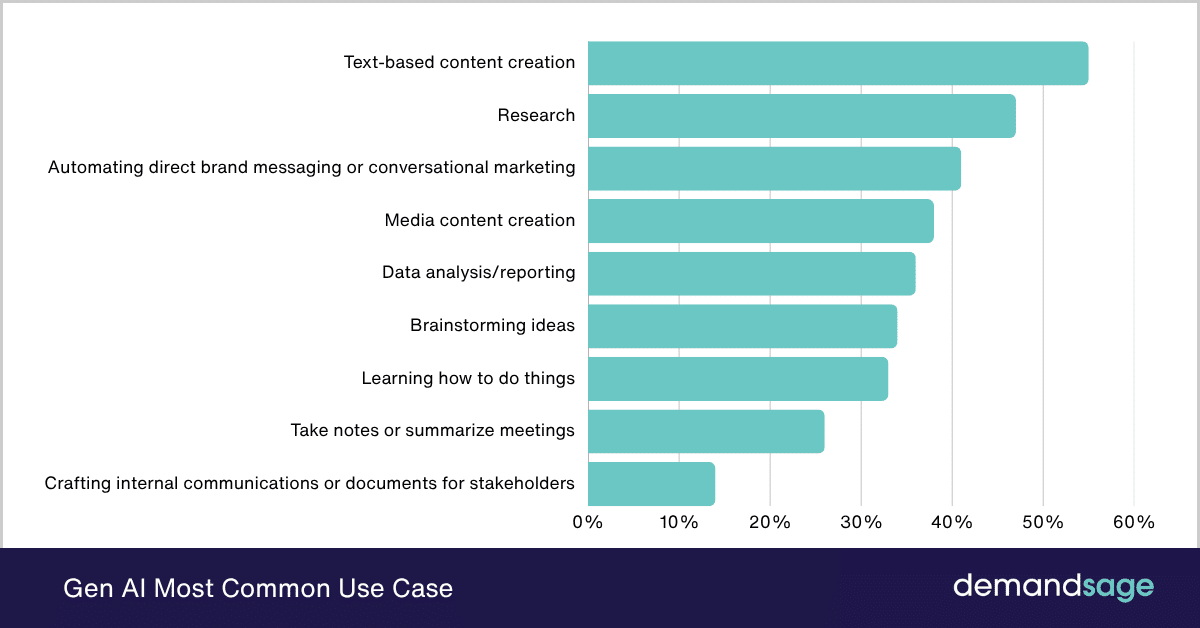
Here’s a tabular representation of generative AI statistics by the tasks marketers are using it for.
| Sr. No. | Gen AI Use Case | % Users |
|---|---|---|
| 1 | Text-based content creation | 55% |
| 2 | Research | 47% |
| 3 | Automating direct brand messaging or conversational marketing | 41% |
| 4 | Media content creation | 38% |
| 5 | Data analysis/reporting | 36% |
| 6 | Brainstorming ideas | 34% |
| 7 | Learning how to do things | 33% |
| 8 | Take notes or summarize meetings | 26% |
| 9 | Crafting internal communications or documents for stakeholders | 14% |
Source: HubSpot
AI Content Marketing Trends
- Over 900k web pages were published in April 2025, and 74.2% of them contained AI-generated content.
- Surprisingly, 86.5% of the top-ranking pages contain some AI-generated content, while AI Overviews are said to reach 2.5 billion monthly users.
- 38% of AI Overview citations from top-10 pages, down from 76%.
- Over 7 in 10 web pages (71.7%) had a mix of AI+human content, while fully AI-generated pages make up just 2.5%.
- AI is widely used, with 87% of respondents incorporating it into content creation, as per our research on content marketing statistics.
- Companies using AI have started publishing 42% more content each month, with a median of 17 articles/month, compared to 12 articles/month for those not using AI.
- Another research shows 69% of the marketing professionals are excited about AI and its impact on new job opportunities. Whereas, 93% of marketers use AI to generate content faster.
- Furthermore, more than half (51%) of marketers use AI to create content for email marketing or other newsletter or email format platforms. Following it very closely is social media (text-based) content marketing, with 49% users.
- AI is least used in audio/video channels like YouTube, Spotify, and podcasts, with just 15% users.
- In relation, 18% of new music on streaming is fully AI-generated
The following table provides an overview of AI use across various marketing channels, along with the percentage of users who use it:
| Sr. No. | Marketing Channels | % Users |
|---|---|---|
| 1 | Email Marketing/Newsletter | 51% |
| 2 | Social Media (Text-based) | 49% |
| 3 | Social Media (Video/Audio Platforms) | 47% |
| 4 | Blog posts, articles, or other long-form content | 46% |
| 5 | Non-editorial pages of your website | 37% |
| 6 | Search / SEO content | 34% |
| 7 | Brand chatbots | 31% |
| 8 | Audio/Video channels | 15% |
Marketers looking to apply these insights in practice can explore the top AI marketing tools of 2026 for content creation, automation, analytics, and campaign optimization.
When it comes to the impact of AI, about 69% of the marketing professionals feel hopeful about AI technology, highlighting optimism around productivity rather than job replacement.
Source: DMI, ahrefs, ahrefs 2, ahrefs 3, ahrefs 4, SurveyMonkey, HubSpot, DIW, Design Rush, Deezer
AI Tools Used By Marketers
Here’s a tabular breakdown of the types of AI tools used by markets in the past 12 months:
| Sr. No. | Types of AI Tools | % used in the past 12 months |
|---|---|---|
| 1 | General-purpose chatbots | 40% |
| 2 | Image or design generators | 40% |
| 3 | SmartAI video or audio editing AI tools | 36% |
| 4 | Voice or narration generators | 33% |
| 5 | Smart/AI image editing tools/features | 33% |
| 6 | Video or animation generators | 30% |
| 7 | General Purpose Text Generation Tools | 27% |
| 8 | AI web design and/or code generators | 24% |
| 9 | Productivity tools | 21% |
| 10 | Non-voice audio generators | 19% |
- As of 2025, ChatGPT remains the most dominant AI chatbot in the marketing sector worldwide, with 88% of users.
- Google Gemini is the second-most-used chatbot among marketers, with 52% of global users.
- Perplexity is the least famous tool among marketers, with just 11% users.
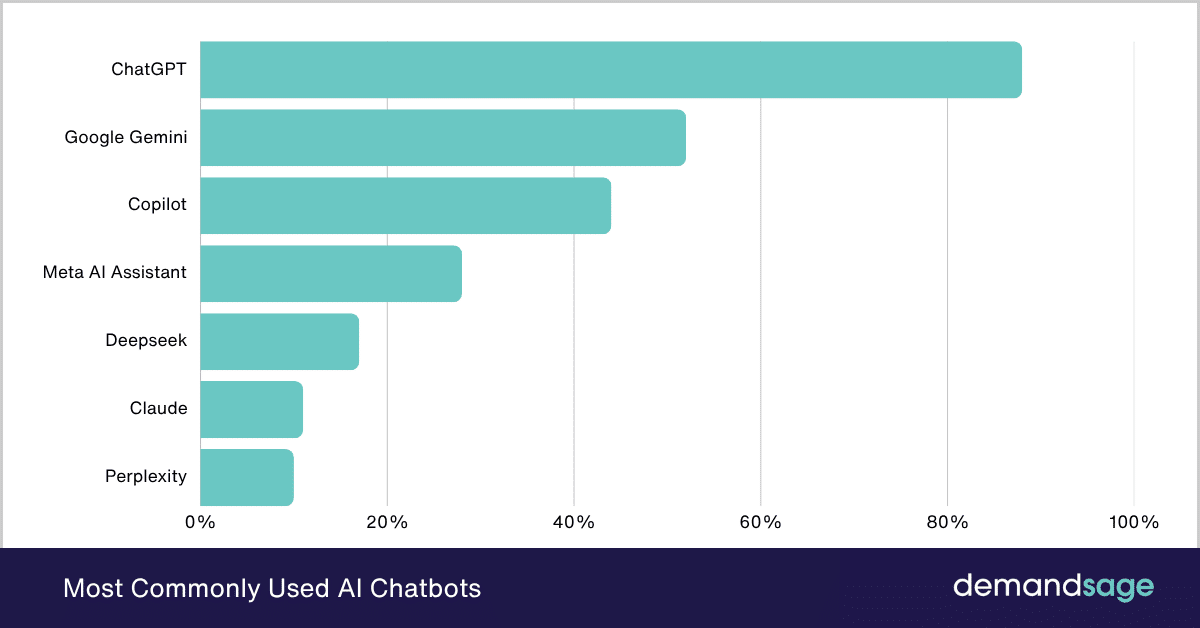
| Sr. No. | AI Chatbots | % Users |
|---|---|---|
| 1 | ChatGPT | 88% |
| 2 | Google Gemini | 52% |
| 3 | Copilot | 44% |
| 4 | Meta AI Assistant | 28% |
| 5 | Deepseek | 17% |
| 6 | Claude | 11% |
| 7 | Perplexity | 10% |
Source: HubSpot
Companies Using AI For Marketing
- As of 2025, 78% of the total companies worldwide are using AI. Additionally, approximately 280 million companies have started using AI in at least one business task.
Source: Hostinger
Let’s have a look at some of the top companies using AI marketing tools in their business operations.
Netflix
- Netflix uses an AI-powered recommendation system to suggest content to its 325 million+ users, accounting for approximately 75% of all viewing.
- Netflix’s AI recommendation system helps save an estimated $1 billion annually by reducing customer churn. It exposes users to four times as many titles as simple popularity-based recommendations, maximizing the return on Netflix’s anticipated $20 billion content investment in 2026.
- In addition, Netflix uses AI to enhance user satisfaction during the first 60-90 seconds by ensuring users quickly find something compelling to watch.
Source: NASDAQ, The AI Track, Factspan, Variety
Amazon
- Advertisers using Amazon AI ads achieved 24% higher returns on ad spend (ROAS) in comparison to generic advertising platforms.
- These AI ads achieve a 5.4% CTR with AI-powered ad placement, compared to 2.8% with manual ad placement.
- Furthermore, 35% of Amazon’s total revenue was generated by product recommendations from its A10 recommendation engine.
- Our AI in e-commerce statistics offers key insights into how top platforms like Amazon are using AI to drive engagement, boost conversions, and increase revenue.
Source: McKinsey, I Mark Infotech, McKinsey 2
Coca Cola
- Coca-Cola’s use of AI in marketing shows how data-driven creativity can deliver measurable results. AI-generated content on platforms like Instagram and Facebook enabled more personalized messaging, leading to a 20% increase in user engagement. The company also applied AI to email campaigns by analyzing consumer behavior, resulting in a 15% higher conversion rate.
- During a targeted summer campaign, AI-generated promotions for limited-edition products aligned content with real-time insights, driving a 25% increase in online sales. At the same time, automating ad creation reduced manual production time by 40%, improving operational efficiency.
- Additionally, AI analysis of social trends in Latin America helped Coca-Cola create more culturally relevant ads, boosting overall campaign performance by 30%.
Source: Data To Storytelling
Unilever
- Unilever utilizes AI tools, such as digital twins, to reduce content costs by 55% and accelerate content production by 65%.
- Unilever’s Beauty & Wellbeing brands use tech like digital twins to reduce content creation costs by up to 55% and accelerate content production by 65%.
- The success of digital twins was not limited to this. In Thailand, TRESemmé reduced content creation costs by 87% while driving a 5% increase in purchase intent through the use of digital twins.
- Besides, Unilever has integrated image capture and AI tech into 50,000 freezers, increasing the retailer’s sales by 15-35%.
Source: Consumer Goods, AGL
Google Ads
- Google has embedded AI across its advertising ecosystem to automate targeting, bidding, and creative optimization. AI-powered YouTube campaigns delivered a 17% higher ROAS than manually managed campaigns, demonstrating the effectiveness of machine learning–driven optimization.
- Combining AI-powered Video Reach Campaigns (VRC) with Video View Campaigns (VVC) further improved performance, boosting sales effectiveness by 23% compared to VRC alone.
- AI also enhanced cross-channel performance by adding Demand Gen to Search and Performance Max, which increased ROAS by 10% and sales effectiveness by 12%. In comparison, Performance Max campaigns alone achieved an 8% higher ROAS and 10% better sales effectiveness.
- In search advertising, Google’s AI-powered broad match improved intent matching and efficiency, resulting in a 15% increase in ROAS and a 10% improvement in sales effectiveness.
Source: Nielsen
Challenges With Artificial Intelligence In Marketing
- Research conducted by Marketing AI Institute, containing 1,741 respondents from the marketing sector, revealed the following challenges they are facing with AI adoption:
- Lack of knowledge/training is the biggest challenge in AI adoption, cited by 23% of the respondents.
- Of the respondents, 27% reported other, unclear struggles.
The table below shows primary struggles in the adoption of AI in marketing:
| Primary Struggles | % Respondents |
|---|---|
| Lack of knowledge/training | 23% |
| Time to learn or experiment | 11% |
| Keeping up with the pace of change | 9% |
| Tool selection and evaluation | 7% |
| Implementation/integration into workflows | 5% |
| Cost/budget constraints | 3% |
| Data quality/privacy and security | 3% |
| Stakeholder buy-in (leadership/client) | 3% |
| Ethics, bias, and legal concerns | 2% |
| Strategy/roadmap definition | 2% |
| Accuracy and hallucinations | 2% |
| ROI and measurement | 1% |
| Scalability/performance | 1% |
| Job-security fears | 1% |
| Content quality/brand voice | 1% |
| Creativity concerns | 1% |
| Other/unclear | 27% |
- What may not appear surprising is that the lack of training/knowledge has been the most significant barrier to AI adoption since 2021.
- However, as AI adoption worldwide increases, this barrier’s % share has declined by 47 percentage points since 2021.
The table below shows the reduction of the barrier over the years:
| Year | Training/knowledge barrier (%) |
|---|---|
| 2025 | 23% |
| 2024 | 67% |
| 2023 | 64% |
| 2022 | 63% |
| 2021 | 70% |
Source: Marketing AI Institute, 2024 State of Marketing, 2023 State of Marketing, 2022 State of Marketing, 2021 State of Marketing
Global AI Marketing Market Size
- The global AI in Marketing Market is projected to grow from $25.83 billion in 2025 to $217.33 billion in 2034, representing a 26.7% CAGR.
- The market is projected to grow more than 8x from 2025 to 2034, adding over $190 billion in new value during the period.
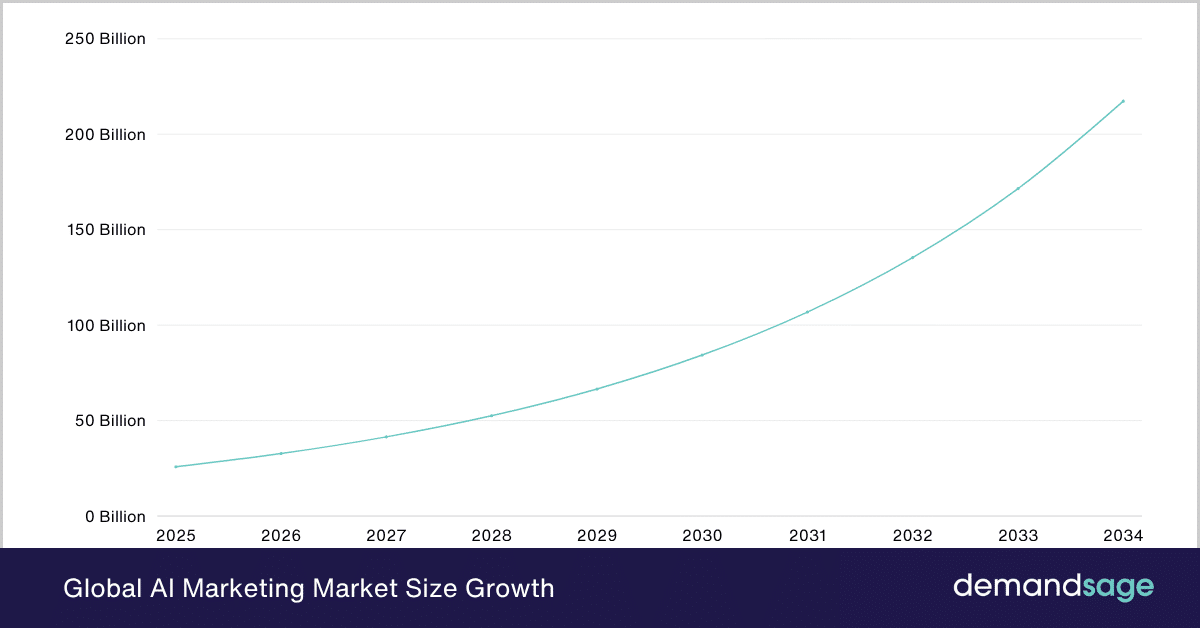
| Year | Market Size ($ billion) |
|---|---|
| 2025 | 25.83 |
| 2026 | 32.73 |
| 2027 | 41.47 |
| 2028 | 52.54 |
| 2029 | 66.56 |
| 2030 | 84.34 |
| 2031 | 106.85 |
| 2032 | 135.38 |
| 2033 | 171.53 |
| 2034 | 217.33 |
Source: Precedence Research
The global AI market size is estimated at $757.6 billion in 2025 and, at a ~19.2% CAGR, could exceed $3.6 trillion by 2034, underscoring the long-term investment case for marketing teams.
AI And Marketing Future Outlook
“The future of AI is not about replacing humans, it’s about augmenting human capabilities.”
— Sundar Pichai
Source: India Today
- The predictive AI market is growing rapidly, with the market forecast to reach roughly $108 billion by 2033, and nearly all companies now rely on predictive models to sharpen targeting and forecasting.
- Right now, 78% of businesses worldwide already use AI in at least one function, which is a sharp increase from 55% just a year earlier (2024).
- This surge is laying the groundwork for the next phase – AI Agents. In fact, the rise of AI agents is expected to surge, with the agent market projected to hit $183.0 billion by 2033.
- Forecasts also suggest that AI-driven productivity gains could add 1.5 percentage points to global annual productivity growth through 2030, indicating strong potential returns on marketing AI investments. This reinforces why businesses are increasingly allocating budget toward AI-driven marketing and automation.
Source: Goldman Sachs, Netguru, Deloitte, Grand View Research
