
Live streaming has transformed into a global phenomenon, with over 26.8% of internet users tuning in weekly and a total market value projected to hit $345.13 billion by 2030.
The article explores viewer behavior, platform preferences, device usage, and regional growth trends. You’ll also learn about the rising role of live video in marketing, business communication, and social media engagement.
With platforms like Twitch, YouTube, and Facebook leading the charge, this detailed statistical breakdown of 2026 uncovers how live streaming is reshaping digital content consumption.
Live Streaming Statistics 2026 (Top Picks)
- Over one-fourth of internet users watch live streams weekly.
- Live streaming is the third most popular type of video content, reaching 26.8% of users each week.
- The global live stream market is estimated to be worth $99.82 billion.
- 27% of the live streams are watched on mobile devices.
- Live streaming viewership in Q1 2024 was 128% higher than in Q1 2019 and 61% greater than in Q1 2020.
- In Q2 2024, viewers watched a total of 8.5 billion hours of live-stream content.
Live Streaming Market Size
The live-streaming market is projected to experience significant growth, with an impressive compound annual growth rate (CAGR) of 23% from 2024 to 2030.
The market is estimated to be valued at $99.82 billion in 2024 and is expected to reach $345.13 billion by 2030, growing at a CAGR of 23%. Comparatively, the market was valued at $87.55 billion in 2023.
This growth in the live streaming market displays new innovations and opportunities in the way we connect and engage with online content.
Source: Grand View Research
Live Streaming Audience Statistics
In this section, I have covered the latest Statistics about live-streaming audience and their habits.
- 26.8% of internet users worldwide watch live streams weekly, as of the last reported data in Q2 2025.
In recent years, live-streaming content has become one of the most popular types of video content consumed.
However, its popularity decreased slightly in the past few quarters, and its audience share reduced from 30.4% of internet users in Q3 2021 to just 28.5% in Q4 2023.
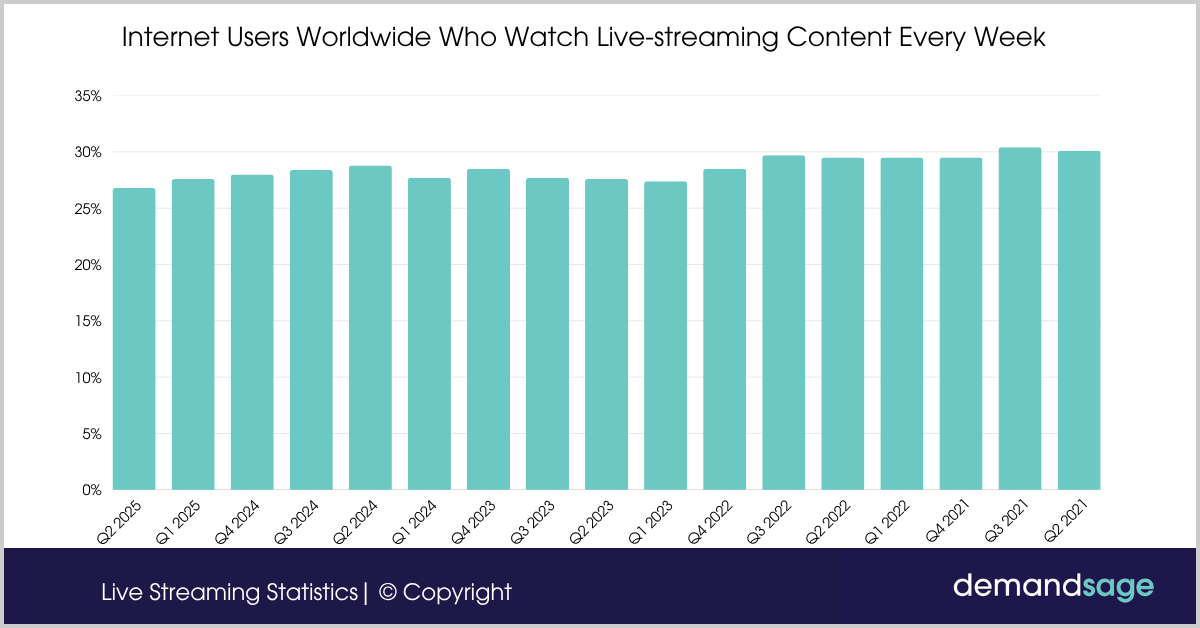
The following table displays the share of internet users worldwide who watch live-streaming content every week.
| Time | Share of Internet Users Watching Live Streaming Weekly |
|---|---|
| Q2 2025 | 26.8% |
| Q1 2025 | 27.6% |
| Q4 2024 | 28.0% |
| Q3 2024 | 28.4% |
| Q2 2024 | 28.8% |
| Q1 2024 | 27.7% |
| Q4 2023 | 28.5% |
| Q3 2023 | 27.7% |
| Q2 2023 | 27.6% |
| Q1 2023 | 27.4% |
| Q4 2022 | 28.5% |
| Q3 2022 | 29.7% |
| Q2 2022 | 29.5% |
| Q1 2022 | 29.5% |
| Q4 2021 | 29.5% |
| Q3 2021 | 30.4% |
| Q2 2021 | 30.1% |
Source: Statista.
Live streaming ranks as the third most popular type of video content, reaching 26.8% of users on a weekly basis.
Music videos boast the highest weekly reach at 50.5% in Q2 2025. Following closely are comedy, memes, and viral videos, while live streaming ranks third in terms of weekly usage.
Live streaming videos enjoy a greater weekly reach than tutorials, how-to content, or product reviews, highlighting their superior engagement compared to other types of video content.
Here’s a comparison of the weekly reach for live-stream videos versus other video formats:
| Video Content Type | Share of Respondents |
|---|---|
| Music video | 50.5% |
| Comedy, meme, or viral video | 35% |
| Video live stream | 26.8% |
| Sports clip or highlights video | 26.4% |
| Product review video | 26% |
| Tutorial or how-to video | 25.2% |
| Educational video | 24.9% |
| Sports match or commentary | 24.8% |
| Influencer videos and vlogs | 23.2% |
| Gaming video | 22.8% |
Source: Statista
- On average, a viewer spends 25.4 minutes watching live video per viewing session.
Live videos usually keep viewers hooked for a longer time than other videos.
Most of the viewers watch live videos for nearly half an hour at a stretch.
Source: Liveryvideo.
Global live stream viewing time is up by 14%.
Asia and the LATAM region witnessed the highest growth in live stream viewing time, with 90% and 70%, respectively.
Even North America witnessed a growth of 5%.

The following table displays the increase in the live-streaming viewing time:
| Region | Increase In Live Streaming Viewing Time In 2022 |
|---|---|
| Global | 14% |
| Africa | 22% |
| Asia | 90% |
| Europe | 20% |
| LATAM | 70% |
| North America | 5% |
| Oceania | 26% |
Source: Conviva.
- People spend eight times more time watching live videos than on-demand videos.
Additionally, users spend 10 to 20 times longer on live videos than on-demand content. This makes live videos a powerful way to deliver interactive content.
Source: Forrester.
In the United States, 34% of monthly live stream viewers favored watching live streams of breaking news compared to other types of live streams.
The second most popular type of live stream content was sports and games, attracting 29% of live stream audiences, while comedy live streams followed closely behind, preferred by 28%.
Here is a table displaying the most popular categories of live-stream videos viewed in the United States:
| Live Stream Categories | Percentage Of Viewers In The United States |
|---|---|
| Breaking news | 34% |
| Sports games/matches | 29% |
| Comedy | 28% |
| Videos by friends or family | 26% |
| How-to videos | 26% |
| Local newscasts | 23% |
| Videos by internet personalities | 21% |
| National newscasts | 20% |
| Videos by celebrities | 17% |
| Concerts/festivals | 15% |
| Video game competitions | 15% |
| Religious content/events | 12% |
| Conferences/speakers | 9% |
Source: Statista
- 40% of live stream viewers use their mobiles and computers.
Meanwhile, 60% of younger adults in the United States watch live streams on their television sets.
- 67% of viewers who watched a live stream of an event purchased a ticket to that event for the next time it took place.
- Live Streams get 10% more engagement than pre-recorded content.
- 3 in 10 respondents in Datareportal’s survey said the main reason for using social media is to watch live streams.
- 30.4% of users aged between 16 and 64 watch at least one live stream every week.
- 45% of users are willing to pay to watch live streams from their favorite speakers and teams.
Sources: Statista, Influencer Marketing Hub, Startup Bonsai, Tech Jury, Data Reportal, Vimeo.
Live Streaming Platform Statistics
In Q1 2024, Twitch users streamed approximately 249 million hours of new game content and 3.3 billion hours of other gaming content.
During the same period, YouTube emerged as the second most popular video streaming platform, featuring 41.5 million hours of new game content live-streamed and 922 million hours of other gaming content.
Steam secured third place, with 30.5 million streams of new game content and an additional 47.4 million streams from other games on the platform
Source: Statista
- 7.6 billion hours of live content were watched across all platforms.
Twitch leads the race in live stream viewership.
Twitch attracted 53% of the esports audience in the quarter, and YouTube gaming attracted 40%. This led to 12 million additional hours watched in this quarter.
The remaining 7% was live-streamed on Facebook, AfreecaTV, Kick all, etc.
Source: Stock Titan.
- YouTube is the most popular live-streaming platform worldwide.
52% of the live stream viewers prefer YouTube to watch live streams.
Facebook is the second most popular livestream platform, with 42.6% of the live-streaming audience.
Instagram and TikTok follow Facebook closely, with 33.4% of the live-streaming audience preferring them.
Source: eMarketer.
- 22.7% of social media users watch live content.
This equals 1.17 billion social media users worldwide.
Source: small business bonfire.
- Twitch is one of the biggest live-streaming platforms, with 31 million daily active users.
Twitch users watch at least 71 million hours of content each day. The platform has 7 million content creators who stream each month.
The majority of Twitch users are between the ages of 20 and 39.
Here is a table showing the Age Distribution of Twitch users:
| Age Group | Percentage Of Twitch Users In The Age Group |
|---|---|
| 18-19 years | 6% |
| 20-29 years | 34% |
| 30-39 years | 34% |
| 40-49 years | 17% |
| 50-59 years | 8% |
| 60-64 years | 1% |
63% of Twitch users are males, while 37% are females.
Source: Statista.
What Are Viewers Expecting In A Live Stream?
Live stream viewers have different tastes and preferences; however, they have common expectations about the basic requirements.
If you are a business owner or a livestream broadcaster, the following stats will help you understand your audience’s expectations.
- 67% of the audience claims that video quality is the most important factor while watching a live stream.
50% of users leave a live stream in 90 seconds or less if it has low-quality output.
People also leave when the live stream takes time to start. Statistics say that every 6-second delay in the start results in a 6% viewer bounce.
Some of the most important factors that the audience seeks during a live stream:
- Video Quality.
- Audio Quality.
- Lighting Conditions.
- Engagement skills of the streamer.
- Quality of the content.
- 85% of users want to see more videos from their favorite brands and businesses.
Sources: Uscreen, Vimeo, Neil Patel, Influencer Marketing Hub.
Live Streaming Statistics For Businesses And Marketers
In this section, I have included data about how businesses and marketers can use live streaming to their advantage.
- 80% of people prefer watching a live stream to reading a blog.
Additionally, 82% of consumers prefer to engage with the brand on a live stream rather than through social media posts.
Source: Livestream
- 35% of marketers use live videos to market their products.
This percentage increases by 20% year over year.
At the same time, 28% of marketers are investing more in live streaming.
Source: go-globe.
- 55% of the companies use live videos for their business presentations.
This is because 82% of consumers prefer live streams as brands’ social media updates.
- 54% of consumers would like to see more video content made by their favorite brands.
75% or more millennials believe that live streams have helped them compare products while shopping online.
Gaming and eSports Live Streaming
The gaming live stream market is estimated to be valued at $13.65 billion.
China is expected to play a significant role in this growth, contributing about $2.58 billion to the live-stream gaming market.
Globally, the market is anticipated to expand at a compound annual growth rate (CAGR) of 8.41% from 2024 to 2027, reaching an impressive $17.39 billion by 2027.
Additionally, the number of live stream gamers is forecasted to rise to 1.6 billion in that same year, showcasing the growing popularity of live stream gaming.
Source: Statista
Live Commerce Statistics
This section covers the latest statistics about the live-streaming e-commerce market.
- Consumers in the Asia-Pacific region have the highest interest in live commerce.
17% of the region’s online shoppers participate in live commerce sales.
The United Arab Emirates closely follows the Asia-Pacific region, with 16% of the online shoppers participating in live commerce taking place in the region.

Here is a table showing the interest in live stream commerce from online shoppers globally:
| World Region | Percentage Of Live Stream Shoppers |
|---|---|
| Asia-Pacific | 17% |
| United Arab Emirates | 16% |
| United States | 14% |
| Latin America | 8% |
| Europe | 5% |
- The live commerce market in China is expected to reach 4.9 trillion yuan.
TikTok live commerce is expected to have a gross merchandise value of $20 billion in Southeast Asia.
The GMV (gross merchandise volume) of live commerce in Southeast Asia is growing at a staggering compound rate of 30% a month.
Source: Campaign.
- Consumers in the United States have spent $17 billion on live-stream shopping in 2022.
- 39.7% of US shoppers say that the main reason they shop online is because of the great deals.
At the same time, 38.2% of the shoppers said that they prefer to shop online as they get to explore new products.
Further, 3 in 10 live stream shoppers in the United States said they prefer to shop during the live stream due to the exciting buying experience.
Here is a table showing the leading reasons for US citizens to shop on live streams:
| Reasons To Shop On Live Streams | Percentage of US live stream shoppers |
|---|---|
| For great deals | 39.7% |
| To discover new products | 38.2% |
| To learn more about new products | 36.6% |
| Because of the exciting buying experience | 30.7% |
Sources: Statista.
United States-Specific Live Streaming Statistics
This section highlights the live-streaming habits of consumers in the United States. This data can help marketers and businesses to target audiences accordingly.
- As per Statista, there are 158.2 million livestream viewers in the United States. This number is set to reach 164.6 million by 2026.
- Twitch is the most popular live-streaming platform in the United States.
47% of the US gamers watch live gaming on Twitch.
At the same time, 40% of the gamers preferred to watch live streams on YouTube Gaming.

Here is a table showing the most popular live-streaming platforms in the United States for gamers:
| Platform | Percentage Of Live stream viewers |
|---|---|
| Twitch | 47% |
| Youtube Gaming | 40% |
| Facebook Gaming | 16% |
| Discord | 14% |
| Bigo Live | 7% |
| Others | 7% |
| Disco Melee | 5% |
| DLive | 4% |
| HitBox | 4% |
| InstaGib TV | 3% |
| Beam | 3% |
- 42% of the people in the United States have watched livestream content.
That’s nearly half of the residents of the United States.
According to the latest data, 163 million live video viewers are in the United States.
This is a 2.1% increase in the live-streaming audience compared to the previous year. In 2022, 160 million live-streaming audiences were recorded.
Source: Insider Intelligence.
- Facebook Live is preferred by 45% of US citizens aged between 35 and 54.
YouTube Live is preferred by 35% of people aged between 18 and 34 years.

Here is the breakdown of the United States’ most popular live-streaming platforms by age group of users:
| Platforms | 18-34 | 35-54 | Over 55 |
|---|---|---|---|
| Facebook Live | 35% | 45% | 21% |
| Youtube Live | 42% | 38% | 20% |
| 39% | 29% | 8% | |
| TikTok | 23% | 18% | 7% |
| Twitch | 31% | 14% | 2% |
Source: Statista.
Live Streaming Trends 2026
By 2026, FAST (free ad-supported streaming) channels are predicted to reach a 10% share of total TV viewing.
8.5 billion hours of live stream content were watched in Q2 2024.
In that quarter, viewers collectively spent 8.5 billion hours watching live content across various streaming platforms.
That’s equivalent to more than 970,000 years of live streaming.
Source: Adam Connel, Roku Advertising
63% of marketers plan to increase their investments in live videos in the future.
At the same time, 32% of marketers look forward to including Facebook Live in their video marketing strategy.
Fun Statistics About Live Streaming
In this section, we will take a look at some interesting statistics about live streaming.
- The 2008 Olympic Opening Ceremony had around 2 billion viewers worldwide, making it the most-viewed livestream event ever.
- CazéTV, with 6.1 million viewers (World Cup 2022 QF live stream), is the most watched live stream in YouTube’s history.
- Using AI virtual hosts can reduce live stream production costs by up to 70% compared to traditional human-led broadcasts.
- League Of Legends is the most-watched game on Twitch of all time.
- In 2025, TikTok Live reportedly surpassed Twitch in total hours watched globally when including its massive Asian audience.
- The combined global AR and VR market is projected to reach $118.79 billion in 2026, with nearly 50% of the market driven by consumer demand for immersive live events and shopping.
Source: Anymind, Teleprompter, Precedence Research
Conclusion: Live Streaming Viewership Grew By 61%
The live streaming industry in 2026 is not just growing but thriving. From an audience that spends 25.4 minutes per session to platforms like Twitch attracting 31 million daily users, the data confirms a decisive shift toward real-time, interactive content.
Businesses are leveraging this format, with 35% of marketers using live video and 80% of consumers preferring it over traditional blogs.
Viewer expectations like high-quality video, quick start times, and authentic engagement are reshaping how content is delivered.
As mobile use, social integration, and viewer interactivity rise, live streaming is poised to remain a dominant force across industries and demographics.
