
The Shopify Starter plan is the most popular and affordable option for beginners, priced at just $5 per month. But is it any good? What features does it offer? Are they enough to run a full-scale business?
While the Shopify Starter plan is ideal for beginners, its features enable you to connect directly to your business’s social media handles, thereby expanding your offline e-commerce sales.
But it is still not the ideal solution you may need. When compared against the Shopify Basic Plan, which offers a live store with a website, the Shopify Starter plan lacks several key features. Learn more about what this Shopify Start plan hits and misses in this detailed Shopify starter plan guide.
Shopify Starter Plan – Price, Features, and Details To Know
Here is a snippet of what this Shopify starter plan offers for a $5 per month price in 2026:
| Parameters | Details |
|---|---|
| Price | Selling on social media with order management and analytics features |
| Discount (New Users) | 3-day free, then $1/mo for 3 months |
| Transaction fees | 5% transaction with Shopify Payments |
| Features | Sell products on social media, take payments, and monitor sales with analytics and reports |
| Best For | Selling on social media with order management, and analytics features |
| Customer Support | 24×7 chat support |
| Biggest Drawback | No access to a fully functional online store |
Before you get bogged down in Shopify’s technical terms, here is a Shopify Glossary to simplify things for you.
Do you know? 💡 There are about over 6.81 million Shopify merchants globally, and if you are planning to be a part of the Shopify community, the $5/month Shopify Starter plan can be a great way to kick things off!
Shopify Starter Plan – The Pros & Cons
One of the quickest ways to start an online business has some drawbacks. Find the good and the bad about the Shopify Starter plan listed below:
Pros
- Sell for just $5/month.
- Unlimited products and bandwidth.
- Shopify order management and reports feature.
- Sell in-person with Shopify POS Lite.
- Sell directly into messages on any social media.
- In-app integration tools (limited)
Cons
- Does not offer a fully functional Shopify store.
- Limited freedom to customize and brand the website.
- High transaction fees at 5%.
- No access to staff accounts.
- Marketing automation features are unavailable.
Shopify Starter plan has a lot of benefits for independent sellers. At the same time, the downsides are there in equal amounts, as it lacks a lot of features that a normal online storefront has. If you want to start a fully-fledged online store, it’s better to compare all the Shopify plans and get the right option that suits your business needs.
Who Is The Shopify Starter Plan Best Suited For?
This lightweight Shopify plan does not fall within the range of the primary Shopify Plans. It is for merchants wanting to start their e-commerce business and set up a Shopify store without a website. It is not for someone willing to build a proper store.

Note: The Shopify Starter Plan is strictly for new Shopify merchants and those currently in their trial period.
Is the Shopify Starter Plan Enough To Start a Store?
To start a store on social media. Yes. This plan is sufficient, but to start a fully functional Shopify store with product listings, themes, and other features, you need to upgrade to the Shopify Base plan or above subscription.
Check out more below!
What Makes The Shopify Starter Plan Special?
Shopify offers a range of useful features, including POS selling access, analytics tools, and more, for just $ 5 per month.
Have a look:
- Unlimited listings – The Shopify Starter plan allows you to add unlimited listings for the store created on social media or messaging apps of your choice.
- Basic Analytics – with access to basic analytics features, you can keep track of your orders, sales, and the profits you are making.
- Shopify Fulfillment network access – Shopify has a special network that can handle storing, packing, and delivering. The Shopify Starter plan also gives you access to this network.
- Shopify POS Selling – Merchants can use the Shopify POS feature for in-person or local market selling by accessing the Shopify POS Lite plan.
Shopify Starter Plan Price
The Shopify Plan in 2026 is still priced at only $5 per month. The plan provides easy access to Shopify, allowing you to start selling products quickly.

However, this is the only tier available for users. If you are looking for a long-term commitment, please note that an annual plan is not available.
The Shopify Started Plan lets you sell your products from the back of your van, garage, or in person. But at only $5 per month, is this the most affordable way to begin your Shopify journey?
Well, it’s not technically the cheapest; There is another way to enjoy more Shopify features while also saving every month! Stay with me until the end to learn more!
Take your first step from the Shopify starter plan, or use our exclusive free trial code shared in the beginning to try out the advanced Shopify plans for $1/month for the first 3 months.
Shopify Starter Plan vs Shopify Basic Plan – Critical Differences To Know
When directly compared to the Shopify Basic plan, the key differences and limitations of the Shopify Starter plan become more evident. Read further to know why upgrading is necessary, and when it is required.
Shopify previously offered a Shopify Lite plan, priced at $9 per month, to help users get started with Shopify.
With a $4 discount for beginners to use Shopify, you can now try out this e-commerce platform for much less.
But how does this new plan compare to the Shopify Basic Plan? Let’s find out:
| Features | Shopify Starter | Basic |
|---|---|---|
| Price | $5/mo | $39/mo |
| Credit Card Fees | 5% + 30¢ | 2.9% + 30¢ |
| Theme to choose | Spotlight Theme only | Choose over 100+ free and paid themes |
| Best For | Beginners wanting to sell on Social Media. | Beginners want to sell from a structured store and website. |
| Online Store/Website | ❌ | ✅ |
| Free SSL certificate | ❌ | ✅ |
| Shopify POS Lite | ✅ | ✅ |
| Customization options | ❌ | ✅ |
| Annual Discount | ❌ | 25% |
| Inventory locations | 2 | 10 |
Demandsage Bonus: Here’s a hack! You can also grab the starter plan for only $1/month for your first three months. If the starter plan is not what you’re looking for, you can sign up for the Shopify trial of any of the standard Shopify plans for $1 per month. Grab either of the above plans by following this guide here.
Hidden Costs & Payment Methods for Shopify Starter Plan
When budgeting for your first online business, it’s important to understand all potential costs. Besides the $5/month fee and 5% transaction charge with Shopify Payments, you may encounter additional expenses for payment gateways and currency conversion if selling internationally.
Some payment providers charge setup or monthly fees, and rates may differ depending on the region. Make sure to check Shopify’s accepted payment methods and any restrictions based on your country, so you avoid surprises down the road. This transparency will help you keep your startup costs in check and plan for a profitable launch.
Shopify Starter Plan Features Explained
In addition to the standard features, here is a brief overview of the key features of the Shopify Starter Plan.
1. Sell Anywhere
With the starter Shopify plan, you can sell anywhere and on social media networks like Instagram, WhatsApp, Facebook, TikTok, Etsy, LinkedIn, etc.
With access to POS Lite, you can sell your products in person. Accepting payments is easy, too, with an option to accept payments using just a smartphone.
2. Reports And Analytics
Though the price of the starter plan is cheap, it is definitely not cheap in terms of its reporting features. The Starter plan provides access to analytics pages, finance reports, product analytics, live view, acquisition, inventory, behavior, marketing, order, sales, retail sales, profit, and customer reports.
3. Shopify Order Management
One of the key features of Shopify is its easy inventory management. It offers a smooth dashboard to keep track of inventory. Stock keeping inside Shopify is one of the easiest methods for storing and categorizing your products.
Note: Shopify retired its free “Link in Bio” integration tool, Linkpop, in mid 2025. So, Shopify Starter users can no longer use or update their existing accounts. For similar integration, users can check out paid apps in the Shopify App Store.
Let’s get you signed up with this exciting plan now!
Demandsage Bonus: Know more about all the features that Shopify offers in its other plans from the Shopify review I covered separately.
How To Sign Up For the Shopify Starter Plan (Full Guide)
Let me show you how to start your Shopify journey. Follow the steps explained below to become a new merchant on Shopify.
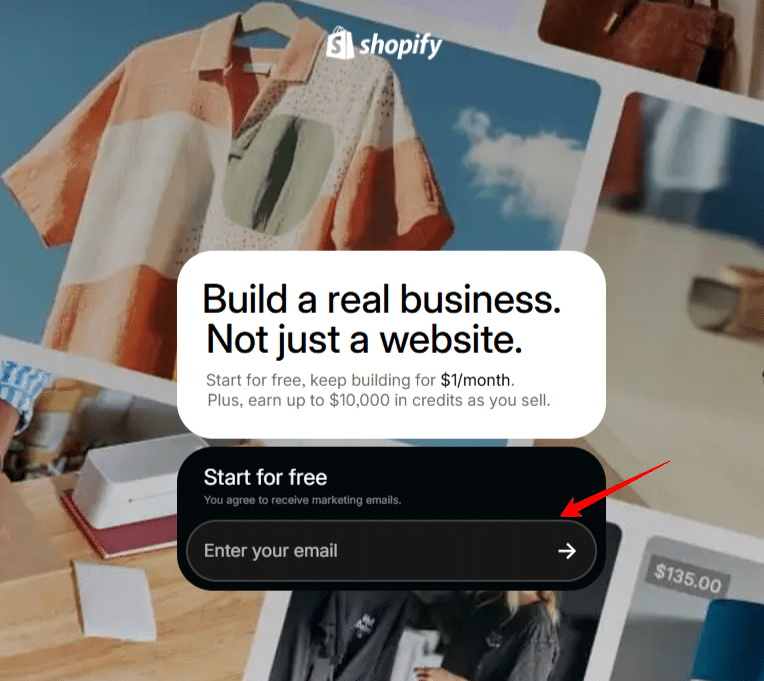
Step 1: Click on the exclusive Shopify 3-month trial link. Then, enter your email address and click the arrow button to activate the trial.
Step 2: Answer a few questions about you as an entrepreneur and about your website. If you wish, you can skip a question, or all of them, from the button on the bottom right.

Step 3: Select the location where your business is located.

Step 4: Select the method for creating a Shopify account.

Step 5: Upon entering account details, you will have successfully created your Shopify store. Next, select the “pick a plan” button on the right.
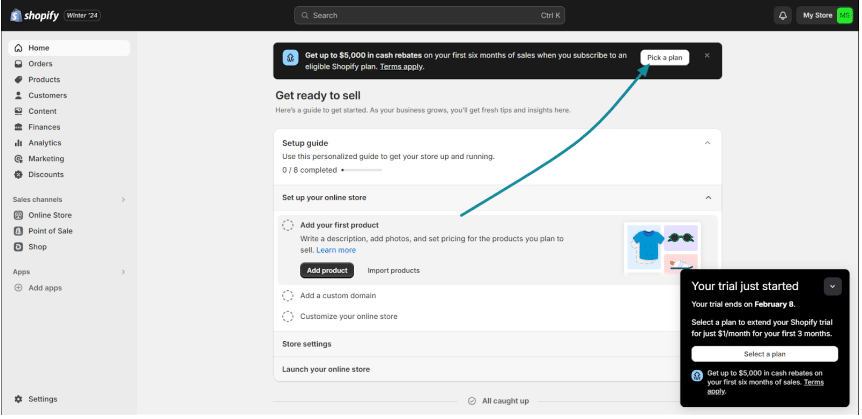
Step 6: After clicking, scroll towards the middle and select the “Starter Plan”.
Step 7: Select a payment method and fill in the payment details. Read the terms and conditions, verify your payment cycle, and click “subscribe” to make a payment.
Once the payment is processed, you will have access to the Shopify Starter Plan.
Shopify Starter Plan Review: My Experience
After reviewing the Shopify Starter plan and its features, I noticed how it is more than just affordable for a beginner. This plan allows you to sell without much stress about the investment, and you can focus more on making your brand accessible across your social media network.

With hundreds of options for integration, you can create a page for your brand and monetize your social media reach to sell directly! For someone like me who does not have many technical skills, the customization options within helped a lot.
However, I would have liked the transaction fees to be a bit lower. That is one thing that I would like to get reduced by 5%.
For a test store we opened, I could not break even the amount I invested as early as I thought we could, even after using Shopify Payments.
Can You Upgrade Your Shopify Starter Plan?
Any seller using the Shopify Starter plan can upgrade their plan to access more advanced features. This will give them the ability to create a proper online storefront and allow their customers to browse through the catalog and purchase.
However, it is technically impossible to downgrade from the seller Shopify plans to the Starter plan, since you are running an online business with advanced features. If you need Starter plan features, you have to create a new account.
Conclusion: The Shopify Starter Plan Allows Selling Online at just $5/mo
Subscribe to a Shopify Starter plan to give your products and services an affordable platform to sell!
If your goal is to create a simple social media sales channel for your products without getting bogged down in complex e-commerce operations, you should definitely start with the Shopify Starter plan.
But be aware that the Starter Shopify plan won’t allow you full access to Shopify features or the creation of a website store. Eventually, as your business grows and you need a full-fledged e-commerce website, you will have to upgrade your plan to Shopify Basic or above for advanced features.
Happy selling!
FAQs
It costs $1/month to start a Shopify store using any of the available Shopify plans during the trial period.
No, the Shopify starter plan does not offer a structured website. You can only sell your products with select product pages, contact pages, and a secure Shopify checkout.
There is no expiration date for the Shopify starter plan. It lasts as long as you pay $5 per month.
The cheapest Shopify plan is the Shopify Starter plan, which is priced at $5/month
